
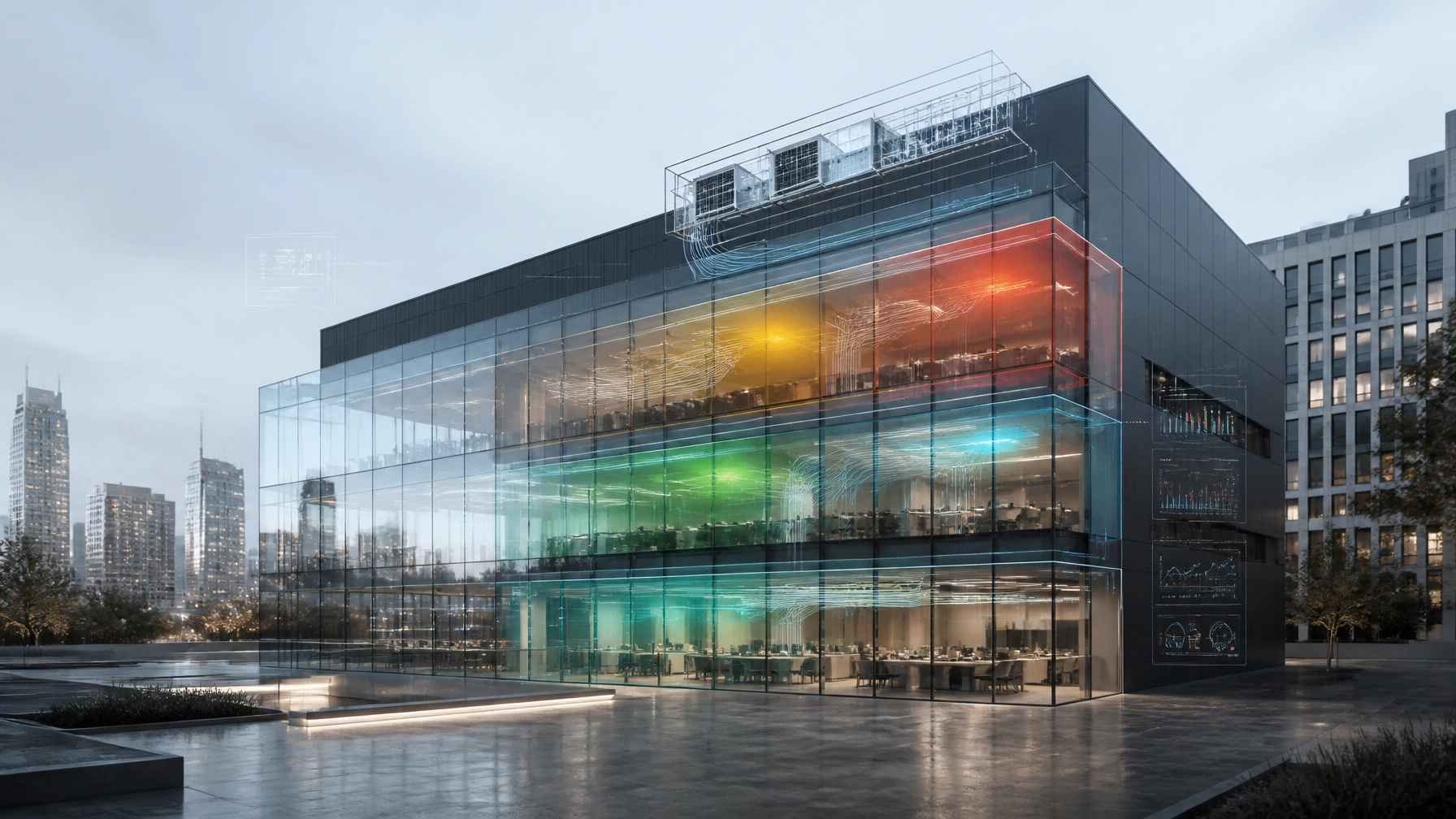
At 7:00 a.m. on day one, the building was doing what commercial buildings do every morning.
The HVAC system started on schedule. Air-handling units ramped up. Chillers responded to the expected load. Some zones became comfortable quickly. Others became too warm, too cold, or comfortable only after someone adjusted a setpoint manually.
Nothing was technically broken.
That was the problem.
The building’s existing Building Management System (BMS) could monitor equipment and execute predefined rules. But it could not fully understand the relationship between weather, occupancy, thermal conditions, energy demand, and equipment health in real time.
So we set up a controlled 30-day experiment.
We connected the building’s BMS and IoT sensors to a MetaWorldX digital twin. Then we gave an AI agent permission to optimize HVAC operations within carefully defined safety and comfort limits.
The question was simple:
Could an agentic AI system reduce energy consumption while making the building more comfortable and easier to operate?
Thirty days later, the answer was clear.
The Building Before the Experiment
The test site was a mid-sized commercial office building with multiple occupied floors, a central cooling plant, air-handling units, variable air volume boxes, and an established BMS.
The building had the usual operational challenges:
- HVAC schedules were based largely on fixed hours rather than actual occupancy.
- Setpoints were adjusted manually in response to occupant complaints.
- Equipment operated conservatively, often using more energy than necessary.
- Maintenance teams responded to alarms after performance had already degraded.
- Data existed across meters, sensors, and BMS screens, but it was not being interpreted as one connected system.
The building was not inefficient because its operators lacked expertise. It was inefficient because the system was largely reactive.
A fixed schedule could not anticipate a sudden change in occupancy. A thermostat could not understand how afternoon sunlight would affect one side of a floor. A conventional alarm could identify an abnormal temperature, but not necessarily explain that a gradually degrading valve was causing it.
The baseline gave us a useful comparison: operational data from the preceding period, normalized against occupancy, weather, and building use.
The baseline HVAC system maintained acceptable comfort. But it consumed energy in ways that were difficult to see until the monthly utility report arrived.
What We Connected to the MetaWorldX Digital Twin
The first step was not to replace the BMS. It was to give the building a more complete operating picture.
The MetaWorldX digital twin created a live virtual representation of the building’s spaces, systems, equipment, and relationships. It integrated data from:
- Temperature and humidity sensors
- CO₂ and indoor air quality sensors
- Occupancy and space-utilization data
- Energy meters
- Air-handling units and variable air volume boxes
- Chillers, pumps, valves, and fans
- Weather forecasts
- BMS alarms and equipment status points
This data created the foundation for what we call thermal intelligence: an AI-supported understanding of how heat, air, people, equipment, and external conditions interact throughout a building.
The agent could then evaluate multiple objectives at once:
- Maintain occupant comfort.
- Reduce unnecessary heating and cooling.
- Avoid sharp demand peaks.
- Operate equipment within safe limits.
- Detect signs of emerging faults.
- Recommend or initiate corrective actions.
The AI did not receive unlimited authority. Operators established boundaries for temperature ranges, ramp rates, equipment sequencing, minimum airflow, and emergency override conditions.
The agent was allowed to optimize. Humans remained responsible for governance.

Week One: The AI Learns the Building
The first few days were intentionally conservative.
The agent observed how the building responded to changing conditions. It compared its digital twin predictions with real sensor readings and refined the model continuously.
This learning period revealed several patterns that were invisible in the baseline reports.
The building did not warm uniformly in the afternoon. Solar gain affected perimeter zones earlier than interior zones. Some spaces remained unoccupied long after scheduled working hours. Several zones reached their comfort target before the HVAC schedule expected them to.
The agent also identified a common source of waste: pre-conditioning the entire building at the same time, regardless of where people were located.
Instead of treating the building as one large thermal space, the AI began optimizing it as a network of connected zones.
By day seven, the system had started making small, explainable adjustments:
- Pre-cooling selected perimeter zones before peak solar exposure.
- Reducing airflow in unoccupied areas without compromising ventilation requirements.
- Staggering equipment start-up to reduce simultaneous demand.
- Adjusting supply-air temperatures based on real thermal load.
- Preventing unnecessary reheating after cooling.
The changes were not dramatic. That was intentional.
The goal was not to make the building behave unpredictably. The goal was to remove waste without disturbing the people inside it.
Week Two: The First Aha Moment
The turning point arrived during an unexpectedly warm afternoon.
The building’s occupancy was lower than forecast, but solar radiation pushed temperatures upward on one side of the building. Under the previous control strategy, the entire system would have responded broadly: more cooling, more fan energy, and more simultaneous plant activity.
The AI agent responded differently.
The digital twin forecast which zones would exceed the comfort range and which would remain stable. It increased cooling where the heat was developing, held back in areas that did not need it, and adjusted equipment sequencing to avoid an unnecessary plant-wide response.
The building stayed within its comfort band.
The system used less energy than the baseline approach would have required.
This was the moment the experiment moved beyond automated scheduling. The AI was no longer simply reacting to a temperature reading. It was anticipating conditions and coordinating several systems around a shared objective.
That is the practical difference between conventional automation and agentic AI for building operations.
Automation follows a rule.
An agent evaluates a situation, considers constraints, predicts likely outcomes, and selects an action.
Week Three: Comfort and Maintenance Become Connected
By the third week, the energy trend was encouraging. But the more important result was that comfort and maintenance were no longer treated as separate issues.
The digital twin continuously compared actual equipment behaviour with expected performance. It examined patterns such as:
- A fan using more power than expected for a given airflow.
- A valve taking longer to reach its commanded position.
- A pump operating outside its normal efficiency range.
- A zone requiring repeated corrections to maintain temperature.
- An air-handling unit drifting from its normal pressure relationship.
The system identified three early warnings during the experiment.
One involved a valve that was beginning to respond slowly. Another indicated abnormal fan behaviour. A third showed an airflow imbalance in an air-handling unit.
None of these issues had yet triggered a serious operational failure. Traditional maintenance processes might have discovered them during a scheduled inspection: or after occupants noticed a problem.
Instead, the AI generated prioritized alerts with context: what had changed, how confident the system was, which zones were affected, and what action an operator should consider.
Two issues were addressed before they became service-impacting faults.
This is where predictive maintenance becomes more than an alarm dashboard. The objective is not to create more alerts. It is to identify the signals that matter early enough for people to act.

Week Four: Would Operators Trust It?
Energy savings are valuable. Reliability is essential. But no building operator will hand over control simply because an algorithm produces an attractive chart.
The central question was trust.
Could the operators understand why the AI was making decisions? Could they intervene quickly? Could they verify that the system was improving performance rather than hiding problems?
The answer depended on the human-in-the-loop design.
Operators could review:
- The current state of each major HVAC asset
- The AI’s predicted load and comfort conditions
- The reason behind each recommended adjustment
- The expected energy impact
- Any constraint or risk associated with the action
- A comparison between the AI strategy and the previous control strategy
The agent also operated inside a controlled envelope. It could not bypass safety interlocks, violate critical ventilation requirements, or make unrestricted changes to equipment logic.
When an operator rejected a recommendation, that decision became part of the learning process. When the AI identified an anomaly, the operator remained the final authority on inspection, repair, and escalation.
Trust did not come from pretending the AI was infallible. It came from making the AI observable, explainable, and reversible.
By the fourth week, operators were no longer asking whether the system was “taking over.” They were asking what other parts of the building could benefit from the same level of intelligence.
Day 30: The Results
At the end of the 30-day experiment, we compared the AI-controlled period with the normalized baseline.
The results:
- 18% reduction in HVAC energy consumption
- Improved temperature consistency across occupied zones
- Fewer manual setpoint interventions
- Three predictive maintenance warnings identified
- Two equipment issues addressed before becoming service-impacting faults
- No interruption to normal building operations
- No compromise to defined comfort, safety, or ventilation limits
The energy result fell within the 15–20% savings range that well-configured AI-based HVAC optimization can target. Actual outcomes vary by building age, equipment condition, climate, sensor quality, occupancy patterns, and the effectiveness of existing controls.
The important result was not one percentage.
It was the change in operating behaviour.
Before the experiment, the building responded to conditions after they occurred. After the experiment, the building began preparing for conditions before they arrived.
That shift reduced wasted energy, stabilized comfort, and gave operators more time to focus on decisions that require human judgment.
HVAC Optimization Is the Beginning, Not the Destination
HVAC is one of the most visible opportunities for AI in a building because it affects energy, comfort, carbon emissions, and equipment life simultaneously.
But the same intelligence can extend across the wider asset ecosystem.
A building digital twin can connect HVAC performance with:
- Lighting and shading
- Access control and occupancy
- Fire and life-safety systems
- Security operations
- Indoor air quality
- Elevators and vertical transportation
- Emergency response procedures
- On-site generation and energy storage
That is why smart buildings cannot be treated as isolated technology projects. They are part of a broader AI digital twin strategy for infrastructure and cities.
The same principles that optimize a building can help a district coordinate energy demand, help an airport manage complex facilities, or help a city understand how infrastructure responds to extreme weather.
MetaWorldX applies this connected approach across smart buildings, critical infrastructure, and smart cities. Our work on the Toronto Digital Twin demonstrates how real-time data, simulation, and predictive analytics can support decisions across an urban environment.
Research into HVAC digital twins similarly shows the potential of combining physics-based models, IoT data, predictive analytics, and advanced control strategies to improve both energy performance and thermal comfort. Results are always context-dependent, but the direction is consistent: better models produce better decisions.
The Era of Virtual Cities Is Here
The 30-day experiment did not prove that AI eliminates the need for building operators.
It proved something more useful.
When an AI agent operates inside a trusted digital twin, with live data, clear constraints, predictive insight, and human oversight, it can help people run complex systems more intelligently.
The building became more responsive without becoming less accountable.
It used less energy without sacrificing comfort.
It found maintenance risks before they became failures.
And it gave operators a clearer view of what was happening: and what was likely to happen next.
That is the promise of agentic AI: not technology acting in isolation, but intelligent systems working continuously with the people responsible for our buildings, infrastructure, and cities.
The future of smart buildings will not be defined by more dashboards. It will be defined by systems that understand conditions, anticipate change, and help decision-makers act with confidence.
The era of virtual cities is here. It begins with a building that knows how to think ahead.
Explore MetaWorldX smart building solutions or book a demonstration.