
Critical infrastructure leaders are moving beyond the question of how to visualize assets. The bigger challenge is turning disconnected data into timely, trusted decisions, without compromising safety, security or operational control.
That shift is gaining momentum. On October 1, 2026, Michael Baker International announced LiveTwin, describing it as an open, AI-native digital twin platform for critical infrastructure. The launch reflects an industry moving from passive visualization toward platforms that connect asset data, analytics and operational workflows.
So, which is better for 2027: a digital twin or an AI-native operating system?
For most infrastructure owners, the strongest answer is both: a digital twin that provides trusted physical context, combined with an intelligent operational layer that helps teams anticipate and respond.
First, what do the terms mean?
The terms are related, but they describe different capabilities.
A digital twin is a digital representation of a physical asset, facility, network or place. When connected to operational data, it can help teams understand what exists, where it is, how its parts relate and what condition it is in. A twin may also support monitoring and simulation. Its value depends on how current, complete and useful its data is.
An AI-native operating system, in this context, describes a platform designed to use artificial intelligence throughout the operational data and decision process, not simply as an add-on. It aims to help teams identify what is happening, understand why, forecast what could happen next and evaluate possible responses.
The phrase AI-native operating system does not mean a literal replacement for SCADA, building management systems, GIS, asset-management software or emergency-response platforms. Think of it as an intelligence and workflow layer that can work with those systems.
| Capability | Digital twin | AI-native operational layer |
|---|---|---|
| Primary role | Represents assets and their relationships | Interprets data and supports decisions |
| Typical strengths | Visualization, monitoring, simulation, asset context | Forecasting, recommendations, workflow support |
| Key question | “What is happening in the physical environment?” | “What may happen next, and what could we do?” |
| Critical requirement | Accurate, connected asset information | Governed analytics, integrations and accountable workflows |
The distinction is useful, but it is not a choice between two competing foundations. The operational layer needs reliable physical context; the twin becomes more valuable when it helps teams take informed action.
From passive visualization to operational intelligence
A detailed 3D model can improve understanding, but a model alone may not tell an operator whether a bridge sensor reading signals a developing risk, which assets may be affected or what response to consider.
A modern digital twin platform can bring together BIM, GIS, IoT sensors, inspections and enterprise systems. AI can then help make sense of that information. For example:
- The twin provides context. It connects an alert to the physical asset, its location and its relationships to other systems.
- Predictive analytics estimate what may happen. Models can identify patterns and forecast maintenance needs, changing conditions or potential disruptions.
- Prescriptive analytics help evaluate options. They can compare potential actions against operational priorities and constraints.
- Operators make accountable decisions. Authorized people review recommendations, approve actions and retain oversight.
Michael Baker’s LiveTwin launch is one example of this direction: the company describes connecting infrastructure models, real-time data and workflows in a shared environment. Its announcement also reported that early-access partners were using the platform across more than 1,400 facilities. These are company-reported launch details, not an independent measure of outcomes across the sector.
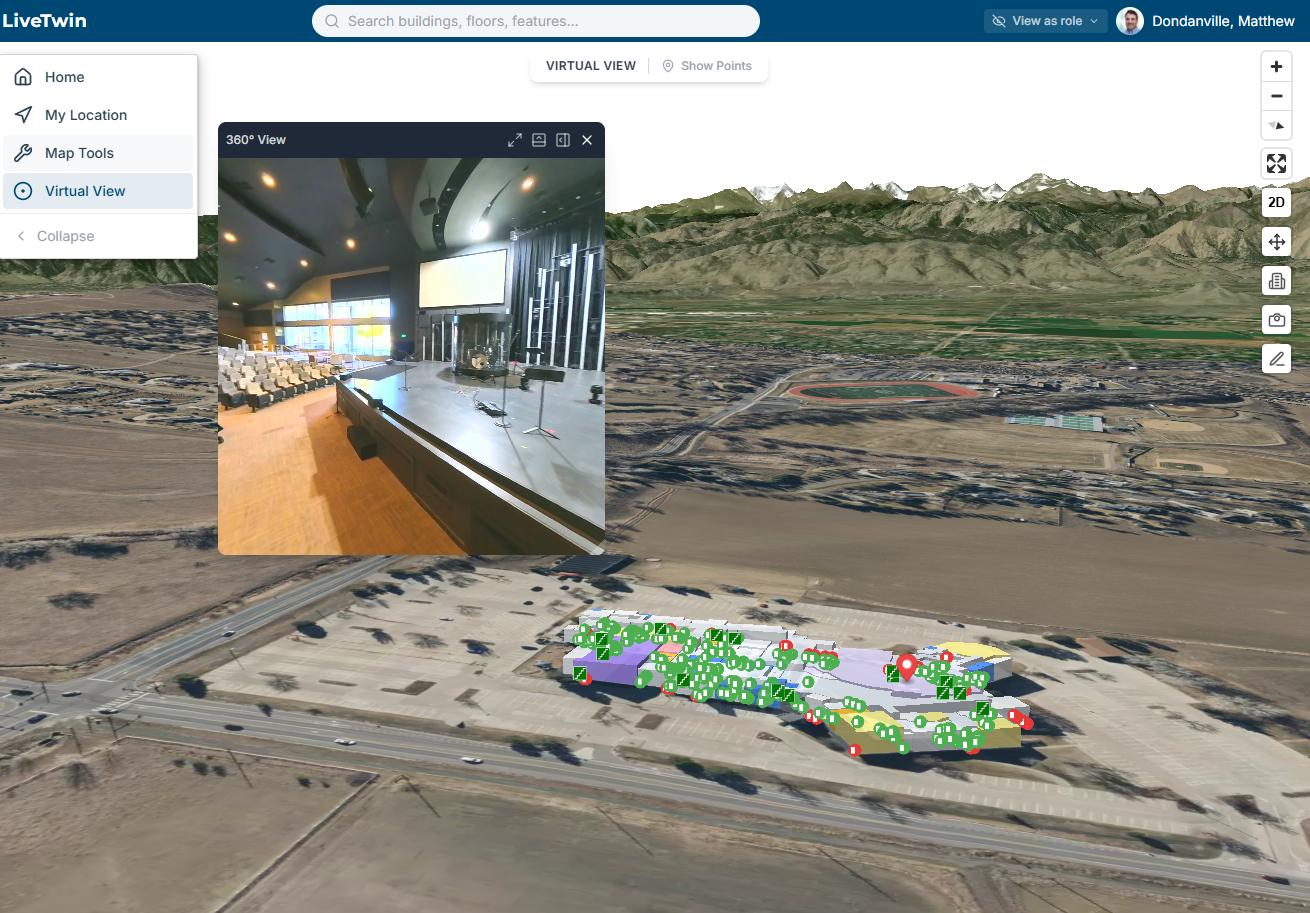
An AI-enabled twin can place asset information and spatial context in a shared operational view. Image: Michael Baker International.
What should infrastructure leaders choose?
The right starting point depends on the operational problem, not the label attached to the software.
Choose a digital twin foundation when:
- Asset information is fragmented across drawings, GIS, BIM and maintenance systems.
- Teams need a shared visual reference for a facility or network.
- Scenario planning and engineering simulation are the immediate priorities.
- You need to establish data quality, asset relationships or lifecycle visibility before applying AI.
Prioritize AI-enabled operations when:
- Teams already have useful data but struggle to identify patterns across systems.
- Predictive maintenance, risk forecasting or incident coordination is a defined need.
- Decision-makers need to compare response options, not just monitor status.
- Existing workflows can use recommendations, alerts or automation with clear human oversight.
For many organizations, the practical route is phased: establish a reliable twin, connect priority data sources, then add predictive and prescriptive analytics to specific use cases. That allows teams to prove value while reducing the risk of attempting a large-scale technology transformation all at once.
Where physical AI can make a difference
Physical AI applies AI to the real-world environments and infrastructure people operate. In a digital twin, it can help connect sensor data and asset context with forecasting, simulation and decision support.
Consider an urban flood scenario. A connected twin could bring together weather information, flood models, roads, critical facilities and emergency-service locations. Predictive analytics may help teams understand which areas face greater exposure. Prescriptive analytics can support comparison of response options, such as alternative routes or the prioritization of inspections. The twin provides the shared spatial context; authorized teams decide what action to take.
MetaWorldX’s Toronto Digital Twin project illustrates how urban data such as traffic, air quality and weather simulations can be brought into a city-scale operational view. The project page describes applications in emergency response and planning; outcomes should be validated against the needs and data of each deployment.

The same principle applies to a hospital campus, airport, port or utility network: connect relevant systems, understand the relationships between assets, then use analytics to support decisions that matter in the real world. MetaWorldX combines this approach through Physical AI for energy microgrid management and other infrastructure applications.
The 2027 buying checklist: assess the operating model, not the buzzword
Whether a vendor calls its product a twin, platform or operating system, decision-makers should test how it works in practice.
- Data lineage: Can operators see where information came from, how current it is and whether it is authoritative?
- Interoperability: Can the platform work with existing GIS, SCADA, BMS, IoT, access-control and asset-management systems?
- Security: How are identity, permissions, data flows and operational-technology boundaries protected?
- AI governance: Can teams understand, review and audit model outputs and recommendations?
- Human oversight: Which actions require approval, and can operators override or stop automation?
- Measurable performance: Can a pilot establish a baseline and track outcomes such as response time, maintenance prioritization or service continuity?
Cybersecurity deserves particular attention. The UK National Cyber Security Centre warns that digital twins can expand an infrastructure system’s attack surface and recommends secure-by-design practices. Its guidance on digital twins and secure development offers relevant considerations for organizations building or deploying connected twins.
An intelligent infrastructure platform must be useful and trustworthy. Security, explainability and accountable decision-making are core requirements, not features to defer until later.
The better question for 2027
The choice is not simply digital twin versus AI-native operating system. A digital twin provides a living representation of infrastructure; an AI-enabled operational layer can help teams interpret its data and act on it. The best architecture connects the two while preserving integration with existing systems and human authority over consequential decisions.
For critical infrastructure, that combination can move organizations beyond static visualization: toward earlier insight, better scenario planning and more coordinated operations. The opportunity is not to automate every decision. It is to give people a clearer, more predictive view of the environments they are responsible for protecting.
Explore the MetaWorldX digital twin platform and discover how physical AI, real-time monitoring, simulation, and predictive and prescriptive analytics can support more resilient infrastructure.