
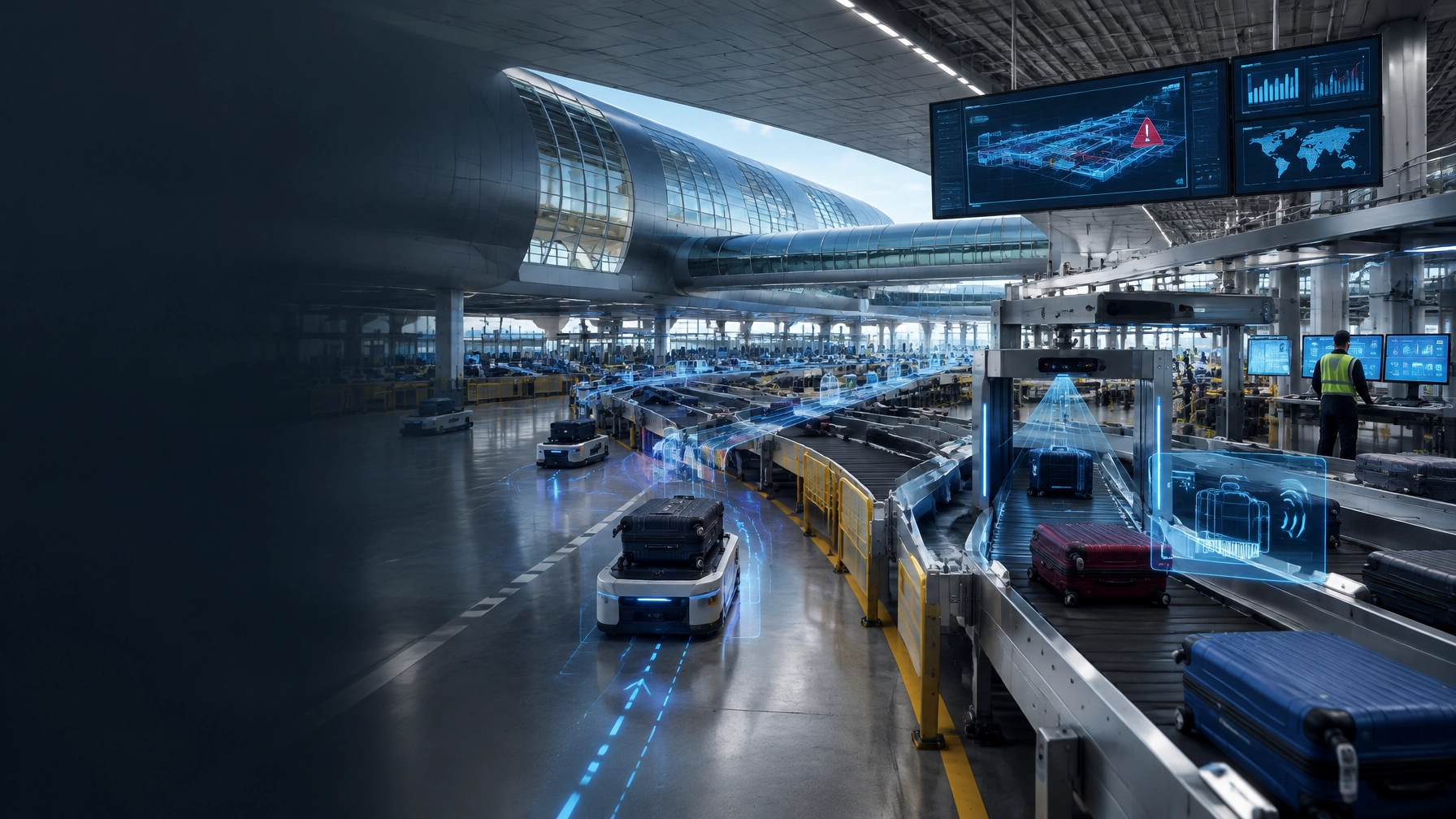
Airports are among the most complex forms of critical infrastructure in the world. Every departing bag must move through check-in, security screening, sortation, transfer processing, make-up, loading and aircraft delivery, often within a tightly constrained window.
When that chain works, passengers rarely think about it. When it fails, the impact is immediate: missed connections, delayed departures, crowded carousels, additional courier costs and a loss of passenger confidence.
The future of baggage handling is predictive, connected and physically aware.
In this use case from the series 50 Ways MetaWorldX Physical AI Is Transforming the World, we examine how an AI digital twin can help airport operators understand the entire baggage handling system (BHS), anticipate disruption and guide faster, better decisions.
Why airport baggage handling remains difficult to optimize
A modern BHS is not a single conveyor. It is a distributed operational ecosystem connecting equipment, software, security controls, ground handlers, airlines and airport command centers.
The system may include:
- Infeed conveyors and check-in interfaces
- Explosive detection system (EDS) and security screening lanes
- Barcode and RFID reading points
- High-speed sortation systems
- Destination-coded vehicle (DCV) carts
- Transfer routing and early baggage storage
- Make-up areas and aircraft loading interfaces
- Arrival conveyors and passenger carousels
- Programmable logic controllers (PLCs), SCADA platforms and maintenance systems
A failure in one area can quickly propagate across the network. A stopped belt can create a queue upstream. A jam at a transfer junction can affect multiple flights. A degraded scanner can lower read rates, forcing manual intervention and increasing the risk of a missed connection.
In many airport operational analyses, baggage handling system failures account for the majority of baggage incidents. The most common pressure points include:
-
Unplanned equipment downtime
Conveyor motors, belts, diverters, scanners and sortation equipment can fail during the busiest operating periods. -
Jam clusters
One obstruction can create cascading congestion across connected lines, particularly when operators lack a shared view of the affected flow. -
Transfer bag misses
Transfer-heavy hubs operate with narrow connection windows. A bag delayed by even a few minutes may miss its onward flight. -
Carousel congestion
Poorly balanced arrival flows can overload one carousel while others remain underused, creating unnecessary crowding and passenger frustration. -
Reactive maintenance
Maintenance teams often respond to visible failures instead of subtle signs of degradation, such as changing motor current, vibration drift or declining scanner performance.
The financial impact is significant. Direct operational estimates for a mishandled bag are often cited at $25–$40 or more, before considering compensation, re-routing, storage, delivery and reputational damage. More comprehensive industry models are considerably higher. SITA’s Baggage IT Insights places the global average cost at $260 per mishandled bag, with lost bags costing substantially more.
A baggage incident is rarely just a baggage incident. It is an operational, financial and customer experience event.

How MetaWorldX Physical AI creates a living model of the BHS
Traditional monitoring tools tend to show isolated alarms, status screens or equipment dashboards. They may identify that a motor has stopped, but not always explain what that failure means for flights, transfer bags or downstream capacity.
MetaWorldX Physical AI connects operational data to a continuously updated 3D digital twin of the full baggage handling environment.
The model can represent:
- Physical conveyor layouts and routing relationships
- EDS screening and security processing capacity
- Sortation lanes and decision points
- DCV cart movements and destination assignments
- Bag volumes by flight, airline or transfer type
- Make-up areas and aircraft loading windows
- Arrival routes, carousels and passenger-facing impacts
- Equipment condition, alarms and maintenance history
This creates a common operational picture for baggage control teams, engineering personnel, airport operations centers and other authorized stakeholders.
1. Predictive analytics identifies risk before failure
The platform can integrate data from existing airport and BHS systems, including:
- Motor current and vibration sensors
- Belt speed and temperature readings
- Jam and blockage sensors
- Barcode and RFID read rates
- Scanner health and exception events
- PLC and SCADA feeds
- Maintenance management records
- Flight schedules and connection windows
AI models compare current patterns with historical operating behavior. A gradual rise in vibration, for example, may indicate bearing wear. A change in motor current may suggest increased mechanical resistance. A declining barcode read rate may reveal scanner contamination, alignment problems or deteriorating equipment.
Instead of treating every alert equally, the system can prioritize assets according to operational consequence.
A motor supporting a low-volume domestic line may be less urgent than one serving a transfer corridor during a major international bank. Prediction becomes more valuable when it is connected to the real operating context.
2. Prescriptive analytics recommends the next best action
Prediction alone is not enough. Airport teams need practical options.
Prescriptive analytics can evaluate possible responses, such as:
- Rebalancing bag volumes across available sortation lines
- Redirecting selected flights or destinations
- Prioritizing transfer bags approaching a connection threshold
- Assigning technicians to the highest-impact asset
- Scheduling repairs during a planned maintenance window
- Opening alternate make-up capacity
- Escalating an issue to the airport command center
- Deploying operators to a specific physical location
Recommendations remain subject to airport procedures, safety rules and human approval. This human-in-the-loop governance ensures that operators stay in control of every automated recommendation.
The role of Physical AI is not to replace operational expertise. It is to give experts a clearer understanding of what is happening, what may happen next and which intervention is most likely to protect the operation.
Simulating disruption before it happens
Airports cannot safely test every failure scenario in live operations. A digital twin provides a controlled environment for scenario planning.
Teams can simulate:
- Peak-season passenger and baggage volumes
- A single conveyor or sortation line outage
- An EDS lane becoming unavailable
- A major flight bank arriving late
- A spike in transfer bags
- Reduced barcode or RFID read performance
- A jam cluster at a critical junction
- A carousel operating below capacity
- Planned maintenance on a high-consequence asset
For a major hub in Toronto, Dubai or a transfer-heavy international gateway, the difference between a manageable disruption and a passenger-facing failure may depend on minutes and routing choices.
The same approach is especially valuable for NEOM-style greenfield developments, where airport and city systems can be designed with operational intelligence from the beginning rather than retrofitted after problems emerge.
Scenario planning turns uncertainty into preparation.

A practical example: protecting a peak morning bank
Consider a hub airport operating a partner-tier BHS during a peak morning departure bank. The system is handling a high volume of originating and transfer bags across several sortation lines.
The digital twin simulates the bank and identifies the likely impact of one sortation line operating below its normal performance level. Rather than waiting for the line to fail, the platform recommends a controlled redistribution of baggage flows across the remaining lines.
The prescriptive response could include:
- Rebalancing selected destinations across available sortation capacity.
- Prioritizing transfer bags with the shortest connection windows.
- Monitoring buffer levels at downstream make-up areas.
- Alerting supervisors if a line approaches a congestion threshold.
- Guiding operators to the physical location of emerging bottlenecks.
At the same time, the system detects signature vibration drift on a motor serving a high-volume conveyor. The asset is not yet in failure, but its condition is trending outside its normal operating range.
Engineering teams replace the motor during a planned maintenance window rather than during live operations. The result is not simply a repaired motor. It is a protected flight bank, fewer manual interventions and lower exposure to mishandled bags.
This example illustrates the value of combining asset intelligence with flow intelligence. A maintenance alert becomes more meaningful when the airport understands exactly which flights, routes and passengers could be affected.
From isolated systems to an operational ecosystem
Airport operators rarely have the option, or the appetite, to replace every existing platform. A practical Physical AI platform must work with the infrastructure already in place.
MetaWorldX digital twin technology can be integrated with existing:
- PSIM and command-and-control platforms
- Access control and security systems
- Building management systems
- IoT networks and edge devices
- PLC and SCADA estates
- Airport operational databases
- Maintenance and work-order systems
- Flight, gate and baggage management systems
This integration-first approach avoids a rip-and-replace strategy. It also supports a broader view of airport resilience, connecting BHS performance with security, terminal operations, emergency response and facilities management.
MetaWorldX’s work across critical infrastructure and smart city use cases, including the Dubai Airport digital twin project and the Toronto Digital Twin, reflects the same principle: complex environments become more manageable when their physical assets, data and decisions are connected.
Measuring the operational and financial impact
A BHS optimization program should be evaluated against measurable outcomes, including:
- Reduced unplanned baggage system downtime
- Fewer mishandled and misrouted bags
- Higher on-time bag delivery
- Fewer missed transfer connections
- Lower reactive maintenance expenditure
- Increased condition-based maintenance
- Faster response to jams and equipment alarms
- Improved utilization of conveyors, sortation lines and carousels
- Shorter recovery times after disruption
The financial case can be built from the airport’s own baseline: baggage volumes, incident rates, maintenance costs, delay exposure and service-level penalties.
Even a modest reduction in mishandled bags can produce meaningful value at a major hub. Avoided costs may include re-routing, storage, courier delivery, compensation, staff overtime and the reputational effects of an unreliable passenger journey.
The next generation of baggage operations is physically intelligent
Airports are becoming smarter, but intelligence cannot remain confined to dashboards. It must understand physical assets, spatial relationships, operational constraints and human decisions.
That is the promise of MetaWorldX Physical AI: a Physical AI platform that combines digital twin technology, IoT integration, predictive analytics, prescriptive recommendations and real-time 3D simulation to help critical infrastructure teams act before disruption spreads.
For airport leaders, BHS optimization is more than an engineering initiative. It is an opportunity to improve resilience, protect passenger trust and create a more coordinated operating model across the entire airport.
The baggage journey may be invisible when it works. With the right digital twin, the intelligence behind it does not have to be.
Explore more digital twin technology and AI for critical infrastructure through the MetaWorldX Physical AI platform.