
This is post #34 in the series “50 Ways MetaWorldX Physical AI Is Transforming the World.”
Airports operate at the intersection of safety, capacity, infrastructure, and time. Every runway movement depends on pavement condition, weather, aircraft sequencing, ground vehicles, lighting, communications, and highly coordinated human decisions.
When one part of that system fails, the impact can spread rapidly. A contaminated runway can trigger a closure. A pavement defect can create foreign object debris (FOD). A single runway restriction can disrupt arrivals, departures, gates, baggage operations, and passenger connections across an entire hub.
The future of airport operations is not simply more data. It is better operational intelligence.
MetaWorldX Physical AI brings together real-time 3D simulation, IoT integration, predictive and prescriptive analytics, and human-in-the-loop governance to help airports anticipate risk, test decisions, and respond with greater precision.
The runway is a high-consequence operating environment
Runways and airfields are among the most safety-critical assets in modern infrastructure. Operators must continuously balance safe aircraft movements with pressure to maintain throughput and minimize disruption.
Several connected challenges make this difficult.
1. Runway excursions
A runway excursion occurs when an aircraft overruns the runway end or veers off the side during takeoff or landing. Contaminated surfaces, poor braking action, crosswinds, unstable approaches, excessive speed, and degraded pavement can all increase the risk.
The FAA identifies runway safety and runway excursion prevention as key elements of airport infrastructure management. Yet risk can change minute by minute as weather, surface conditions, aircraft weight, and traffic patterns evolve.
A static inspection or periodic report cannot provide the complete operational picture. Airport teams need to understand not only the current condition of a runway, but also how that condition may develop over the next hour, shift, or operating day.
2. Pavement degradation and FOD
Runway pavement experiences repeated loads from heavy aircraft, service vehicles, temperature changes, water, de-icing chemicals, and freeze-thaw cycles. Small defects can develop into larger maintenance requirements or generate FOD.
FOD can damage aircraft, disrupt operations, and create immediate safety concerns. Cracks, loose materials, construction debris, damaged lighting components, or objects carried onto the movement area all require rapid detection and removal.
The challenge is not only finding defects. It is prioritizing which defects require immediate action, which can be monitored, and where inspection resources should be deployed first.
3. Snow, ice, and de-icing sequencing
Winter operations introduce a complex coordination problem. Snow removal, runway treatment, aircraft de-icing, taxiway access, vehicle routing, braking-action assessments, and departure sequencing must work together.
If a runway is cleared too early, it may become contaminated again before aircraft can use it. If aircraft are de-iced too far in advance, treatment effectiveness may decline while they wait for departure. If snow-clearing vehicles conflict with aircraft movements, capacity may fall further.
For a major hub, the question is not simply whether to close a runway. It is how to sequence treatment and movements to preserve the safest possible capacity.

4. Single-runway capacity constraints
Many airports depend heavily on one primary runway during particular wind, weather, construction, or noise-management conditions. A runway closure or operating restriction can therefore create a capacity shock.
Arrivals may need to hold or divert. Departures may be resequenced. Taxiways can become congested. Gates, baggage systems, ramp teams, and passenger services may all experience secondary impacts.
These effects are difficult to model using disconnected systems. The airport needs a shared operational view that shows how a runway decision will affect the wider airfield and terminal environment.
5. Closed-runway cascade delays
Runway closures can result from severe weather, pavement inspections, emergency response, maintenance, FOD events, wildlife activity, or runway incursions. The initial event may be localized, but the delay pattern can spread quickly.
A decision-support system must help airport leaders compare options:
- Close one runway temporarily or reduce its operating capacity?
- Shift traffic to an alternate runway?
- Prioritize departures, arrivals, or critical flights?
- Reroute ground vehicles and aircraft around a work zone?
- Reopen a runway in phases after inspection or treatment?
- Communicate changing conditions to the relevant operational teams?
The objective is not to eliminate every disruption. It is to shorten the disruption and prevent it from becoming a network-wide failure.
6. Runway incursions
A runway incursion is the incorrect presence of an aircraft, vehicle, or person on a protected runway or designated movement area. Incursion risk can increase during low visibility, construction, unfamiliar routing, complex taxiway configurations, or periods of high traffic.
The ICAO Runway Safety Team Handbook emphasizes coordinated, airport-specific approaches to runway safety. MetaWorldX Physical AI supports that approach by connecting movement data, asset status, procedures, and operational context within one visual environment.
How MetaWorldX Physical AI transforms airfield management
MetaWorldX Physical AI functions as an intelligent operational layer above existing airport systems. It does not require an airport to discard its current investments. Instead, it connects data from systems that already support airfield, safety, security, maintenance, and facilities teams.
A typical implementation can integrate:
- ATC and airfield movement systems
- Runway and taxiway lighting systems
- Pavement inspection and maintenance records
- Weather stations and surface-condition sensors
- FOD reporting and inspection logs
- Aircraft and ground-vehicle tracking
- De-icing, snow-removal, and fleet-management systems
- PSIM, access control, and security platforms
- Building management systems and IoT networks
- GIS, BIM, asset-management, and airport operations data
The result is a living AI digital twin of the runway environment.
Predictive analytics: identify risk before disruption
Predictive models analyze historical and real-time data to detect patterns that may precede an operational problem.
For example, the platform can help identify:
- Runway sections likely to experience accelerated pavement degradation
- FOD hot spots associated with construction, weather, or vehicle activity
- Changing friction and braking-action risk under snow, ice, water, or slush
- Weather conditions that may increase excursion exposure
- Taxiway intersections with elevated incursion risk
- Operational periods when a single-runway configuration may become constrained
- Maintenance activities likely to affect runway availability
This approach shifts airport management from reactive response to earlier intervention.
Predictive intelligence helps teams see what is developing, not only what has already happened.
Prescriptive analytics: recommend the next best action
Prediction alone is not enough. Airport operations teams need practical recommendations that align with safety procedures, staffing, equipment, and current traffic conditions.
Prescriptive analytics can compare response options and recommend actions such as:
- Prioritizing a pavement inspection based on risk and traffic exposure
- Adjusting FOD inspection routes toward higher-probability locations
- Sequencing snowplows, sweepers, and de-icing vehicles
- Reassigning aircraft or vehicle routes around a restricted area
- Evaluating whether to close, partially restrict, or reopen a runway
- Coordinating runway treatment with aircraft de-icing and departure queues
- Escalating a situation to the appropriate airport authority or safety team
Recommendations remain subject to airport procedures and authorized human decisions. MetaWorldX supports governance rather than replacing it.
Real-time 3D simulation: test decisions before acting
A major differentiator of MetaWorldX is the ability to visualize airport conditions and simulate operational scenarios in a comprehensive 3D environment.
Operations teams can examine:
- Aircraft positions and projected movement paths
- Runway, taxiway, and apron availability
- Surface condition changes across specific runway zones
- Vehicle routes and work areas
- Lighting, access, and security conditions
- Potential conflicts between aircraft, vehicles, and personnel
- The impact of runway closures on wider airport capacity
Teams can then run “what-if” scenarios before committing resources. For example:
- A winter storm is forecast to intensify during the evening departure bank.
- The digital twin models snow accumulation, runway treatment cycles, aircraft queues, and vehicle availability.
- Several de-icing and runway-clearing sequences are compared.
- Decision-makers select the option that best balances safety, capacity, and recovery time.
- The approved plan is monitored in real time and adjusted as conditions change.

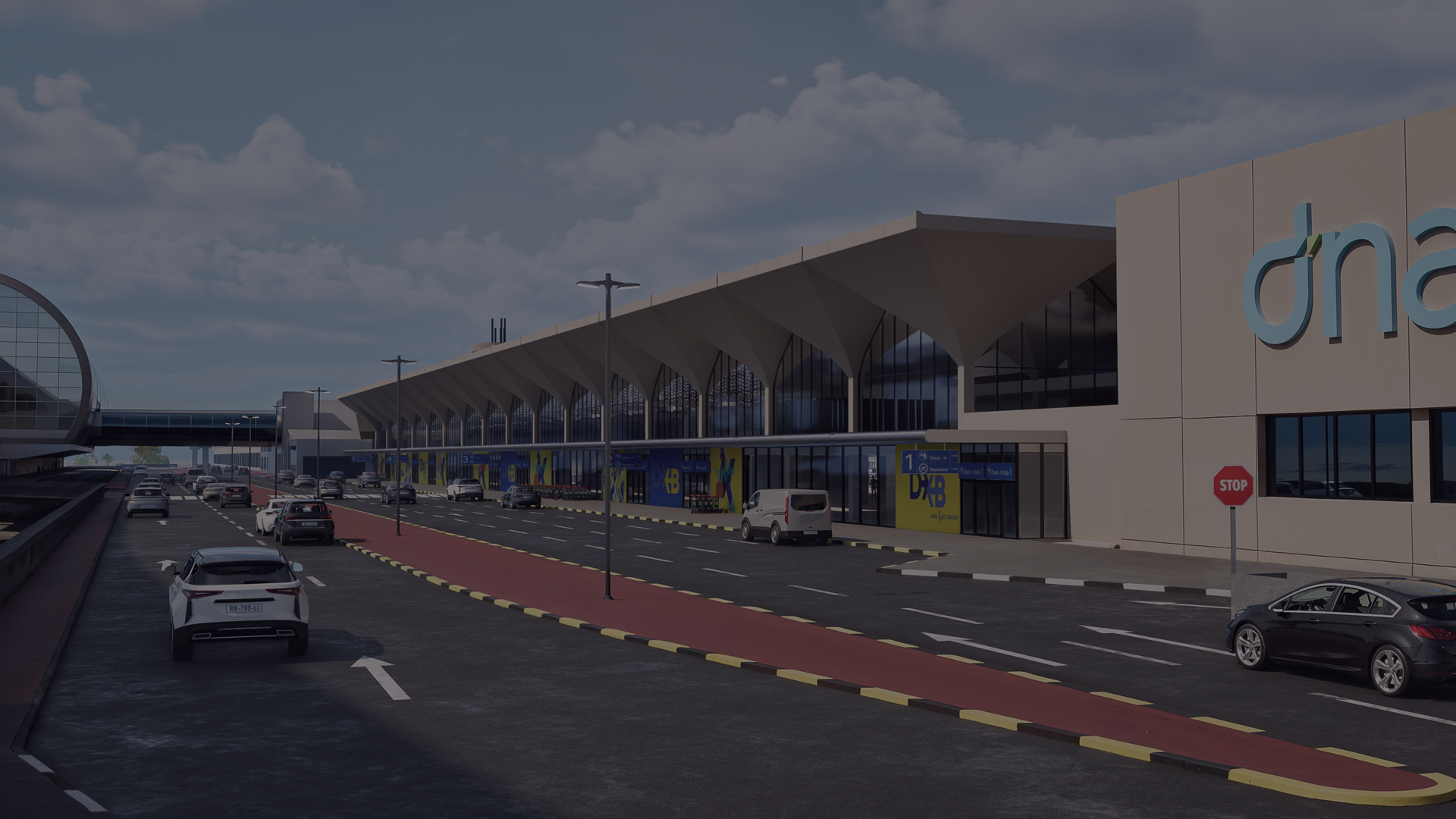
A Dubai-style hub airport scenario
Consider a high-volume hub airport operating in a hot, arid climate, similar to Dubai. Extreme heat can stress pavement, accelerate material fatigue, affect equipment performance, and increase the need for maintenance planning. At the same time, the airport must manage dense aircraft movements, complex ground operations, security requirements, and strong passenger-service expectations.
A MetaWorldX Physical AI deployment could connect runway condition data, aircraft movements, maintenance schedules, weather information, security systems, and airfield vehicle locations.
The airport operations center could use the digital twin to:
- Visualize heat-sensitive pavement areas and maintenance priorities
- Identify how a temporary runway restriction would affect traffic flows
- Simulate aircraft and vehicle movements around a work zone
- Coordinate inspections, FOD sweeps, and maintenance crews
- Monitor runway access and authorized personnel in real time
- Evaluate recovery options following an unexpected closure
This scenario reflects the type of integrated airport intelligence described in the MetaWorldX Dubai Airport project, where real-time data integration, predictive maintenance, situational awareness, and scenario planning support safer and more efficient airport operations.
The same operating model can be adapted to a Toronto-style hub, where snow, freezing rain, and rapid temperature changes create a different set of runway and de-icing challenges. It can also support large-scale developments such as NEOM, where airport infrastructure is being planned alongside new urban, logistics, and mobility ecosystems.
Measuring the operational and financial return
The value of runway and airfield intelligence should be measured through operational outcomes rather than technology adoption alone.
Airports can establish a baseline and track improvements across metrics such as:
- Number and duration of runway closures
- Delay minutes linked to airfield restrictions
- Time required to detect and remove FOD
- Pavement defects identified before escalation
- Pavement life extended through condition-based maintenance
- Snow and ice treatment cycle times
- De-icing resource utilization
- Recovery time after severe weather
- Runway incursion precursors and alerts
- Aircraft and ground-vehicle conflicts avoided
- Capacity maintained during partial runway restrictions
The ROI comes from combining several gains: fewer avoidable closures, better use of maintenance resources, lower disruption costs, longer asset life, and faster recovery when events occur.
A smarter runway is not merely one that operates more often. It is one that operates with greater foresight, resilience, and control.
The runway becomes part of the smart city
Airports are critical infrastructure nodes. Their performance affects trade, tourism, emergency response, logistics, employment, and regional mobility.
That is why runway and airfield management is an important physical AI use case and a natural extension of smart city infrastructure. The same digital twin technology used to model roads, utilities, public safety, and buildings can provide airport operators with a shared, real-time understanding of complex physical systems.
MetaWorldX brings these capabilities together through:
- AI-powered predictive and prescriptive analytics
- Real-time 3D simulation
- IoT and legacy-system integration
- Scenario planning for routine and emergency conditions
- Interoperability with PSIM, access control, BMS, ATC, and airfield platforms
- Human-in-the-loop governance for accountable decision-making
From Toronto to Dubai, from established hub airports to the next generation of infrastructure in NEOM, the opportunity is clear: airport leaders can move from fragmented monitoring to coordinated operational intelligence.
Explore how MetaWorldX applies AI digital twins to critical infrastructure, smart cities, and airport operations at metaworldx.com.