
Part 19 of 50 Ways MetaWorldX Physical AI Is Transforming the World
Infrastructure does not fail overnight. A bridge gradually accumulates stress. A tunnel’s ventilation equipment loses efficiency. A utility network develops small weaknesses that become major outages. A building’s critical systems age while maintenance records remain scattered across spreadsheets, work orders, inspection reports, and disconnected software.
For cities and infrastructure operators, the challenge is not simply maintaining individual assets. It is understanding how thousands of assets perform together: and deciding where limited maintenance and capital budgets will create the greatest improvement.
The era of reactive infrastructure management is ending.
With MetaWorldX Physical AI, infrastructure owners can use an AI digital twin to monitor asset condition, forecast degradation, simulate future scenarios, and determine whether an asset should be maintained, retrofitted, or replaced.

The Infrastructure Lifecycle Challenge
Infrastructure owners manage assets that often have long, complex, and unpredictable lifecycles. Roads, bridges, tunnels, utilities, airports, ports, public buildings, and industrial facilities must remain safe and operational despite changing demand, weather, usage, and environmental conditions.
Several problems make this difficult:
-
Aging assets create rising risk
Many infrastructure networks were designed decades ago. Their condition may be affected by traffic growth, heavier vehicles, extreme weather, corrosion, settlement, flooding, or changing operating patterns.
-
Maintenance records remain siloed
Asset registers, inspection reports, work orders, sensor readings, BIM models, GIS data, and financial records frequently reside in separate systems. Teams may have valuable information without having a complete view of the asset.
-
Reactive upkeep increases cost
When operators respond only after an asset fails or shows visible damage, they often face emergency repairs, service disruption, safety risks, and higher procurement costs.
-
Lifecycle costs are difficult to predict
A low-cost maintenance decision today may create a larger rehabilitation requirement later. Conversely, replacing an asset too early can divert capital from higher-priority risks elsewhere in the network.
-
Assets are interconnected
A bridge closure affects roads, emergency routes, freight movement, public transit, and nearby facilities. A power or water disruption can affect hospitals, buildings, manufacturing sites, and public safety operations.
The result is a familiar dilemma: decision-makers must allocate finite resources across a large portfolio while working with incomplete, inconsistent, or outdated information.
The core issue is not a lack of data. It is the lack of connected intelligence that turns data into timely action.
From Static Asset Records to a Living AI Digital Twin
A digital twin is a dynamic virtual representation of a physical asset or system. It combines 3D models, operational data, IoT feeds, inspection records, and analytics to reflect how infrastructure is performing over time.
MetaWorldX extends this concept through Physical AI: an approach that connects artificial intelligence to the physical world so operators can understand conditions, test decisions, and coordinate action across real assets.
The MetaWorldX Physical AI platform creates an AI digital twin that can:
- Track the current condition and operational status of assets
- Identify anomalies and emerging deterioration
- Forecast how an asset may degrade under different conditions
- Simulate maintenance, retrofit, replacement, and disruption scenarios
- Recommend practical interventions based on risk, cost, criticality, and service requirements
- Keep human decision-makers in control of approvals and execution
This moves infrastructure management from “What failed?” to “What is likely to fail, when could it happen, and what is the best intervention?”
How MetaWorldX Physical AI Transforms Asset Lifecycle Management
1. Connects the systems operators already use
Infrastructure organizations do not need another isolated data store. They need intelligence that works with their existing operational environment.
MetaWorldX can integrate with systems such as:
- CMMS and EAM platforms for work orders, inspections, asset histories, and maintenance schedules
- PSIM systems for security, incident management, and command-and-control workflows
- BMS platforms for building equipment, energy, environmental, and safety data
- IoT networks for real-time sensor readings and equipment status
- GIS, BIM, CAD, and 3D models for location, geometry, and asset relationships
- Traffic, weather, environmental, and emergency management systems
This interoperability helps create a more complete operational picture without forcing organizations to abandon systems that already support daily work.
2. Replaces calendar-based maintenance with predictive insight
Traditional maintenance often follows a fixed schedule. While scheduled inspections remain important, they may not reflect the actual condition of an asset.
MetaWorldX uses predictive analytics to assess patterns such as:
- Increasing vibration or structural movement
- Moisture intrusion or corrosion risk
- Repeated equipment alarms
- Abnormal temperature or pressure
- Changes in traffic loading or utilization
- Energy inefficiency in building systems
- Weather and environmental exposure
The platform can then estimate how asset performance may change and flag risks before they become failures.
For example, an operator could identify that a tunnel ventilation unit is operating outside its normal efficiency profile. Instead of waiting for a breakdown, the maintenance team can inspect the unit, schedule a targeted intervention, and avoid an unplanned closure.
3. Prescribes the next best action
Prediction alone is not enough. Decision-makers need to understand what to do next.
Prescriptive analytics evaluates possible interventions and helps answer questions such as:
- Should this bridge component be repaired or replaced?
- Is a retrofit sufficient to extend service life?
- What happens if maintenance is delayed by six months?
- Which assets should receive capital funding first?
- How will a road closure affect emergency response and traffic flow?
- Can several maintenance projects be coordinated to reduce disruption?
The recommendation can account for asset condition, criticality, lifecycle cost, operational impact, safety, resilience, and available resources.
Predictive analytics identifies the risk. Prescriptive analytics helps determine the response.

4. Uses real-time 3D simulation for scenario planning
A spreadsheet can describe an asset. A live 3D simulation can show how that asset affects the wider environment.
MetaWorldX provides real-time 3D visualization and comprehensive scenario planning across infrastructure portfolios. Operators can examine:
- A bridge under changing traffic loads
- A tunnel during an equipment outage
- A utility disruption affecting connected buildings
- A road closure during an emergency response
- A flood or extreme-weather event
- A phased rehabilitation program across a city district
This makes complex infrastructure decisions easier to communicate across engineering, operations, emergency management, finance, and executive teams.
It also enables decision-makers to test interventions before implementing them in the physical world.
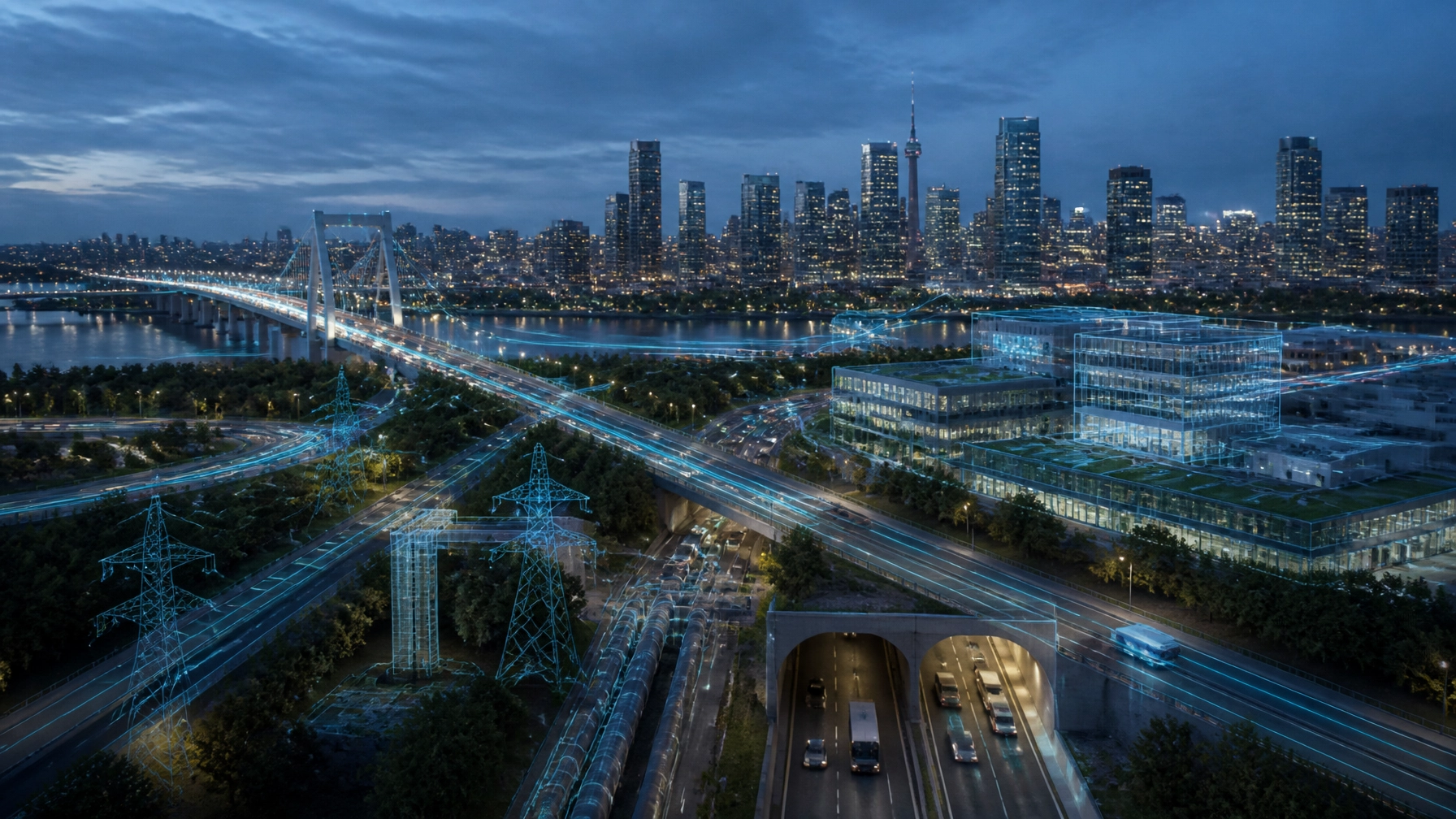
A Toronto-Inspired Infrastructure Scenario
MetaWorldX’s Toronto Digital Twin project demonstrates how real-time simulation can bring together traffic, weather, air quality, road infrastructure, and other city datasets.
The project was designed to support predictive urban planning, emergency response, environmental management, and public safety. That same connected foundation can support a practical infrastructure lifecycle scenario.
Imagine a city operations team responsible for a portfolio of bridges, roads, tunnels, public buildings, and utility corridors.
The team could use a MetaWorldX AI digital twin to:
-
Create a unified asset view
Maintenance histories, inspection records, IoT readings, traffic data, weather conditions, and 3D models are connected to the relevant assets.
-
Identify deterioration patterns
The platform detects that a bridge deck is experiencing accelerated wear because of traffic loading and repeated freeze-thaw cycles.
-
Compare intervention strategies
Engineers simulate routine maintenance, a deeper retrofit, and full replacement. Each scenario includes estimated cost, disruption, service-life impact, and network consequences.
-
Prioritize capital spending
The city compares this bridge with other assets using a risk-based view. A lower-cost repair may extend the bridge’s useful life while capital is directed toward a more critical tunnel ventilation system.
-
Coordinate execution
Approved work orders and maintenance actions can flow into existing operational systems. Traffic and emergency teams can also plan around the intervention.
The result is not an autonomous system making irreversible decisions. It is a human-in-the-loop governance model in which AI identifies patterns and options while qualified professionals retain responsibility for approval, safety, and policy.
The Business and Public Value
A well-governed Physical AI approach to infrastructure lifecycle management can deliver value across four dimensions:
Extended asset lifespan
Early intervention can prevent small defects from becoming major structural or operational problems. Targeted repairs and retrofits may defer costly replacement.
Reduced maintenance OPEX
Predictive maintenance helps reduce emergency callouts, unnecessary inspections, inefficient service visits, and avoidable downtime.
Avoided catastrophic failures
Continuous monitoring and scenario analysis help operators identify risks before they cause major safety incidents, service interruptions, or cascading failures.
Data-driven capital planning
Leaders can compare investment options using condition, risk, criticality, lifecycle cost, and public impact: not simply the loudest immediate request.
These outcomes align with the broader goals of MetaWorldX Critical Infrastructure solutions and the company’s work in Smart Cities: helping organizations transform complex information into actionable decisions.
The Future of Infrastructure Management Is Predictive
The infrastructure assets that support cities and industries will continue to age. At the same time, climate pressures, urban growth, resource constraints, and rising service expectations will increase the cost of poor decisions.
Digital twin technology provides the foundation for seeing infrastructure as a connected, continuously evolving system. Physical AI adds the intelligence required to interpret conditions, forecast change, simulate consequences, and recommend action.
MetaWorldX brings these capabilities together through:
- AI-powered predictive and prescriptive analytics
- Real-time monitoring
- 3D simulation
- IoT and enterprise-system integration
- Comprehensive scenario planning
- Human-led governance and decision support
The outcome is a more resilient and sustainable approach to infrastructure stewardship: one that protects public value while helping operators make every maintenance and capital decision count.
For decision-makers exploring AI for critical infrastructure, asset lifecycle management is a practical place to begin. Explore the MetaWorldX platform to see how an AI digital twin can help connect your infrastructure data, anticipate risk, and support better decisions across the full asset lifecycle.