
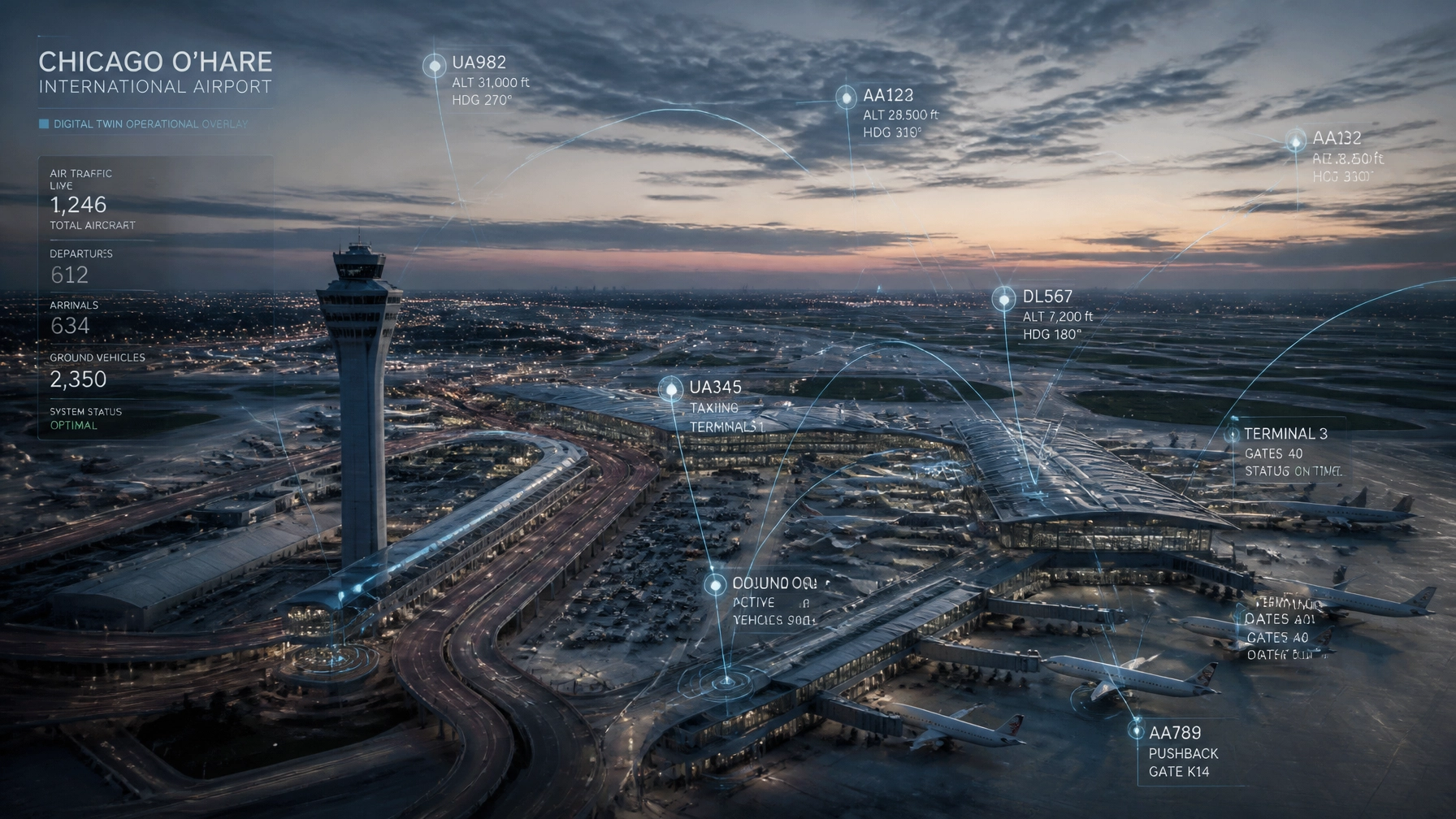
Chicago O’Hare International Airport (ORD) is more than just a transit point; it is a sprawling, high-stakes ecosystem that functions as the heartbeat of American aviation. Ranking as the #6 busiest airport globally in 2025, O’Hare manages a staggering 84.8 million passengers annually across its four massive terminals and 215 gates. For the uninitiated, navigating this beast can be a daunting prospect.
However, behind the scenes of the bustling concourses and mid-century architecture, a silent technological revolution is underway. As of late 2025, O’Hare has solidified its position as a global leader in "Smart Airport" infrastructure, leveraging advanced AI and digital twin principles to optimize every second of the passenger journey. Whether you are a traveler looking for the fastest route to Terminal 5 or an infrastructure professional interested in the future of urban mobility, understanding O’Hare requires looking through the lens of both physical layout and digital innovation.
The Terminal Breakdown: Mapping the Beast
Navigating O'Hare efficiently starts with understanding the "The Big Four." Unlike many newer hub airports, ORD is built in a crescent shape (Terminals 1, 2, and 3) with a detached international terminal (Terminal 5).
- Terminal 1 (United Airlines): The home of United’s massive Chicago hub. It is famous for the neon-lit underground walkway between Concourses B and C. If you are flying United, this is your primary base.
- Terminal 2 (United Express, Delta, Air Canada): A central hub for regional hops and Delta’s primary Chicago presence. It serves as the bridge between Terminals 1 and 3.
- Terminal 3 (American Airlines): The fortress hub for American Airlines. It is expansive, covering Concourses G, H, K, and L, and features the iconic "flag-lined" walkway.
- Terminal 5 (International Carriers & Budget Airlines): The crown jewel of O'Hare’s recent modernization. T5 handles almost all international arrivals and is the primary hub for airlines like British Airways, Emirates, and Southwest.
The era of virtual cities is here. While these terminals are physically distinct, they are digitally unified by a new operational backbone that ensures the millions of people moving through these spaces stay on schedule.

Navigating Connections: Airside vs. Landside
The most critical mistake a traveler can make at O’Hare is misjudging the distance between Terminal 5 and the domestic terminals (T1, T2, T3).
1. The Airside Walkway (T1, T2, T3)
If you are connecting between United, American, or Delta (T1 through T3), you are in luck. These terminals are connected airside (inside security). You can walk between them without ever exiting the secure area or re-clearing TSA. A walk from the far end of T1 to the far end of T3 takes approximately 15–20 minutes.
2. The Terminal Transfer Bus (TTB)
For those connecting between T5 and the domestic terminals, the TTB is your best friend. This airside shuttle runs daily from approximately 11:30 AM to 9:30 PM. It allows eligible passengers to move from T1 or T3 directly to T5 without exiting security. This is the ultimate "pro tip" for avoiding the notorious Chicago security lines.
3. The Airport Transit System (ATS)
The ATS is O’Hare’s 24/7 automated people-mover. It is a landside train, meaning you must exit security to use it. It is essential for international arrivals (who must clear customs first) or for those heading to the Multi-Modal Facility for rental cars and the CTA Blue Line.
Pro Tips for the 2026 Traveler
To navigate O'Hare like a professional, keep these operational benchmarks in mind:
- Minimum Connection Times: For domestic-to-domestic, aim for 60 minutes. For domestic-to-international (especially if moving to T5), 120 minutes is the safe floor.
- The CTA Blue Line: If you are heading downtown, skip the $60 rideshare. The Blue Line train is located in the lower level of the main terminal area and takes you to the Loop in 45 minutes for a fraction of the cost.
- Security Wait Times: Always check the live TSA wait times via the FlyChicago app. O’Hare’s Smart Cities infrastructure now feeds real-time data into these platforms to help you choose the least crowded checkpoint.
The Digital Twin Powering O'Hare: The August 2025 Transformation
While the physical terminals are impressive, the true innovation lies in what we call the Airport Digital Twin. In August 2025, O’Hare completed its transition to a cloud-native operational backbone using AirportLabs’ SkyCore AODB (Airport Operational Database) and Allegra RMS (Resource Management System).
This deployment, managed in partnership with International Gate Control (IGC), acts as O’Hare's "digital brain." It serves as a real-world example of the Critical Infrastructure solutions that MetaWorldX champions.
Key features of this digital transformation include:
- Zero-Conflict Gate Allocation: Since the go-live, the system has managed over 140,000 flights with near-zero conflicts. The AI predicts aircraft arrival times and gate availability with millisecond precision.
- Predictive Passenger Flow: By integrating IoT sensors across the terminals, the airport can now predict bottlenecks at security checkpoints or baggage carousels before they happen, allowing staff to be redeployed in real-time.
- Autonomous Tows: The digital twin environment enables safer, more efficient terminal-to-terminal aircraft tows by simulating ground traffic patterns in a virtual environment before they occur on the tarmac.
This is the standard for Smart Buildings and infrastructure: moving from reactive management to proactive simulation.

How MetaWorldX Takes the Smart Airport Further
The current systems at O’Hare are just the beginning. At MetaWorldX, we envision a future where the digital twin isn't just an operational database, but a fully immersive, AI-powered ecosystem.
Imagine a version of O'Hare where:
- Predictive Maintenance: AI-driven digital twins monitor the health of every escalator, HVAC unit, and baggage belt, predicting failures weeks in advance to ensure zero downtime for travelers.
- Emergency Simulation: Public Health & Safety teams use high-fidelity 3D simulations to run "what-if" scenarios for evacuations or medical emergencies, ensuring the fastest possible response times.
- Environmental Efficiency: The airport’s HVAC and lighting systems are optimized in real-time based on actual passenger density, significantly reducing the carbon footprint of the Midwest’s busiest hub.
By integrating these disparate data sources into a single, unified 3D visualization, decision-makers can move beyond spreadsheets and into a visionary interface that mirrors reality.

Conclusion: The Future of Your Journey
Navigating Chicago O’Hare in 2026 is a testament to how far aviation technology has come. From the ease of the airside Terminal Transfer Bus to the complex AI algorithms of the SkyCore AODB, every element of the airport is being refined to create a more seamless human experience.
At MetaWorldX, we believe that the technologies powering O’Hare: predictive analytics, real-time IoT integration, and comprehensive digital twins: are the keys to unlocking a more sustainable and efficient world. Whether you are a traveler rushing for a flight or a developer building the next great city, the lesson of O'Hare is clear: Knowledge is power, but simulation is the future.
As you prepare for your next journey through the Windy City, take a moment to look at the screens and the sensors around you. You aren't just walking through a building; you are walking through one of the most advanced digital ecosystems on the planet.
We invite you to explore the potential of your own infrastructure projects. Contact MetaWorldX today to see how our AI-powered digital twins can transform your operations.