
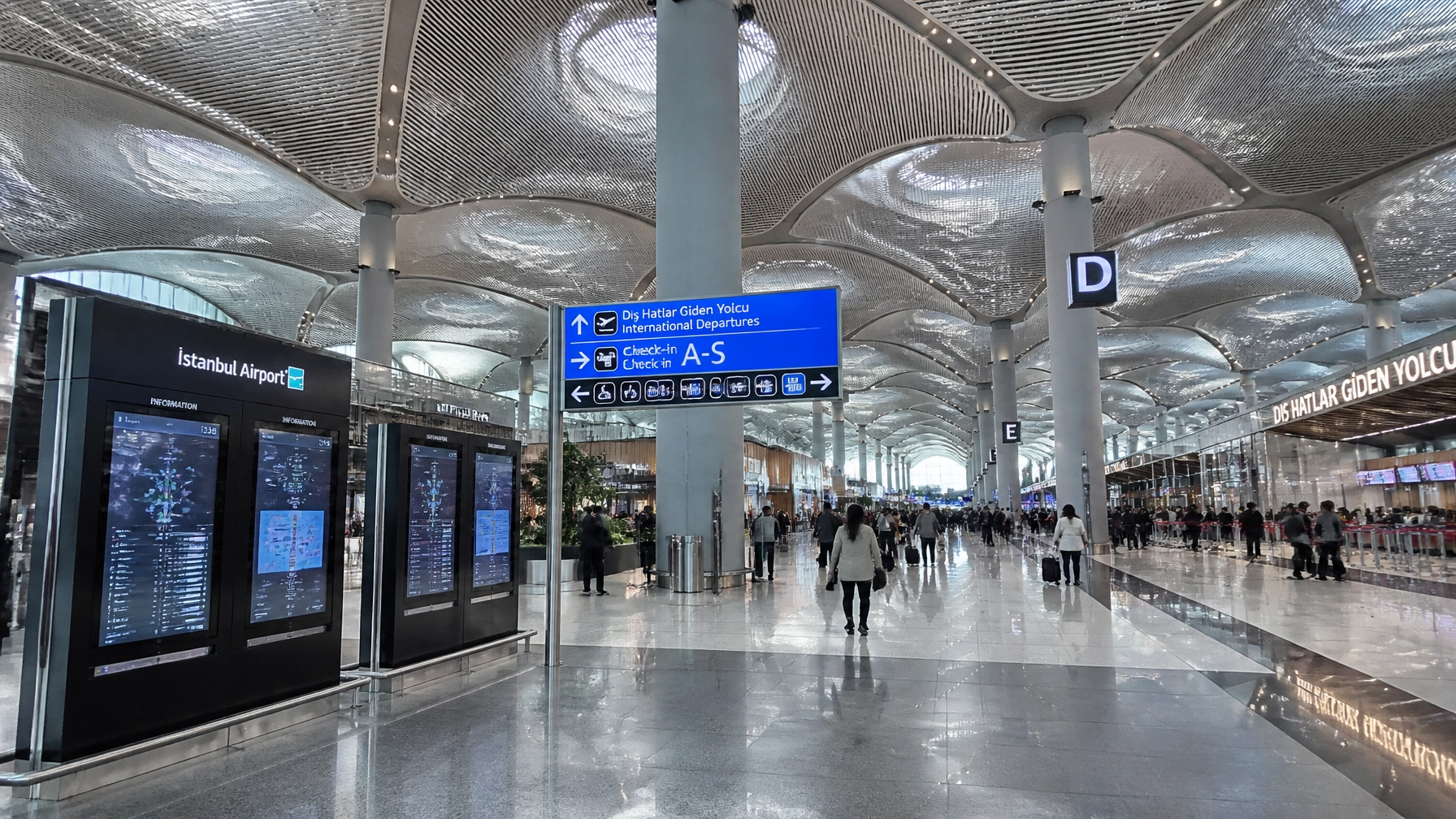
As the physical bridge between Europe and Asia, Istanbul Airport (IST) has rapidly ascended to become one of the most critical nodes in global aviation. In 2025, IST handled a staggering 84.4 million passengers, securing its position as the 8th busiest airport in the world according to ACI World data. For the modern traveler, navigating this architectural marvel requires more than just a boarding pass; it requires a strategy.
Beneath the gleaming glass and vaulted ceilings of IST lies a complex ecosystem where technology and logistics converge. While the scale of the airport can be daunting, it is currently serving as a global testbed for the next generation of AI digital twin airports. By integrating real-time data with predictive intelligence, IST is not just moving people; it is defining the future of the "Cognitive Airport."
1. Terminal Overview: One Roof, Infinite Possibilities
Unlike many global hubs split across disconnected buildings, Istanbul Airport operates out of a single, massive terminal: one of the largest in the world. This centralized design simplifies connections but demands an understanding of its layout to avoid fatigue.
- Five Major Concourses: The terminal branches into five main concourses: A, B, D, F, and G.
- Airside Connectivity: All concourses are connected airside, meaning once you pass security, you can move between them without exiting.
- The Central Hub: Most retail, dining, and lounges are clustered in the central "Duty-Free" area, which acts as the heart of the terminal before passengers branch out to their respective gates.
The era of virtual cities is here. The sheer scale of IST makes it a prime candidate for digital twin technology airports, where every square meter is monitored and optimized for efficiency.
2. Check-in & Security: Precision Timing
With nearly 85 million passengers annually, the check-in and security process is a masterclass in high-volume management. To ensure a smooth departure, precision is key.
- Arrival Windows: It is highly recommended to arrive at least 3 hours before international flights and 2 hours for domestic travel. During peak summer waves (July–August), adding an extra 30–60 minutes is a wise tactical move.
- Biometric Integration: IST is increasingly utilizing AI airport security and biometrics to streamline identity checks. Keep an eye out for dedicated biometric lanes that can significantly reduce wait times.
- Self-Service Kiosks: Numerous self-check-in and bag-drop kiosks are available to bypass traditional counters, especially for Turkish Airlines passengers.
Efficiency is the new luxury. By leveraging automated systems, IST minimizes bottlenecks during record-breaking traffic days.
3. Navigating the Concourses: Buggies and Beyond
The distances at IST are significant; walking from the central hub to the furthest gates in Concourse A or G can take upwards of 25 to 30 minutes.

- iGA Buggy Service: For those with tight connections or limited mobility, the iGA Buggy service is an essential tool. These electric vehicles operate throughout the terminal and can be booked via the iGA FIRST platform for a premium, expedited experience.
- Ask Me Kiosks: Digital "Ask Me" kiosks are stationed throughout the terminal, providing real-time directions and walking time estimates to your gate.
- AR Navigation: The iGA mobile app offers Augmented Reality (AR) navigation, allowing you to follow visual markers on your phone screen to reach your destination.
Navigation should be intuitive. Whether by foot or buggy, the integration of digital wayfinding ensures no passenger is left behind in the terminal’s vast expanse.
4. Connections & Transfers: The 90-Minute Rule
As a major global hub, roughly 48% of IST’s passengers are in transit. Navigating the transfer process efficiently is vital for maintaining your itinerary.
- International-to-International: These transfers typically stay airside. Follow the "Transfer" signs directly to the departure level.
- Domestic-to-International: This requires exiting the domestic area and passing through passport control.
- Minimum Connection Time: While the official minimum can be lower, a 90-minute buffer is highly recommended to account for the physical distances between gates.
Pro Tip: If your connection is under 90 minutes, bypass the central shopping district and head directly to your next concourse.
5. World-Class Amenities: Luxury in Transit
IST is designed to be a destination in itself, offering amenities that rival luxury hotels.
- Lounges: The Turkish Airlines Lounge is legendary for its culinary offerings, while the iGA Lounge provides a serene environment for all travelers.
- Accommodation: For overnight layovers, YOTEL and YOTELAIR offer sleek, cabin-style rooms located both landside and airside.
- Touristanbul: Passengers with layovers between 6 and 24 hours can take advantage of a free city tour, including transport and meals, courtesy of Turkish Airlines.
6. How MetaWorldX Digital Twin Technology Elevates IST
While IST currently utilizes the iGA FIRST and "Cognitive Airport" platforms for real-time monitoring, the integration of MetaWorldX digital twin technology represents the next frontier in airport management.

Predictive and Prescriptive Analytics
MetaWorldX moves beyond simple monitoring to predictive and prescriptive analytics. By simulating millions of passenger movements, our technology can predict a bottleneck at passport control 45 minutes before it happens, suggesting the optimal number of lanes to open.
Comprehensive 3D Simulations
Using our What-If Machine, airport operators can run scenario planning for emergency responses, extreme weather, or sudden flight diversions. This ensures that the airport remains resilient under any conditions.
Smart Building & HVAC Efficiency
Airports are massive energy consumers. The MetaWorldX Thermal Intelligence Layer can optimize HVAC systems based on real-time passenger density in specific concourses, significantly reducing carbon footprints and operational costs.
Seamless PSIM Integration
Security is paramount in a facility handling 84M+ people. A MetaWorldX smart airport integrates seamlessly with Physical Security Information Management (PSIM) and access control, providing a unified "single pane of glass" for security teams to monitor the entire infrastructure.

The future of aviation is data-driven. By transforming complex information into actionable insights, MetaWorldX enables airports like IST to operate with unprecedented precision and sustainability.
Conclusion: The Blueprint for Future Hubs
Istanbul Airport is more than just a transit point; it is a testament to what is possible when visionary architecture meets advanced technology. As it continues to grow toward its ultimate capacity of 200 million passengers, the role of AI for airport operations will only become more critical.
The success of IST serves as a global model for the 1 trillion dollar digital twin revolution. By embracing digital twins, airports can ensure that even with 84.4 million passengers, every single journey feels personalized, efficient, and safe.
Explore how MetaWorldX is redefining the limits of smart infrastructure. Contact us today to see how our AI-driven digital twins can transform your operations.