
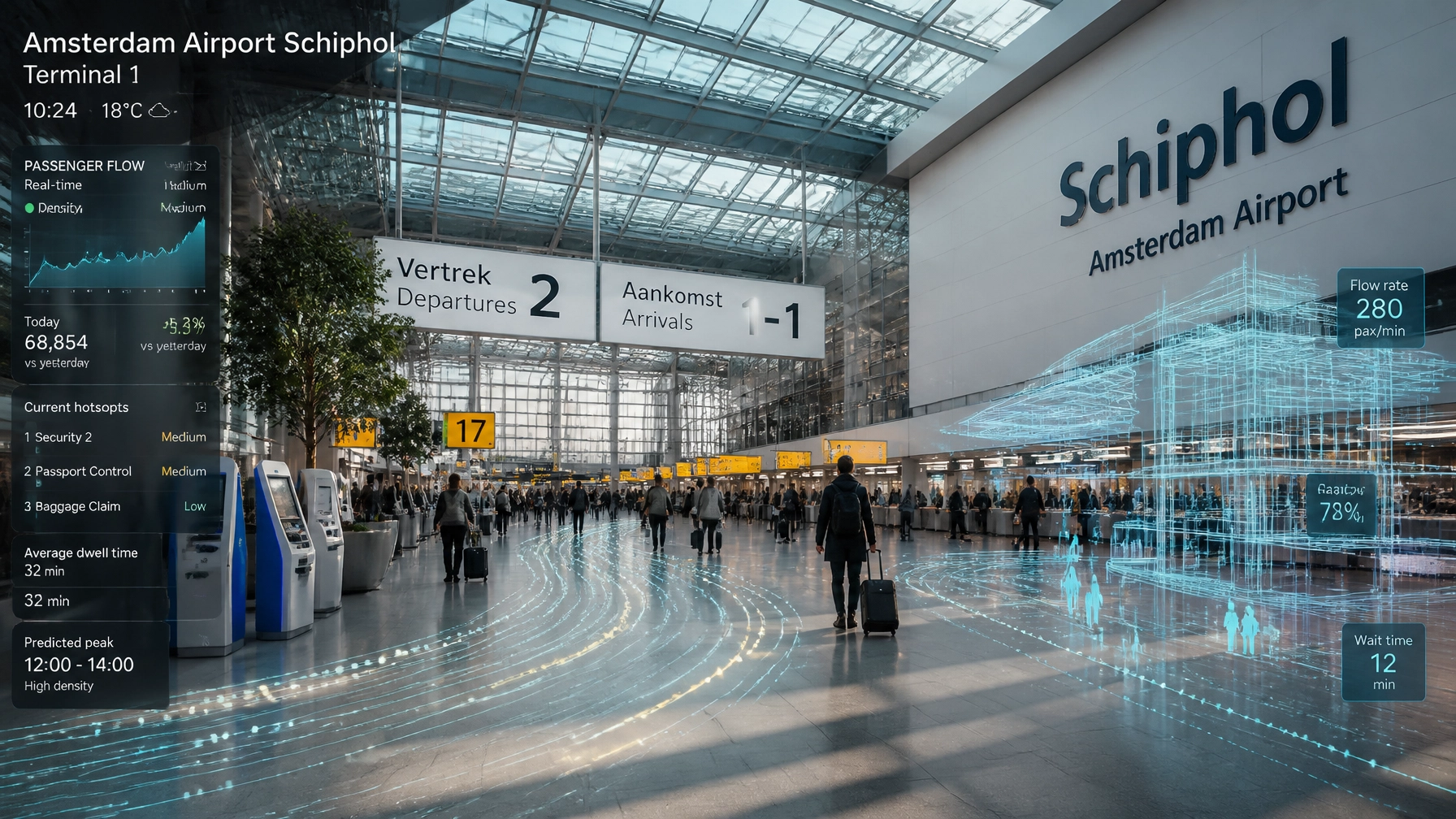
The era of virtual cities and intelligent mega-hubs is here. As one of Europe’s premier aviation gateways and ranking #17 among the world's busiest airports, Amsterdam Airport Schiphol (AMS) handles tens of millions of passengers annually with remarkable Dutch precision. Yet, navigating a mega-hub of this scale requires more than just luck: it demands insider knowledge and an understanding of the cutting-edge infrastructure that keeps it moving.
Behind every smooth transition from train platform to boarding gate lies an invisible layer of innovation. Today, digital twin technology airports are redefining how global terminals operate, turning complex passenger flows and vast physical spaces into synchronized, real-time ecosystems. Whether you are catching a quick connection to a Schengen destination, experiencing the new 2026 border protocols, or heading into the heart of Amsterdam via high-speed rail, here is your definitive masterclass for navigating Schiphol like a seasoned professional.
1. The Single-Terminal Blueprint: Navigating Halls and Piers
Mastering Schiphol starts with understanding its ingenious architectural layout. Unlike sprawling multi-terminal airports that require confusing inter-terminal buses or trains, Schiphol operates under one continuous, unified terminal roof. This centralized design connects all check-in desks, security zones, and gate piers into a single, walkable ecosystem.
Inside this expansive complex, the layout is categorized into three main departure halls and a network of boarding piers:
- Departure Hall 1: Primarily dedicated to Schengen area flights within Europe, offering swift access to Piers B and C.
- Departure Hall 2: Features a dynamic mix of both Schengen and non-Schengen departures, connecting travelers directly to Pier D.
- Departure Hall 3: Handles the bulk of long-haul, non-Schengen international flights, feeding into Piers E, F, G, H, and M.
The critical rule of thumb: Once you cross the passport control boundary into the non-Schengen zone, you cannot freely wander back to the Schengen side without re-clearing security. Always verify your gate assignment on airport monitors before settling into a lounge or exploring airside amenities.
2. Mastering 2026 Border Realities: EES Biometric Checks and Security
Seamless travel is increasingly powered by advanced biometric verification and predictive intelligence. With the full rollout of the European Union's EES (Entry/Exit System), non-EU travelers arriving at Schiphol encounter automated biometric border controls that register facial images and fingerprints at automated kiosks.
To ensure a friction-free journey through security and passport control, keep these essential operational milestones in mind:
- Allocate Proper Margins: Arrive 2 hours before European Schengen flights and 3 hours before non-Schengen long-haul departures, especially during peak morning and late-afternoon windows.
- Utilize Free Time Slots: Take advantage of Schiphol’s free 15-minute online security time slots to bypass peak queues.
- Lounge and Layover Gems: Unwind at the iconic KLM Crown Lounge (Non-Schengen Lounge 52 or Schengen Lounge 25), the quieter Aspire Lounge, or explore airside cultural touchpoints like the Rijksmuseum Schiphol airside branch, the Airport Library, and the panoramic views at the Panorama Terrace.
Modern terminals maintain these high-throughput standards by integrating AI airport security and AI for airport operations. By analyzing real-time queue density and crowd dynamics, intelligent management systems dynamically reallocate security lanes and border booths before bottlenecks can form.

3. Seamless Ground Transit: From Schiphol Plaza to Amsterdam Centraal and Beyond
Efficient travel does not end at the baggage carousel; it extends directly into the Dutch rail network. Positioned directly underneath the central shopping hub of Schiphol Plaza, the underground Schiphol Airport train station is one of Europe's most integrated multimodal transit interchanges.
Getting from the tarmac to the city center is remarkably straightforward:
- The 15-Minute City Link: Direct NS (Dutch Railways) trains run from subterranean platforms up to Amsterdam Centraal every 10 to 15 minutes during the day, taking roughly 15 minutes.
- Contactless Convenience: Skip the ticket machine lines entirely by tapping in and out at ticket barriers using contactless bank cards, smartphones, or OVpay-enabled travel cards.
- Nationwide Connectivity: From Schiphol station, direct rail services also connect you seamlessly to Rotterdam, The Hague, Utrecht, and Eindhoven, allowing you to bypass city-center transfers entirely.
For travelers with extended layovers (5 hours or more), this rapid rail link makes a quick trip into Amsterdam’s historic canal ring entirely feasible: provided you factor in security and border re-entry times upon your return.

4. The Invisible Intelligence: How MetaWorldX Transforms Modern Aviation Hubs
Behind every optimized passenger journey and perfectly conditioned terminal stands the power of enterprise digital twinning. While travelers experience Schiphol through clean signage, rapid trains, and efficient security lanes, visionary airport operators rely on sophisticated spatial platforms to orchestrate these complex systems in real time.
This is where the MetaWorldX digital twin redefines infrastructure management. By creating high-fidelity, interactive 3D virtual replicas of physical mega-hubs, MetaWorldX smart airport solutions empower operations teams to anticipate change rather than simply react to it:
- Passenger Flow Optimization: Predictive analytics simulate crowd behavior across terminals, preventing congestion before it impacts flight schedules.
- Predictive Maintenance: IoT sensors monitor critical infrastructure: from baggage handling belts to HVAC systems: forecasting mechanical wear and scheduling servicing proactively to eliminate costly downtime.
- Environmental Efficiency: Advanced climate and energy modeling significantly reduce carbon footprints, aligning Europe's premier aviation hubs with aggressive global sustainability targets.
To discover how these transformative capabilities are deployed across global transport, smart cities, and critical infrastructure, explore our specialized solutions at MetaWorldX Services and view our international footprint on the MetaWorldX Projects page.

Conclusion: Embrace the Future of Connected Travel
The future of urban mobility and aviation excellence belongs to systems that harmonize human experience with intelligent technology. Navigating Amsterdam Airport Schiphol like a pro means understanding its architectural layout, mastering seamless rail connections, and appreciating the sophisticated engineering that keeps millions of passengers moving every year. As aviation hubs continue to evolve, the integration of real-time data ecosystems and predictive spatial modeling will remain the benchmark of world-class infrastructure.
Ready to explore how cutting-edge digital twin ecosystems can transform your enterprise, smart city, or critical infrastructure? Connect with our team of visionaries today at MetaWorldX or reach out directly through our MetaWorldX Contact Page to start building the interconnected, sustainable spaces of tomorrow.