
The era of virtual cities is here. As one of Europe's most critical aviation hubs, Adolfo Suárez Madrid-Barajas Airport (MAD) handles tens of millions of passengers annually across a sprawling 760-hectare footprint. Navigating this vast international gateway requires precision, foresight, and an understanding of its unique layout. Whether you are connecting between flights or beginning your journey in Spain, mastering the airport's terminal complexes, transit links, and modern infrastructure is essential.
Behind the seamless passenger experience lies a revolution in digital twin technology airports. At Spain’s premier gateway, advanced AI for airport operations and the MetaWorldX digital twin ecosystem orchestrate every moving part: from real-time baggage simulation to predictive energy management. In this guide, we break down everything you need to know to navigate Madrid-Barajas like a professional while exploring the sophisticated tech powering the operation.
1. Decoding the Terminal Layout: T1–T3 vs. T4 & T4S
Madrid-Barajas is structured around two distinct operational zones located kilometers apart. Understanding this separation prevents costly transit mistakes.
- The T1–T2–T3 Complex: Operating as a continuous interconnected building, these older terminals handle primarily European, Schengen, and select international carriers. Passengers can walk end-to-end between T1, T2, and T3 both landside and airside in about 10 to 15 minutes.
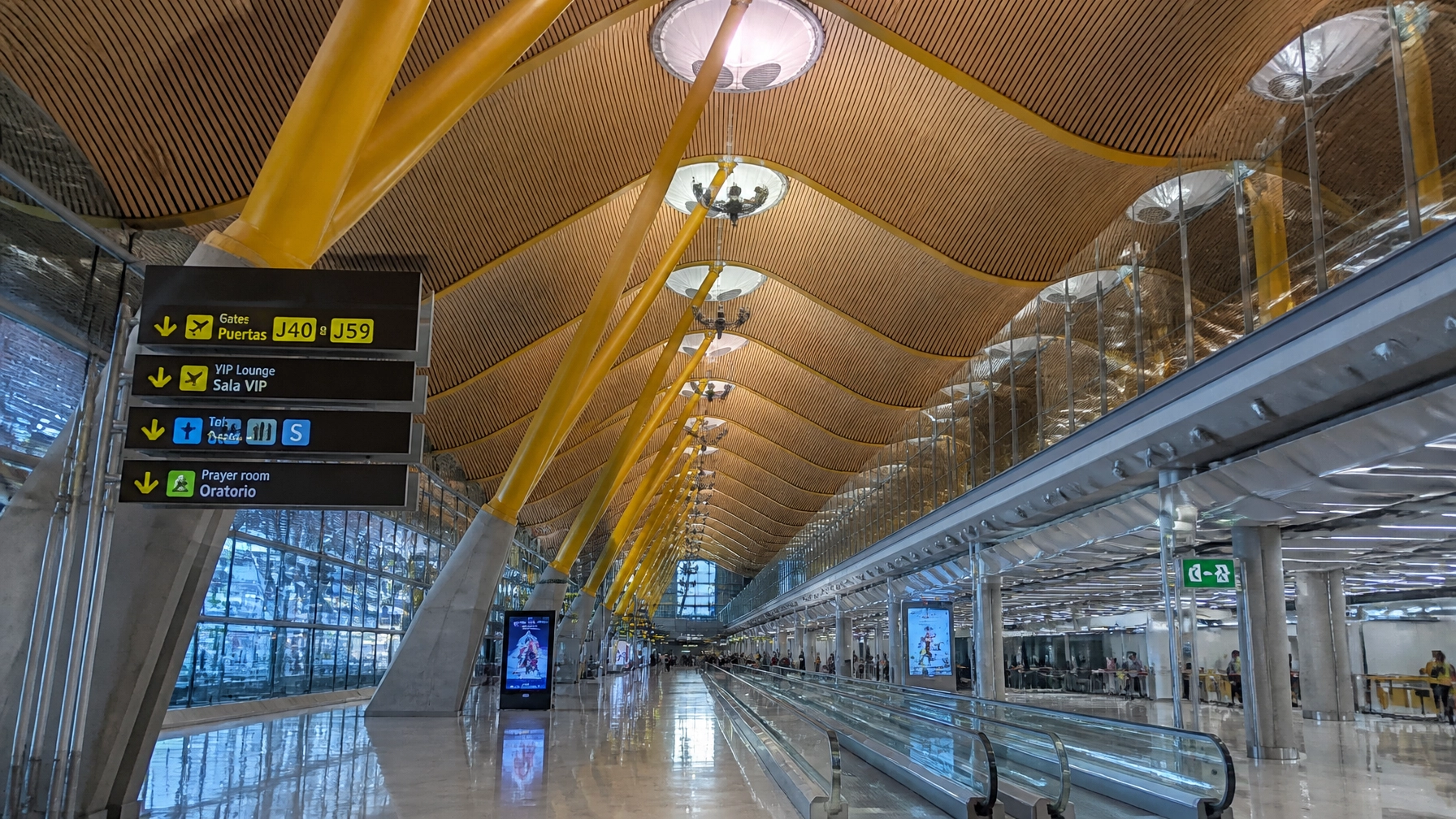
- The T4 & T4S Complex: Situated several kilometers north, Terminal 4 (main building) and Terminal 4 Satellite (T4S) form a massive architectural masterpiece designed by Richard Rogers. T4 handles domestic and Schengen flights (notably Iberia and oneworld partners), while T4S is dedicated to long-haul, non-Schengen international departures.
Seamless orchestration across massive infrastructure is the hallmark of modern aviation. To manage crowd density and movement across this 760-hectare site, aviation authorities leverage AI digital twin airports to analyze passenger flow patterns in real time, preventing bottlenecks before they form.
2. Transit & Connections: Master the Shuttle Bus, Metro Line 8 & Cercanías C-1
Moving efficiently between terminals and into downtown Madrid depends on choosing the correct transit artery.
+-----------------------------------------------------------------+
|               MADRID-BARAJAS TRANSIT QUICK GUIDE                 |
+------------------------------------+----------------------------+
| Connection / Route                 | Primary Mode               |
+------------------------------------+----------------------------+
| T1 ↔ T2 ↔ T3                       | Walkway (Airside/Landside) |
| T1–T3 ↔ T4                         | Free Airport Shuttle Bus   |
| T4 Main Building ↔ T4S Satellite   | Automated People Mover (APM)|
| Airport ↔ Central Madrid (Centro)  | Metro Line 8 / Cercanías C-1|
+------------------------------------+----------------------------+
- The Inter-Terminal Shuttle: If you need to transfer between the T1-T2-T3 block and T4 landside, a complimentary 24/7 airport shuttle bus connects the terminals regularly.
- The T4–T4S Automated People Mover (APM): Once checked in at T4 for a non-Schengen flight, head to Floor -2 to board the driverless underground train connecting the main building to T4S in under four minutes.
- Metro Line 8: Offering direct service from central Madrid (Nuevos Ministerios), Line 8 features two dedicated airport stations: Aeropuerto T1-T2-T3 (located under T2) and Aeropuerto T4 (located in the T4 basement).
- Cercanías C-1 Commuter Train: For travelers heading to major railway hubs like Chamartín or Atocha, the C-1 commuter train station is located directly beneath T4 in the basement level (-1), sharing corridors with the Metro.
3. Security Fast-Track, E-Gates & AI Airport Security
Navigating security lines smoothly is vital for maintaining stress-free travel schedules. Madrid-Barajas has heavily invested in biometric e-gates, automated tray return systems, and advanced screening technologies.
- Fast-Track Access: Available for business class passengers, elite frequent flyers, and those who purchase fast-track passes online. It significantly reduces wait times during peak morning departure banks.
- Biometric E-Gates: Automated passport control kiosks expedite immigration clearance for EU citizens and eligible international travelers through facial recognition technology.

Behind these touchpoints, AI airport security systems monitor queue lengths, detect anomalies, and dynamically allocate security personnel. Through solutions inspired by industry leaders like MetaWorldX Smart Airport frameworks, operators gain predictive foresight into passenger arrival surges, ensuring optimal lane staffing and minimum wait times. Learn more about how modern intelligent hubs operate by reviewing our insights on how AI digital twins are redesigning airport operations.
4. Behind the Scenes: The AI Digital Twin Powering Spain's Global Gateway
While passengers experience the physical terminals, an invisible digital replica oversees the entire ecosystem. The integration of digital twin technology airports allows management teams to simulate, monitor, and optimize every operational dimension.
- Predictive Maintenance: IoT sensors embedded throughout runways, baggage systems, and jet bridges feed real-time performance data into the digital twin, predicting equipment wear before failures occur.
- Baggage Handling Simulation: Complex sorting networks are continuously modeled in 3D to identify pinch points and optimize tray routing, virtually eliminating lost luggage incidents.
- Energy & HVAC Efficiency: With massive glass facades across T4 and T4S, climate control represents a major energy expenditure. AI-driven models dynamically adjust heating, ventilation, and air conditioning based on real-time weather forecasts and passenger density heatmaps.
Optimization meets sustainability in the modern smart terminal. Discover similar large-scale infrastructure achievements in our portfolio covering Dubai Airport digital twin deployments and our global infrastructure case studies on the MetaWorldX project page.
5. Practical Checklist for Your Next Journey Through MAD
To ensure an effortless transit through Madrid-Barajas, keep these final pointers in mind:
- Verify Your Terminal Early: Always double-check your airline ticket. Confusing T1-T3 with T4 adds significant transit time.
- Allow Extra Time for T4S: If departing from satellite gates M, R, S, or U, factor in an extra 15 minutes to clear passport control and ride the underground APM train.
- Utilize Digital Apps: Pair official airport navigation apps with real-time transit schedules for Metro Line 8 and Cercanías C-1.
The future of urban and aviation mobility is interconnected, intelligent, and sustainable. As digital twins continue to redefine how massive facilities operate, traveling through gateways like Madrid-Barajas becomes smoother and more reliable than ever before. Explore our comprehensive guide on navigating Hartsfield-Jackson Atlanta (ATL) to see how global mega-airports are embracing the same technological evolution.

Conclusion
Navigating Madrid-Barajas like a professional is all about preparation and understanding the interplay between its physical terminals and invisible digital infrastructure. By mastering the terminal divisions, utilizing efficient rail links like Metro Line 8 and the C-1 commuter train, and appreciating the sophisticated AI systems at work, your journey through Spain's premier international gateway will be entirely seamless.
Ready to transform how your organization monitors, simulates, and optimizes complex urban and transportation infrastructure? Explore the frontier of intelligent environments and connect with our team at MetaWorldX to discover what next-generation digital twins can achieve for your smart city or aviation hub today.
