
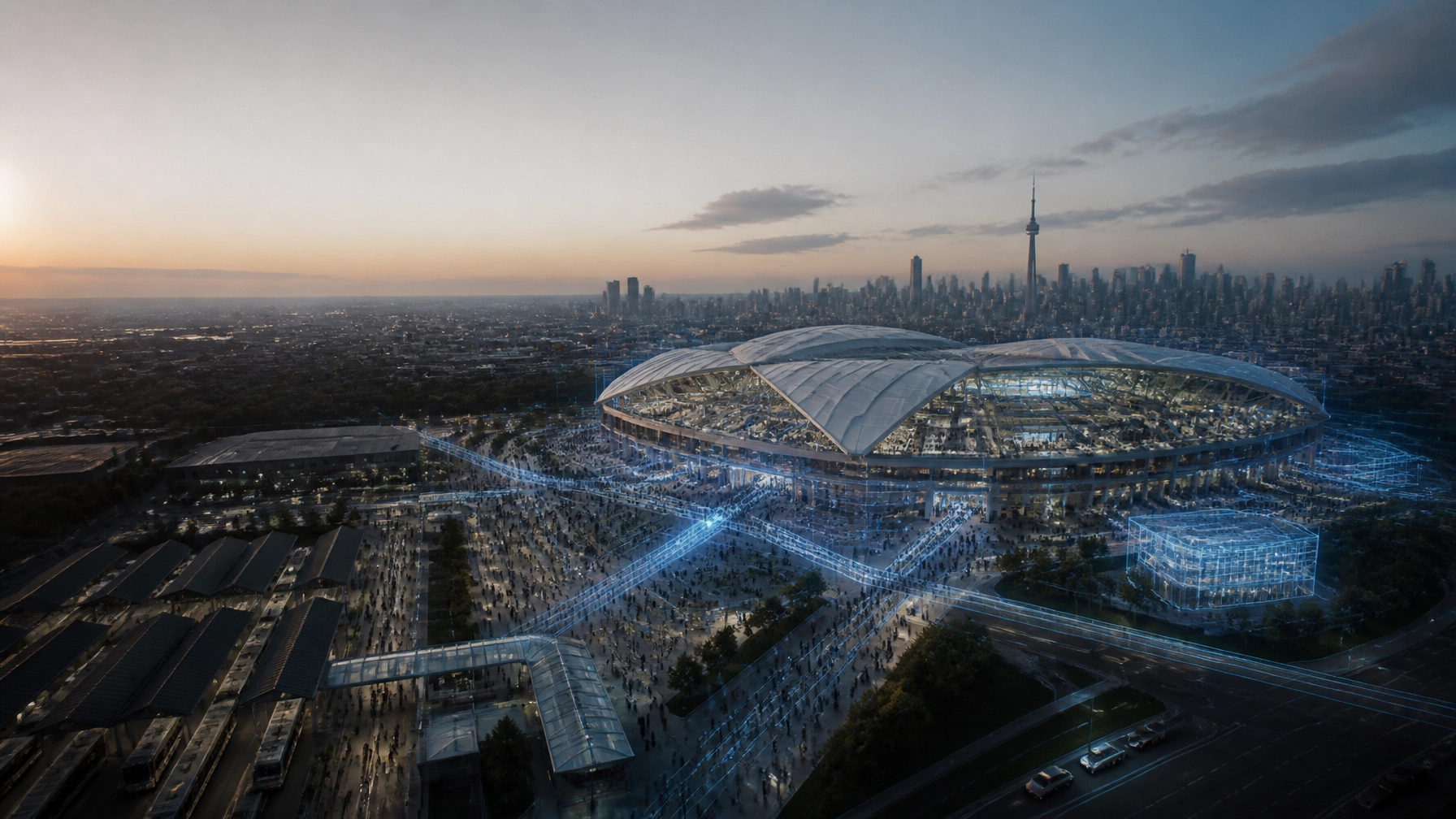
Part of the “50 Ways MetaWorldX Physical AI Is Transforming the World” series.
A sold-out stadium, arena, convention center, festival, airport terminal, or transit hub is more than a physical structure. It is a dynamic environment where thousands: or hundreds of thousands: of people move through gates, corridors, stairways, concessions, platforms, and exits within a limited period.
When crowd movement is predictable, visitors experience shorter queues, safer circulation, and more efficient services. When movement becomes concentrated or unexpected, congestion can escalate quickly.
The era of reactive crowd management is giving way to predictive, model-driven venue operations.
With MetaWorldX Physical AI, large venues can combine an AI digital twin, real-time 3D simulation, IoT data, predictive analytics, and human-led operational decisions to understand how crowds are moving now: and determine how they are likely to move next.
The Challenge: Crowd Movement Changes by the Minute
Large venues face recurring crowd-flow pressures across the entire event lifecycle:
- Arrival surges: Attendees often arrive within a narrow window before a game, concert, conference session, or festival program.
- Entry bottlenecks: Ticket scanning, security screening, elevators, turnstiles, and limited access points can create queues that spill into surrounding areas.
- Internal congestion: Popular concessions, merchandise areas, restrooms, stairs, and narrow concourses can become localized hotspots.
- Event-phase transitions: Halftime, intermissions, keynote breaks, and program changes can trigger synchronized movement.
- Departure waves: Thousands of people may leave simultaneously, placing pressure on roads, parking facilities, public transit, and nearby pedestrian routes.
- Emergency conditions: Fire, severe weather, security incidents, or infrastructure failures require rapid, coordinated movement away from risk.
Traditional systems typically provide isolated views: a camera feed here, a turnstile count there, and radio updates from staff in the field. These inputs are valuable, but they do not always provide a unified understanding of how one decision may affect the entire venue.
The result is often reactive management: responding after queues form rather than preventing them.
Guidance from organizations such as the UK Health and Safety Executive emphasizes the importance of planning, monitoring, communication, and controlled movement. MetaWorldX extends these principles by connecting them through a living digital model of the venue.
The Solution: A Living Digital Twin for Crowd Flow
MetaWorldX Physical AI creates a continuously updated operational view of the venue and its surrounding environment.
A digital twin is a data-connected virtual representation of a real-world asset or place. In this use case, the model can include the venue’s architecture, access points, internal zones, surrounding roads, transit links, security infrastructure, and operational systems.
The MetaWorldX Physical AI platform adds intelligence to that model. It can help venue teams:
- See current conditions
- Predict emerging congestion
- Simulate possible interventions
- Prescribe recommended actions
- Keep human operators in control
This transforms crowd flow management from a collection of disconnected observations into a coordinated operational capability.
1. Predictive Analytics: Identify Problems Before They Escalate
Predictive analytics examines live and historical data to identify patterns that may lead to congestion or elevated risk.
Relevant data can include:
- Ticket sales and attendance estimates
- Ticket scan rates and entry throughput
- CCTV and video analytics
- Wi-Fi and cellular density trends
- People-counting sensors
- Access control and turnstile data
- Event schedules and seating zones
- Weather conditions
- Public transit arrivals and road traffic
- Staffing levels and facility availability
The platform can use these inputs to forecast where and when pressure is likely to build.
For example, if one gate is receiving a higher percentage of attendees while a nearby security checkpoint is operating below capacity, the digital twin can identify the imbalance early. It may also detect that a keynote break will send a large group toward the same corridor, concession area, and restroom cluster within minutes.
Prediction creates time: the most valuable operational resource during a crowded event.
2. Prescriptive Analytics: Recommend the Best Response
Knowing that congestion may occur is only the first step. Venue operators also need to understand which intervention is most likely to improve conditions without creating a new problem elsewhere.
Prescriptive analytics evaluates possible actions, such as:
- Opening an additional entrance or screening lane
- Redirecting visitors to underused gates
- Adjusting digital signage and public announcements
- Repositioning crowd-management staff
- Temporarily changing access-control rules
- Opening alternative corridors
- Modifying pedestrian routes to transit stations
- Coordinating with police, medical teams, or transportation agencies
The platform can compare these options against operational objectives, including safety, accessibility, throughput, guest experience, and emergency readiness.
Rather than simply displaying a red zone on a dashboard, MetaWorldX Physical AI can help answer a more practical question:
What should the venue do next, and what is the likely impact of that decision?
Real-Time 3D Simulation: Test Decisions Before Acting

A major differentiator of MetaWorldX is the use of real-time 3D simulation for both planning and live operations.
Before an event, teams can use the digital twin to test scenarios such as:
- Different gate-opening schedules
- Alternative security checkpoint layouts
- Changes to queue barriers and pedestrian zoning
- Revised staff deployment plans
- Concert-stage or exhibition-floor configurations
- Emergency evacuation routes
- Transit and parking strategies
- Severe-weather sheltering procedures
During an event, the model can be updated with live conditions and used to evaluate interventions while the situation develops.
For instance, operators could compare the predicted effect of closing one concourse, opening a secondary route, and redirecting attendees toward another exit. The objective is not to automate every decision. It is to provide a comprehensive, shared operational picture that allows qualified teams to act with greater confidence.
Simulation turns uncertainty into a set of visible, comparable choices.
IoT Integration: Connect the Venue’s Existing Data Ecosystem
Crowd flow management becomes more effective when it works with the systems a venue already uses.
MetaWorldX is designed to integrate with existing:
- PSIM platforms for physical security information management
- Access control and ticketing systems
- Building management systems (BMS)
- CCTV and video analytics
- IoT people-counting and environmental sensors
- GIS and BIM data
- Transportation and traffic systems
- Emergency communication tools
This interoperability is essential for large venues and infrastructure operators. Replacing every legacy system is costly, disruptive, and often unnecessary. The greater opportunity is to connect those systems into a unified AI digital twin that provides context across operations.
A people-count sensor may show that density is increasing in a corridor. Access-control data may reveal that the increase is linked to a particular gate. BMS data may show that ventilation or temperature conditions are changing. Traffic data may indicate that an external route is becoming constrained.
Individually, these signals are limited. Together, they provide operational intelligence.
MetaWorldX helps bring those signals into one spatial and analytical environment.
A Representative Example: A Sold-Out Stadium Event

Consider a representative scenario: a 50,000-seat stadium hosting a sold-out evening event in a major urban district.
Two hours before the event, ticket scans show that attendance is arriving faster than expected through the eastern entrance. At the same time, video analytics and IoT counters indicate that queues are beginning to form near security screening.
The venue’s MetaWorldX digital twin combines these live inputs with the event schedule, road conditions, transit arrivals, and historical attendance patterns.
The platform identifies three likely developments:
- The eastern screening area may exceed its safe operating density within the next 20 minutes.
- A nearby pedestrian corridor may become congested when a train arrival coincides with the next attendee surge.
- The western entrance has available capacity but is receiving fewer visitors.
Operators use the real-time 3D model to compare response options. They decide to:
- Open an additional screening lane in the east
- Redirect a portion of arriving attendees to the west
- Update digital signage and staff instructions
- Coordinate with transit and security teams
- Maintain accessible routes and emergency egress paths
The command team retains authority throughout the process. The system provides recommendations, but trained personnel validate the decision based on safety protocols, current conditions, and situational context.
Later, during the event, the platform detects a developing concentration near a popular concession zone. Operators simulate temporary directional routing and deploy staff before the area becomes a significant bottleneck.
This same approach can support arenas, convention centers, airports, festival grounds, and transit hubs. It is also relevant to large-scale development environments such as Dubai and NEOM, where venues and public spaces must be planned as part of broader connected districts.
Outcome and ROI: Measure More Than Throughput

Effective crowd flow management produces value across safety, operations, experience, and long-term planning.
Key performance indicators can include:
- Reduced queue duration
- Improved gate and checkpoint throughput
- Lower crowd density at identified hotspots
- Faster detection of emerging risks
- More efficient use of security and guest-services staff
- Improved emergency preparedness
- Fewer operational disruptions
- Better accessibility and route continuity
- More predictable transit and traffic coordination
- Stronger post-event planning and reporting
The ROI case can be evaluated through a combination of direct and indirect benefits:
- Operational savings: Deploy staff where they are most needed instead of distributing resources uniformly.
- Risk reduction: Identify unsafe density patterns and improve response readiness before incidents occur.
- Revenue protection: Reduce abandoned purchases and visitor frustration caused by excessive queues.
- Asset optimization: Use evidence from real events to improve future layouts, access points, and facility planning.
- Reputation and trust: Demonstrate that safety and guest experience are managed through disciplined, transparent processes.
MetaWorldX does not treat ROI as a single number generated by an algorithm. Venue leaders can establish measurable baselines, compare simulated plans with real outcomes, and refine operations from one event to the next.
The return is a safer, more efficient, and more adaptable venue: supported by decisions that can be measured and improved.
Human-in-the-Loop Governance Keeps Technology Accountable
Crowd safety involves people, context, and judgment. For that reason, human-in-the-loop governance is central to responsible Physical AI.
MetaWorldX supports: not replaces: venue command teams, emergency managers, security leaders, facilities staff, and public agencies. Operators can review model outputs, validate recommendations, apply established policies, and document decisions.
This approach helps organizations maintain:
- Clear accountability
- Role-based access to sensitive information
- Consistent escalation procedures
- Alignment with emergency plans
- Human oversight of automated recommendations
- Better coordination between public and private stakeholders
The goal is not to remove human judgment from venue operations. It is to give decision-makers a clearer, faster, and more comprehensive basis for exercising it.
The Future of Intelligent Venue Operations
Crowd flow management is one of the most practical physical AI use cases for large-scale environments. It connects the physical world: people, buildings, gates, roads, sensors, and public spaces: with the analytical power needed to manage complexity in real time.
The same principles that support AI for critical infrastructure and smart city use cases can help venues become safer and more responsive. MetaWorldX’s work across digital twin initiatives, including the Toronto Digital Twin, demonstrates how diverse data sources can be brought together to support planning, monitoring, and public safety.
For venue operators, the opportunity is clear: plan comprehensively, monitor continuously, simulate alternatives, and act proactively.
Explore the MetaWorldX Physical AI platform to learn how digital twin technology can help transform event operations, large venues, airports, and connected urban districts into safer and more intelligent environments.