
The era of invisible building inefficiency is ending.
In a large facility, HVAC faults rarely announce themselves with a dramatic failure. More often, they begin as small deviations: a sensor drifting out of calibration, a valve that does not close completely, a clogged filter, a leaking damper, or a control sequence that causes simultaneous heating and cooling.
Each issue may appear minor. Together, they can silently drain energy budgets, reduce occupant comfort, accelerate equipment wear, and create a growing backlog of reactive service calls.
Use Case #40 in the “50 Ways MetaWorldX Physical AI Is Transforming the World” series explores how AI-powered digital twins make HVAC performance visible, explainable, and actionable.
The hidden cost of undiagnosed HVAC faults
HVAC systems represent one of the largest operational energy loads in commercial buildings, hospitals, airports, industrial facilities, and large residential developments. Yet many organizations still manage them through a combination of scheduled maintenance, alarms, manual inspections, and occupant complaints.
That approach creates a visibility gap.
A traditional Building Management System (BMS) may show that a room is too warm or that an air-handling unit is operating outside its setpoint. It may not explain why the system is underperforming, how long the issue has existed, which other assets are affected, or what intervention will produce the best outcome.
Common undiagnosed faults include:
- Sensor drift: A temperature or pressure sensor reports inaccurate data, causing the system to overcompensate.
- Valve and damper leakage: Components fail to close fully, creating unnecessary heating, cooling, or airflow.
- Coil fouling: Dirt and debris reduce heat-transfer efficiency and increase fan or compressor demand.
- Simultaneous heating and cooling: Poor control logic wastes energy while maintaining inconsistent comfort.
- Incorrect schedules: Equipment operates at full capacity when spaces are unoccupied.
- Degrading equipment: Fans, pumps, compressors, and motors show early warning signs before failure.
Research from the Lawrence Berkeley National Laboratory Fault Detection and Diagnostics program indicates that automated fault detection and diagnostics can support material energy savings. Across studies and deployments, reported savings commonly fall near 9–10% annually, although results vary according to building condition, system complexity, data quality, and whether recommended actions are implemented.
The central lesson is simple: HVAC efficiency depends not only on installing efficient equipment, but also on continuously understanding how that equipment performs in real conditions.

From reactive maintenance to physical AI
MetaWorldX Physical AI connects the digital and physical layers of building operations.
Unlike a static 3D model, an AI digital twin is a live, data-connected representation of a facility, its equipment, its spaces, and its operating conditions. It combines IoT data, BMS information, building models, operational history, and AI analytics to reflect what is happening now and evaluate what may happen next.
For HVAC fault detection and diagnostics, the MetaWorldX Physical AI platform can:
-
Establish a performance baseline
The system learns how equipment and zones normally behave across different weather conditions, occupancy levels, schedules, and operating modes. -
Detect deviations in real time
It identifies patterns that may indicate a fault, such as rising energy consumption, declining temperature differentials, abnormal pressure, or inconsistent actuator behavior. -
Diagnose likely root causes
Instead of presenting an isolated alarm, the digital twin connects related signals to help operators understand the probable source of the problem. -
Predict fault progression
Predictive analytics estimates whether a developing issue is stable, worsening, or likely to create downtime. -
Recommend corrective actions
Prescriptive analytics evaluates possible interventions and helps teams prioritize actions by energy impact, comfort risk, cost, and operational urgency.
This is the difference between knowing that a system is “not right” and knowing what is wrong, what it may affect, and what to do next.
How MetaWorldX solves the visibility problem
MetaWorldX combines several capabilities into one operational environment.
1. Seamless integration with existing systems
Building owners do not need to replace every system to achieve intelligent operations. MetaWorldX is designed to integrate with existing:
- BMS and building automation systems
- IoT sensors and edge devices
- BIM and GIS data
- PSIM and command-and-control platforms
- Access control and security systems
- Maintenance and operational workflows
This interoperability supports a no-rip-and-replace strategy. Existing infrastructure remains valuable while the digital twin adds an intelligence layer for real-time monitoring, diagnostics, and decision support.
2. Real-time monitoring and simulation
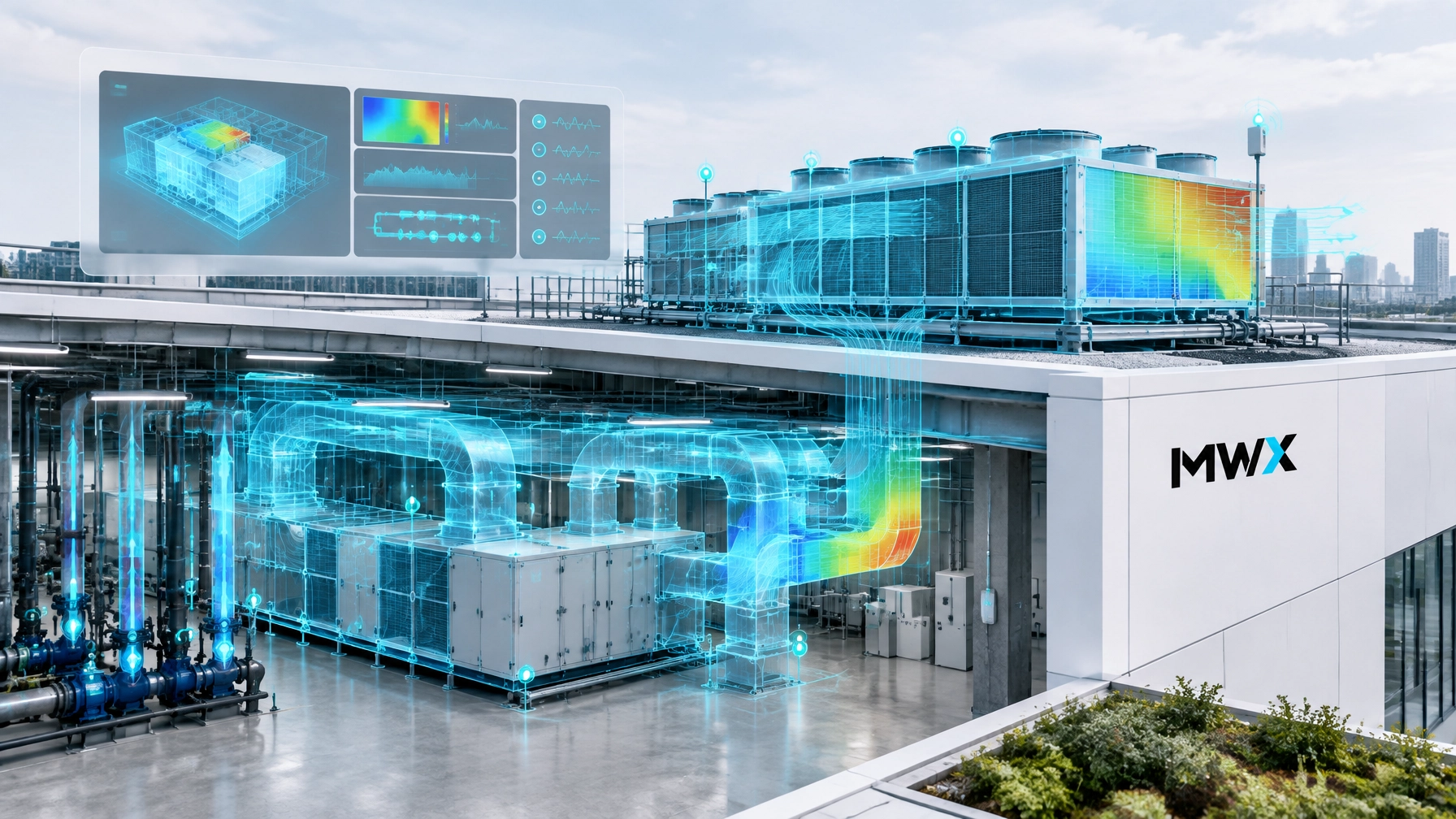
An operator can view HVAC performance within a spatially accurate 3D environment rather than interpreting disconnected charts alone.
The twin can show:
- Which air-handling unit serves a specific zone
- Where temperature or airflow is outside the expected range
- How a fault may affect adjacent spaces
- Which equipment is operating inefficiently
- How a proposed intervention may change system performance
With real-time 3D simulation, teams can test scenarios before implementing them. For example, they can evaluate the effect of changing a supply-air setpoint, isolating an air-handling unit, adjusting a schedule, or redirecting maintenance resources.
This capability is especially valuable in hospitals, airports, ports, luxury developments, and other facilities where an incorrect intervention can affect safety, service continuity, or occupant experience.
3. Human-in-the-loop governance
Automation should improve decisions, not remove accountability from the people responsible for the facility.
MetaWorldX supports human-in-the-loop governance by presenting evidence, confidence levels, operational context, and recommended actions to authorized personnel. Facility managers and engineers remain in control of approvals, overrides, escalation thresholds, and final execution.
This approach creates a practical balance:
- AI continuously monitors complex systems.
- Operators review and validate recommendations.
- Maintenance teams receive prioritized actions.
- Governance policies define what can be automated and what requires approval.
The result is a more trusted form of physical AI: one that combines machine-scale awareness with human judgment.
A representative HVAC fault scenario
Consider a large mixed-use development with several towers, retail areas, parking facilities, and shared mechanical infrastructure.
Over several weeks, the digital twin detects that one air-handling unit is consuming more energy than expected during moderate outdoor temperatures. The BMS shows that supply-air temperature remains within a broad acceptable range, so no critical alarm is generated.
MetaWorldX Physical AI correlates multiple data points:
- Increased fan energy
- Reduced coil temperature differential
- A control valve operating near maximum position
- Slightly elevated humidity in several connected zones
- A gradual increase in occupant comfort complaints
The system identifies a likely combination of coil fouling and valve performance degradation. It then simulates two response options:
- Continue operating until the next scheduled maintenance window
- Schedule a targeted inspection and coil cleaning during a low-occupancy period
The simulation estimates that early intervention will reduce energy waste, lower the risk of comfort disruption, and avoid a more expensive component failure.
The maintenance team receives a prioritized work item with the affected equipment, supporting evidence, and recommended inspection steps. After the intervention, the digital twin verifies whether energy and temperature performance return to the expected baseline.
This is not simply fault detection. It is a closed operational loop: observe, diagnose, simulate, act, and verify.

The operational and financial outcomes
HVAC fault detection creates value across energy, maintenance, reliability, and occupant experience.
| Outcome | How the digital twin contributes |
|---|---|
| Energy savings | Identifies control issues, equipment inefficiencies, schedule errors, and waste before they become normalized. |
| Reduced downtime | Predicts degradation and allows teams to schedule interventions before equipment fails. |
| Extended asset life | Reduces prolonged operation under inefficient or stressful conditions. |
| Fewer service calls | Helps maintenance teams address root causes instead of repeatedly responding to symptoms. |
| Improved comfort | Connects equipment behavior with actual zone conditions and occupant experience. |
| Better capital planning | Provides evidence for repair, replacement, and efficiency investments. |
| Lower emissions | Reduces unnecessary energy consumption and supports sustainability targets. |
The precise return on investment depends on facility size, equipment condition, operating schedules, energy prices, and maintenance practices. For decision-makers, the strongest business case comes from establishing a baseline and tracking measurable indicators such as:
- Energy use per square metre
- Number and duration of HVAC faults
- Comfort complaints
- Emergency maintenance events
- Mean time to repair
- Equipment availability
- Service-call frequency
- Carbon emissions from building operations
The U.S. Department of Energy’s HVAC fault detection datasets and prioritization methods and NIST’s FDD research demonstrate the broader industry movement toward measurable, data-driven building performance.
From smart buildings to resilient infrastructure
HVAC intelligence is one of the most practical physical AI use cases because it addresses a continuous operational challenge with direct financial and environmental consequences.
The same principles extend beyond individual buildings. At an airport such as the Dubai Airport digital twin, real-time operational data and predictive maintenance support the coordination of complex critical infrastructure. In large-scale developments such as NEOM, unified monitoring and scenario planning help command centers manage safety, security, and operational complexity. The Toronto Digital Twin demonstrates how multiple datasets can support broader urban planning and resilience objectives.
These are connected smart city use cases. A building’s HVAC system does not exist in isolation. It affects energy demand, indoor air quality, public health, occupant safety, sustainability performance, and the resilience of the wider infrastructure network.
The building of the future will not merely report what happened. It will understand what is happening, anticipate what comes next, and help people choose the best response.
The next generation of building operations
HVAC fault detection and diagnostics shows how digital twin technology becomes operationally valuable when it is connected to live data, AI, simulation, and human expertise.
MetaWorldX Physical AI transforms a facility from a collection of disconnected systems into an intelligent operational environment. By integrating with existing infrastructure, visualizing performance in 3D, applying predictive and prescriptive analytics, and keeping people involved in governance, it helps organizations move from reactive maintenance to proactive performance management.
For building owners, infrastructure operators, hospitals, airports, ports, and large-scale developers, the opportunity is clear: reduce hidden waste, protect critical assets, and create healthier, more resilient spaces.
Explore the MetaWorldX platform to see how AI digital twins and real-time monitoring and simulation can support smarter building operations.