
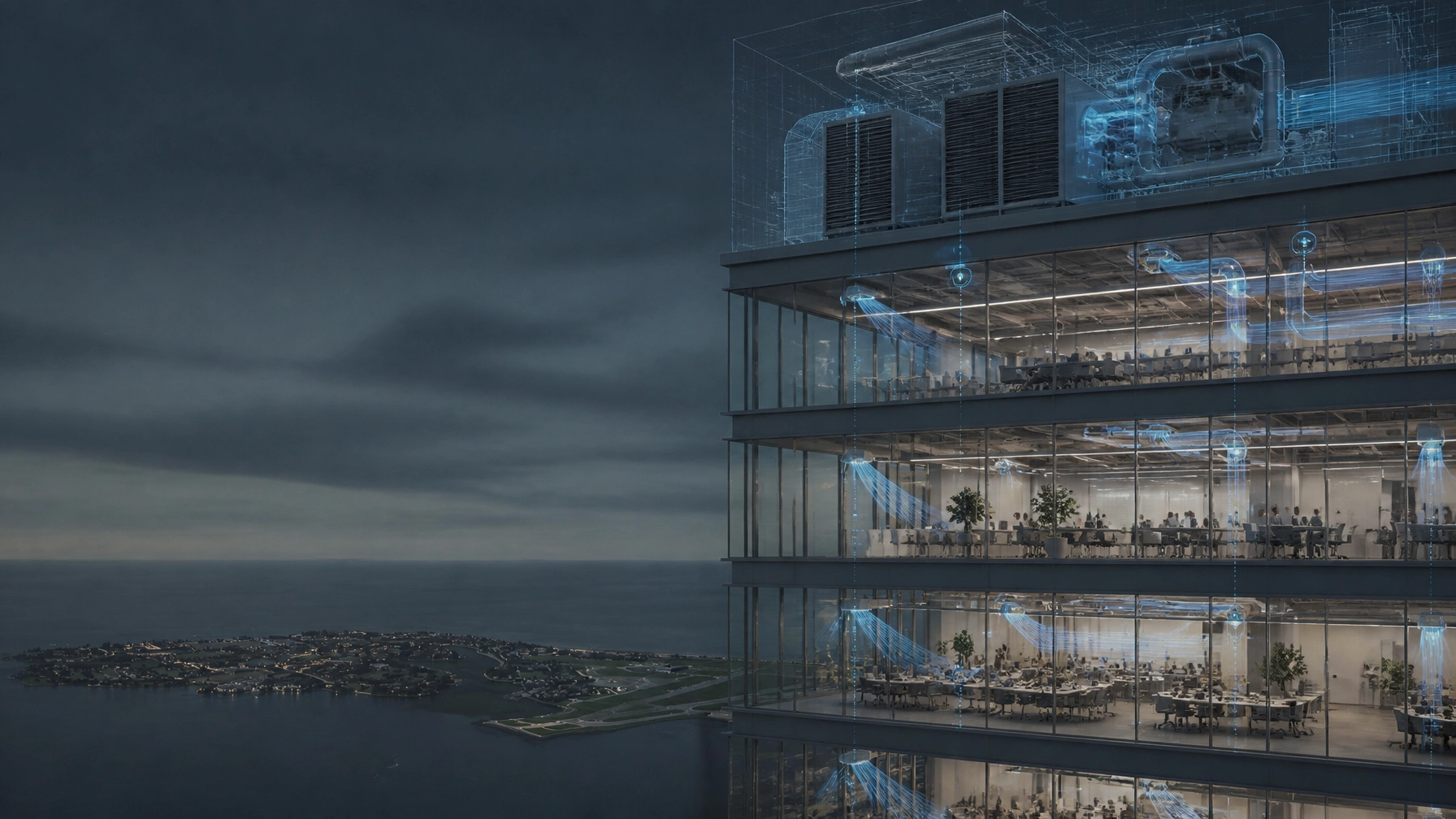
The era of intelligent building operations is here.
Commercial buildings are expected to deliver more: better occupant comfort, healthier indoor environments, lower operating costs, and measurable progress toward sustainability targets. Yet many facilities still manage heating, ventilation, and air conditioning through fragmented systems, fixed schedules, and reactive maintenance.
HVAC remains one of the largest sources of building energy consumption. In many commercial properties, it can represent approximately 30–50% of total energy use, depending on the building type, climate, occupancy, and operating model. The U.S. Department of Energy identifies heating and cooling as a major building energy end use, while the U.S. Energy Information Administration tracks the significant role of building systems in commercial energy demand.
MetaWorldX Physical AI changes this equation by connecting real-world building data to an intelligent, continuously updated AI digital twin. The result is a practical decision and optimization layer that helps facilities teams understand what is happening, predict what will happen next, and determine the most effective action.
The Challenge: HVAC Systems Waste Energy Through Disconnected Decisions
Efficient buildings require more than automation. They require context.
Traditional Building Management Systems (BMS) can monitor temperatures, equipment status, alarms, and energy consumption. However, many systems still operate in isolated zones. They may not fully account for occupancy, weather forecasts, equipment health, energy prices, indoor air quality, or the relationship between one building system and another.
This creates several common sources of HVAC waste:
- Fixed schedules: Air conditioning may continue operating at full capacity after occupancy has declined.
- Inaccurate assumptions: Setpoints may reflect historical routines rather than current building use.
- Simultaneous heating and cooling: Different zones can work against one another because their control logic is not coordinated.
- Reactive maintenance: Fouled filters, stuck dampers, failing sensors, and inefficient chillers may remain undetected until performance deteriorates.
- Limited visibility: Operators may see alarms and data points without understanding their location or wider operational impact.
- Comfort versus efficiency trade-offs: Teams may avoid energy-saving changes because they cannot confidently predict how those changes will affect occupants.
These challenges become more complex in large commercial towers, hospitals, campuses, airports, and mixed-use developments. A single change to a chiller setpoint can affect multiple air handling units, floors, tenants, and peak-demand conditions.
The core problem is not a lack of data. It is a lack of connected intelligence.
How MetaWorldX Physical AI Creates an Intelligent HVAC Control Loop
MetaWorldX Physical AI combines sensing, simulation, prediction, recommendation, and human oversight in one operational framework.
The MetaWorldX digital twin platform can connect building data from IoT devices, meters, sensors, GIS, BIM models, and existing operational systems. This creates a real-time 3D representation of the building and its systems: not simply a static model, but a living operational view.
The process follows four connected stages:
1. Sense: Connect the Building to Its Digital Twin
The platform can integrate with existing BMS infrastructure, HVAC controls, IoT networks, access control systems, and other operational technologies.
Relevant inputs may include:
- Zone temperature and humidity
- CO₂ and indoor air quality readings
- Occupancy and access patterns
- Chiller, boiler, and air handling unit performance
- Fan and pump speeds
- Valve and damper positions
- Energy meters and demand data
- Weather conditions and forecasts
- Maintenance alarms and equipment history
This approach avoids replacing every existing system. Instead, MetaWorldX can provide an intelligence layer across the systems already operating inside the building.
2. Understand: Use Predictive Analytics to Identify What Comes Next
Predictive analytics helps answer a critical operational question: What is likely to happen if current conditions continue?
The AI can identify patterns such as:
- A chiller operating outside its normal efficiency range
- An air handling unit running longer than expected
- A temperature drift that may indicate sensor or damper problems
- Rising energy consumption in a lightly occupied zone
- A likely peak-demand event during a hot afternoon
- A maintenance condition that could lead to reduced performance
Instead of waiting for an equipment failure or a monthly utility bill, facilities teams gain earlier insight into emerging inefficiencies.
3. Simulate: Test Scenarios in a Real-Time 3D Environment
A digital twin makes HVAC decisions easier to understand because operators can see the building spatially.
For example, teams can simulate:
- Raising cooling setpoints in selected zones
- Pre-cooling occupied floors before a known peak period
- Adjusting ventilation based on occupancy and CO₂
- Staging chillers more efficiently
- Reducing airflow in underused areas
- Coordinating HVAC operation with access control and occupancy data
- Evaluating the impact of a planned equipment shutdown
The platform can compare potential outcomes before changes are made in the physical building. This reduces the risk of implementing a control strategy that saves energy in one area but creates comfort, safety, or reliability problems elsewhere.
4. Prescribe and Act: Recommend the Best Operational Response
Predictive analytics explains what is likely to happen. Prescriptive analytics recommends what should happen next.
Depending on governance rules and system configuration, MetaWorldX Physical AI can support actions such as:
- Recommending optimized temperature setpoints
- Adjusting equipment schedules
- Identifying the most efficient chiller sequence
- Prioritizing maintenance work orders
- Suggesting demand-response strategies
- Flagging zones that need operational review
- Passing approved control changes through existing building systems
Every action can remain subject to human-in-the-loop governance. Facilities managers retain authority to review recommendations, approve changes, define operating limits, and override automated decisions when safety, comfort, tenant requirements, or emergency conditions require it.
Physical AI does not remove the operator from the building. It gives the operator better intelligence and more precise control.

A Concrete Example: Optimizing a Large Commercial Tower in Dubai
Consider a high-rise commercial tower in Dubai with extended cooling requirements, variable tenant schedules, retail or hospitality areas, and significant afternoon heat loads.
A conventional HVAC strategy may cool large parts of the building according to fixed schedules. This can result in over-conditioning during low-occupancy periods and excessive energy demand during peak heat.
A MetaWorldX Physical AI workflow could:
- Combine BMS data, occupancy information, access control events, energy meters, weather forecasts, and equipment status.
- Display the tower as a live 3D digital twin, with floor-by-floor thermal and operational conditions.
- Predict which zones will require cooling based on occupancy, solar exposure, tenant schedules, and outdoor conditions.
- Simulate alternative strategies, such as pre-cooling only high-occupancy floors or adjusting supply air temperature.
- Recommend an optimized sequence for chillers, pumps, fans, and air handling units.
- Allow the facilities team to approve the strategy within defined comfort and safety parameters.
- Monitor results in real time and adjust the plan as conditions change.
This operating model is especially relevant to the region’s rapidly developing smart-building and smart-city environments. MetaWorldX’s Dubai Silicon Oasis digital twin project demonstrates how real-time data, centralized dashboards, and digital twin technology can support more efficient and sustainable urban operations. While that project focuses on traffic, parking, and air quality, the same connected intelligence principles apply inside commercial buildings.
The result is a building that can respond dynamically rather than operating according to assumptions made months or years earlier.
Measuring the ROI: Energy, Cost, Carbon, and Comfort
The strongest HVAC business cases connect technical improvements to measurable operational outcomes.
Actual results depend on the building baseline, equipment condition, climate, tariffs, control quality, and implementation scope. However, research and industry benchmarks commonly place advanced controls and analytics in the range of 10–30% HVAC energy savings when properly implemented.
A project team can evaluate value through several measures:
Energy savings
The digital twin can compare actual consumption against historical performance, weather-normalized expectations, and modeled scenarios.
Cost reduction
Lower energy use can reduce utility costs, peak-demand charges, and the cost of emergency maintenance. Prescriptive analytics can also help teams prioritize the interventions with the strongest financial return.
Carbon reduction
Reduced electricity and fuel consumption generally supports lower operational emissions. MetaWorldX can help organizations track energy performance against carbon and ESG objectives.
Equipment life and resilience
More stable equipment operation, earlier fault detection, and better maintenance planning can reduce stress on HVAC assets and improve reliability.
Occupant comfort
Energy optimization should not mean sacrificing comfort. Zone-level monitoring and human governance allow teams to balance efficiency with temperature, ventilation, and indoor air quality requirements.
For example, if a tower spends $1 million annually on HVAC energy, a 15% improvement would represent approximately $150,000 in annual energy savings, before considering maintenance benefits or demand-charge reductions. This is an illustrative calculation: not a guaranteed result: but it shows why HVAC optimization remains one of the most practical smart-building use cases.

Why the Digital Twin Matters Beyond One Building
HVAC optimization is not an isolated facilities-management task. It connects to broader smart city use cases and AI for critical infrastructure.
A building’s energy demand influences:
- District-level electricity planning
- Emergency response and resilience
- Carbon reporting and sustainability programs
- Tenant experience and property value
- Grid-interactive building strategies
- Campus and portfolio-wide operational decisions
In Toronto, for example, MetaWorldX developed a Toronto Digital Twin integrating traffic, air quality, weather, infrastructure, and public safety data. The project illustrates how multiple datasets can be brought together to support predictive planning and coordinated decisions across a complex urban environment.
The same principle applies to a portfolio of smart buildings. Once HVAC data, spatial information, and operational intelligence are connected, decision-makers can compare buildings, identify recurring inefficiencies, and prioritize investment across an entire district or property portfolio.
The building becomes part of a larger, interconnected operational ecosystem.
The Future of Building Management Is Predictive, Prescriptive, and Human-Centred
HVAC optimization represents one of the clearest physical AI use cases because the benefits are both measurable and immediate. Buildings already generate vast amounts of operational data. The next step is turning that data into coordinated, explainable action.
MetaWorldX Physical AI enables this transition through:
- A real-time 3D AI digital twin
- Predictive and prescriptive analytics
- IoT and BMS integration
- Scenario planning before physical intervention
- Compatibility with access control and existing systems
- Real-time monitoring and response
- Human-in-the-loop governance
For commercial towers in Dubai, smart buildings in Toronto, and large-scale developments worldwide, this approach can reduce waste while improving resilience, comfort, and operational confidence.
The future is not a building that simply reacts to temperature changes. It is a building that understands its operating context, anticipates demand, tests possible outcomes, and supports better decisions in real time.
Explore the MetaWorldX Physical AI platform to learn how digital twin technology can help transform building management, energy performance, and the connected environments of tomorrow.
Frequently Asked Questions
What is Physical AI in smart buildings?
Physical AI connects artificial intelligence to real-world environments through sensors, digital models, analytics, and control systems. In a smart building, it can monitor HVAC conditions, predict operational changes, simulate options, and recommend or execute approved actions.
How does an AI digital twin optimize HVAC?
An AI digital twin combines live building data with a 3D model and predictive analytics. It can identify inefficiencies, forecast demand, simulate changes to schedules or setpoints, and recommend strategies that balance energy, cost, comfort, and equipment performance.
Can MetaWorldX integrate with an existing BMS?
MetaWorldX is designed to integrate with existing BMS, IoT, access control, and operational technology environments. This allows organizations to add intelligence and visualization without necessarily replacing their current building infrastructure.
How much energy can smart HVAC optimization save?
Savings vary by building, climate, equipment, and baseline performance. A realistic planning range for advanced controls and analytics is often 10–30% of HVAC energy use, although each project should establish its own measured baseline and verified targets.
Does human oversight remain part of the process?
Yes. Human-in-the-loop governance allows facilities teams to review recommendations, set operational boundaries, approve actions, and intervene when safety, comfort, tenant, or emergency requirements take priority.