
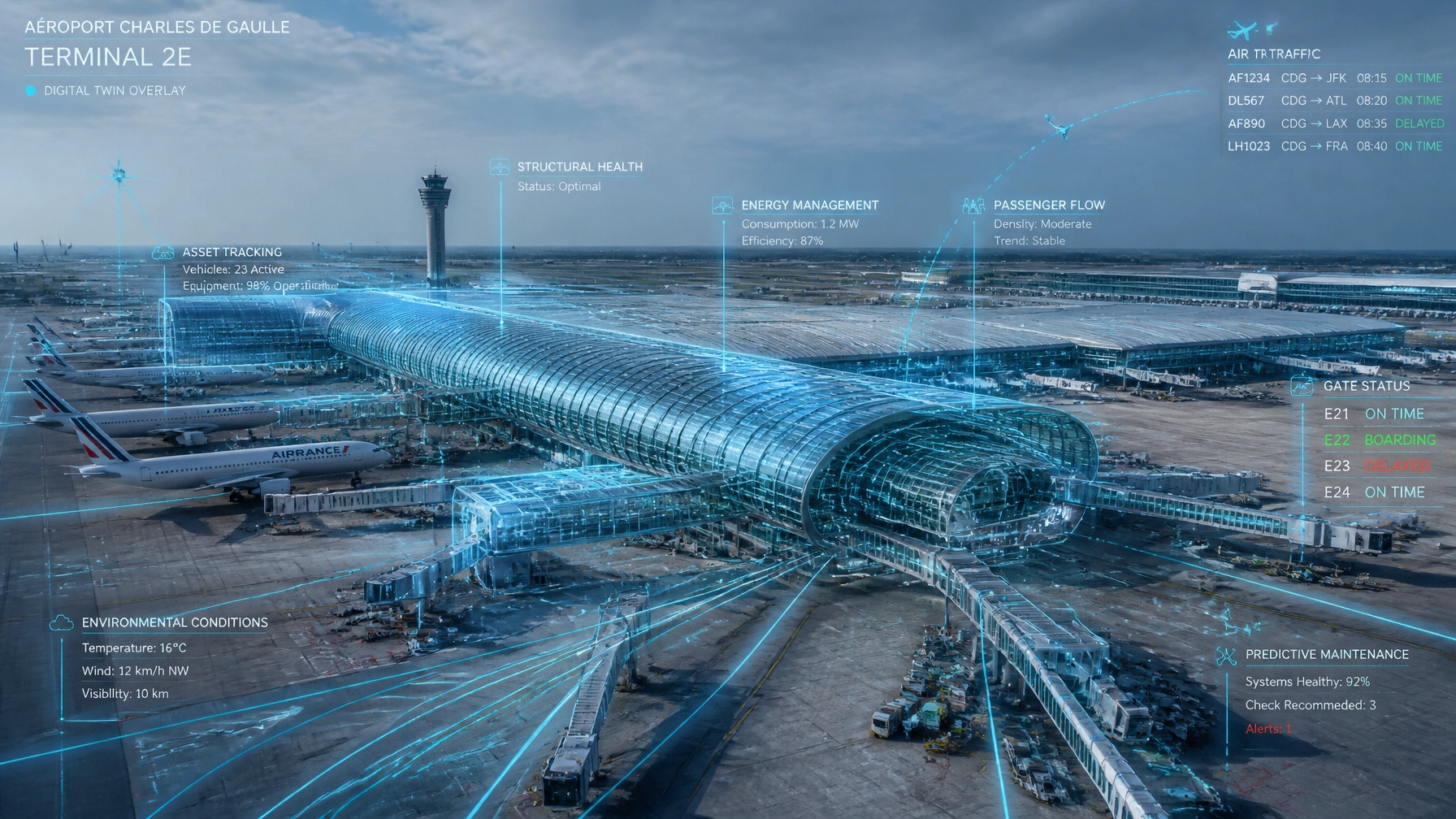
Paris Charles de Gaulle Airport (CDG) is more than just a gateway to the City of Light; it is a sprawling, high-tech megalopolis that serves as Europe’s second-busiest aviation hub. Handling over 72 million passengers annually, it ranks as the 14th busiest airport globally. For the uninitiated, its complex web of circular terminals and sub-terminal clusters can be daunting. However, with the right strategy: and a look at the AI digital twin technology currently transforming its operations: you can navigate this massive facility with the precision of a seasoned traveler.
The era of virtual cities is here, and CDG is at the forefront of this digital revolution. In this guide, we break down the physical layout of CDG and pull back the curtain on the critical infrastructure solutions that keep one of the world's most complex environments running smoothly.
Mastering the CDG Layout: A Terminal Breakdown
Navigating CDG requires understanding its three primary hubs. Each serves distinct purposes and requires different transit strategies.
Terminal 1: The Circular Classic
The original terminal, T1 is a circular marvel of 1970s avant-garde architecture. Check-in and baggage claim are located in the central building, while seven satellite boarding halls are reached via underground walkways. It primarily hosts Star Alliance carriers like United, Lufthansa, and Singapore Airlines.
Terminal 2: The Main Event
Terminal 2 is the largest and most complex hub, divided into seven sub-terminals (2A through 2G).
- 2A to 2F: These terminals are interconnected by elevated walkways and are generally walkable, though distances can be significant.
- 2G: This is a remote satellite terminal used mainly for regional flights. It is only accessible via the N2 shuttle bus from Terminal 2F.
Terminal 3: The Budget Hub
A compact, single-level building dedicated to low-cost and charter airlines. Unlike the other terminals, passengers are often bussed directly to the aircraft.
Moving Between Hubs: The CDGVAL
The CDGVAL is a free, automated light-rail shuttle that is essential for inter-terminal movement. It connects Terminal 1, Terminal 3 (Roissypôle), and Terminal 2. The train runs every 4 minutes during peak hours, ensuring seamless connectivity between the smart building environments of the various terminals.
Timing and Security: The 2-3 Hour Rule
Given the scale of CDG, time management is your greatest asset. We recommend arriving at least 3 hours before international long-haul flights and 2 hours for European departures.
PARAFE e-Gates
To expedite your journey through border control, look for the PARAFE e-gates. These automated kiosks use biometric technology to process eligible travelers (including EU and certain international passport holders) in seconds. By automating the identity verification process, CDG reduces bottlenecks, a key goal in any public health and safety strategy for high-traffic environments.
The TGV Station Locator
CDG is unique in that it houses a major high-speed rail station directly within the airport. The Aéroport Charles de Gaulle 2 TGV station is located in Terminal 2, positioned between sub-terminals 2C/2D and 2E/2F. Look for signs marked "Gare SNCF" to find your platform.

Ground Transportation: Moving Beyond the Tarmac
Getting from the airport to central Paris: or elsewhere in Europe: is streamlined through a variety of transit options:
- RER B (Suburban Rail): The fastest public transport link to central Paris, stopping at both Terminal 3 (Roissypôle) and Terminal 2.
- TGV (High-Speed Rail): Connects CDG directly to cities like Lyon, Marseille, and even Brussels without entering Paris.
- Roissybus: A dedicated shuttle service providing a direct link between the Opéra district and all terminals.
- Taxis and Private Services: Official taxi ranks are available outside all arrivals levels. We recommend booking authorized car services in advance for a more personalized experience.
Dining and Lounges: The Height of Parisian "Bistronomy"
CDG offers a culinary experience that rivals the city itself. For those seeking luxury, the Air France La Première Lounge in Terminal 2E remains the gold standard of airport hospitality.
Travelers can also enjoy "bistronomy": high-end bistro cooking: at venues like Les Saisons or the sophisticated Le Relais Plaza. For those on the move, Michelin-starred chef Yves Camdeborde has curated menus for Air France that bring the flavors of Paris directly to the terminal, proving that airport dining can be an integral part of the journey rather than a mere necessity.
Behind the Scenes: The MetaWorldX AI Digital Twin Powering CDG
While passengers see the elegant architecture and gourmet dining, a sophisticated digital ecosystem is working tirelessly behind the scenes. At MetaWorldX, we specialize in the AI digital twin technology that makes hubs like CDG possible.
The integration of a MetaWorldX smart airport framework allows operators to visualize and manage the facility in real-time.
AI for Airport Operations
Using video and thermal analytics, the digital twin monitors aircraft turnaround. By tracking fuel trucks, baggage loaders, and catering services in a 3D virtual environment, the system identifies delays before they occur. This real-time monitoring ensures that every minute on the tarmac is optimized for efficiency.
Predictive Maintenance with Siemens SmartService 360
Equipment failure is not an option in a 24/7 hub. By integrating Siemens SmartService 360 with a digital twin, CDG can move from reactive to predictive maintenance. Whether it is a critical HVAC system in Terminal 2E or the complex baggage conveyors, sensors feed data into the twin, allowing technicians to fix components before they break.
AI Airport Security & Passenger Flow
The safety of 72 million people requires more than just cameras. AI airport security modules within the digital twin analyze passenger flow and density. Heatmaps identify crowded zones in real-time, allowing staff to redistribute resources to PARAFE gates or security checkpoints, ensuring a smooth and safe transit experience.

Seamless Baggage Handling
A digital twin for airport operations transforms baggage handling from a logistics challenge into a data-driven science. By simulating the entire journey of a suitcase through miles of conveyors, AI can predict bottlenecks and reroute baggage paths to ensure that your luggage reaches its destination as quickly as you do.
The Future of Aviation Infrastructure
Navigating Paris Charles de Gaulle "like a pro" is about more than just knowing which shuttle to take; it is about understanding the synergy between physical space and digital intelligence. The innovations seen today: from AI-driven security to predictive maintenance: are just the beginning.
At MetaWorldX, we are proud to be at the forefront of this transformation. We empower cities and industries to make smarter, more impactful decisions through comprehensive 3D simulations and real-time monitoring. The era of virtual cities is here, and it is making our physical world safer, more sustainable, and infinitely more efficient.
Are you ready to transform your infrastructure? Explore MetaWorldX's Digital Twin solutions and see how we are building the interconnected world of tomorrow.
