
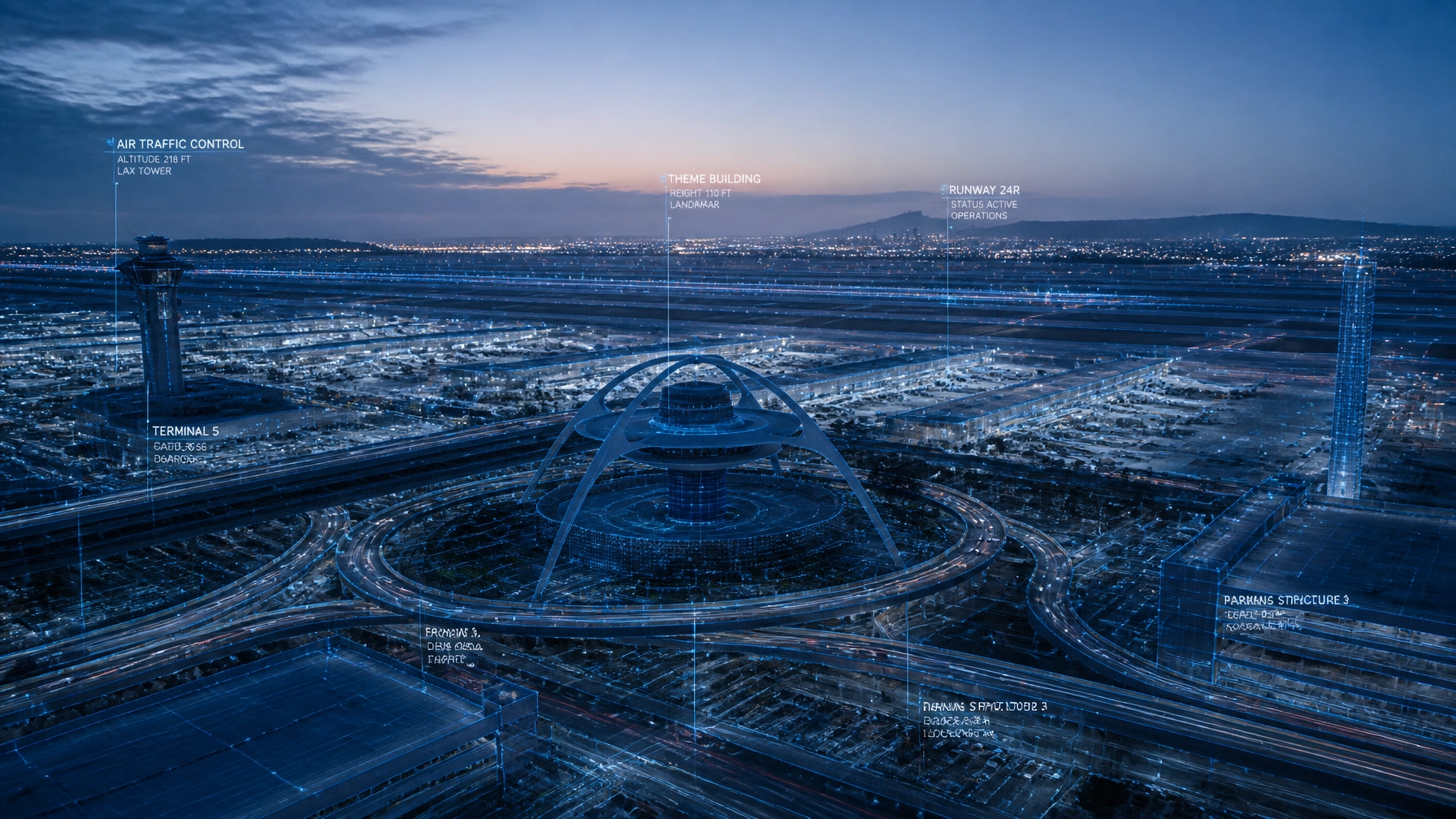
Los Angeles International Airport (LAX) is more than just a transportation hub; it is the primary gateway to the Pacific Rim and a cornerstone of global aviation. Ranked as the 13th busiest airport in the world, handling over 73.7 million passengers annually, LAX can feel like a sprawling labyrinth to the uninitiated. However, behind the scenes of its nine terminals, a digital revolution is taking place.
The modern traveler no longer needs to fear the "horseshoe." With recent airside connectivity improvements and the integration of cutting-edge AI digital twin airports technology, navigating LAX has become a data-driven science. At MetaWorldX, we are at the forefront of this transformation, providing the predictive and prescriptive analytics that turn chaotic hubs into seamless smart cities.
Mastering the LAX Layout: The Terminal Horseshoe
The layout of LAX is famously arranged in a U-shaped horseshoe, consisting of nine terminals. Understanding this geography is the first step to a stress-free experience.
- Terminal B (TBIT): The Tom Bradley International Terminal is the crown jewel of LAX, situated between Terminals 3 and 4. It handles the majority of international arrivals and departures.
- Airside Connectivity: As of 2026, all nine terminals are connected airside. This means ticketed passengers can walk from Terminal 1 all the way to Terminal 8 without ever leaving the secure area or reclearing TSA.
- The 2-Mile Walk: A full trek from T1 to T8 is approximately 2 miles and typically takes between 35 to 45 minutes.
For those connecting between domestic and international flights, the "Delta Sky Way" bridge connects Terminal 3 directly to TBIT, while a similar connector links TBIT to Terminal 4 (American Airlines). These corridors feature moving walkways and vibrant digital art installations, making the transition between terminals both efficient and visually engaging.
Timing and Security: The Professional’s Timeline
Success at LAX is a matter of timing. The airport experiences two primary peak periods: 6:00 AM – 9:00 AM and 4:00 PM – 7:00 PM. During these windows, wait times for security and ground transportation can spike significantly.
- Arrival Recommendations: Arrive at least 2 hours before domestic flights and 3 hours before international departures.
- Security Fast-Tracks: To bypass standard queues, TSA PreCheck and CLEAR are highly recommended. These services are available in nearly all terminals and can reduce wait times from 30 minutes to under five.
- The LAX-it Lot: Remember that rideshare pickups (Uber, Lyft) and taxis do not happen at the terminal curbside. You must take the free green shuttle or walk to the LAX-it lot located next to Terminal 1.
Ground Transportation and Future Infrastructure
Navigating the roads around LAX has historically been the greatest challenge for travelers. While the much-anticipated Automated People Mover (APM): a train system designed to link terminals to parking and the Metro: is a centerpiece of LAWA’s modernization, as of July 2026, it remains in the final testing phase and is not yet open to passengers.
In the interim, the FlyAway bus remains the gold standard for public transit, offering direct service to Union Station and Van Nuys. For those utilizing the Los Angeles Metro, the C and K Lines are accessible via a free shuttle from the lower level of each terminal.
The Traveler’s Edge: Where to Dine and Unwind
While waiting for a flight, LAX offers some of the best airport concessions in the United States. TBIT’s Great Hall is a destination in itself, featuring luxury retail and global cuisine.
- Top Dining Picks:
- Native by Nyesha (T3) – Elevated California soul food.
- Fat Sal’s (T3) – Famous, over-the-top sandwiches.
- Yakumi (T3) – High-quality, fast-casual sushi.
- Premium Lounges: For those with lounge access, the Amex Centurion Lounge (TBIT) and the Star Alliance Lounge (TBIT): which features a stunning outdoor terrace: are the top choices. United passengers should seek out the United Polaris Lounge (T7) for a quiet, luxury experience.

Behind the Scenes: The MetaWorldX AI Digital Twin Powering LAX
While passengers enjoy the amenities, MetaWorldX technology is working behind the scenes to ensure the entire ecosystem functions with surgical precision. The complexity of LAX requires more than just reactive management; it requires a MetaWorldX digital twin.
An AI digital twin is a high-fidelity virtual replica of the airport that integrates real-time IoT data, flight schedules, and passenger flow metrics. This "virtual airport" allows operators to see the invisible: identifying bottlenecks before they happen and optimizing every facet of the operation.
1. AI for Airport Operations & Traffic Optimization
LAX uses digital twin technology to manage the intricate dance of ground traffic. By simulating shuttle coordination and vehicle volume in the horseshoe, MetaWorldX smart airport solutions help reduce congestion on the world’s busiest airport loop. This extends to the airfield, where digital twins optimize gate allocation to minimize taxi times and fuel consumption.
2. Predictive Maintenance & HVAC Efficiency
Airports are massive energy consumers. Through MetaWorldX’s critical infrastructure solutions, LAX can monitor the health of thousands of assets: from baggage handling belts to massive HVAC systems.
- Asset Management: Instead of waiting for a jet bridge or air conditioning unit to fail, predictive sensors alert maintenance teams to anomalies weeks in advance.
- Energy Savings: The digital twin adjusts climate control in real-time based on terminal occupancy, significantly reducing the airport's carbon footprint.

3. Enhancing AI Airport Security & Passenger Flow
Security is the top priority at Hollywood’s gateway. AI airport security integration allows for sophisticated passenger flow analysis. By monitoring queue densities at TSA checkpoints via the digital twin, airport staff can dynamically reassign personnel or redirect passengers to less-crowded terminals through the airside walkways. This data-driven approach ensures that security is both robust and efficient, maintaining safety without compromising the traveler experience.
4. Seamless Baggage Handling
Few things disrupt a journey like lost luggage. MetaWorldX’s integration with baggage handling systems creates a transparent data ecosystem. By tracking every bag through a digital replica of the conveyor network, the airport can identify mechanical "hiccups" and reroute luggage instantly, ensuring that 73 million passengers remain reunited with their belongings.
The Era of Virtual Cities is Here
The transformation of LAX is a testament to the power of digital twin technology airports. By merging the physical and digital worlds, we are enabling airport operators to make smarter, more impactful decisions that enhance safety, efficiency, and sustainability.

LAX is no longer just a place where you catch a flight; it is a living, breathing example of how AI-driven simulations can revolutionize urban infrastructure. Whether it's through optimizing the energy of a smart building or managing the flow of an entire city, the goal remains the same: a more interconnected and efficient world.
The next time you walk the airside corridor from Terminal 3 to TBIT, know that there is a digital twin watching over your journey, ensuring that every gear, every sensor, and every gate is perfectly synchronized for your arrival.
Are you ready to bring visionary digital twin technology to your city or infrastructure project? Explore how MetaWorldX is redefining the future of smart cities and critical infrastructure.