
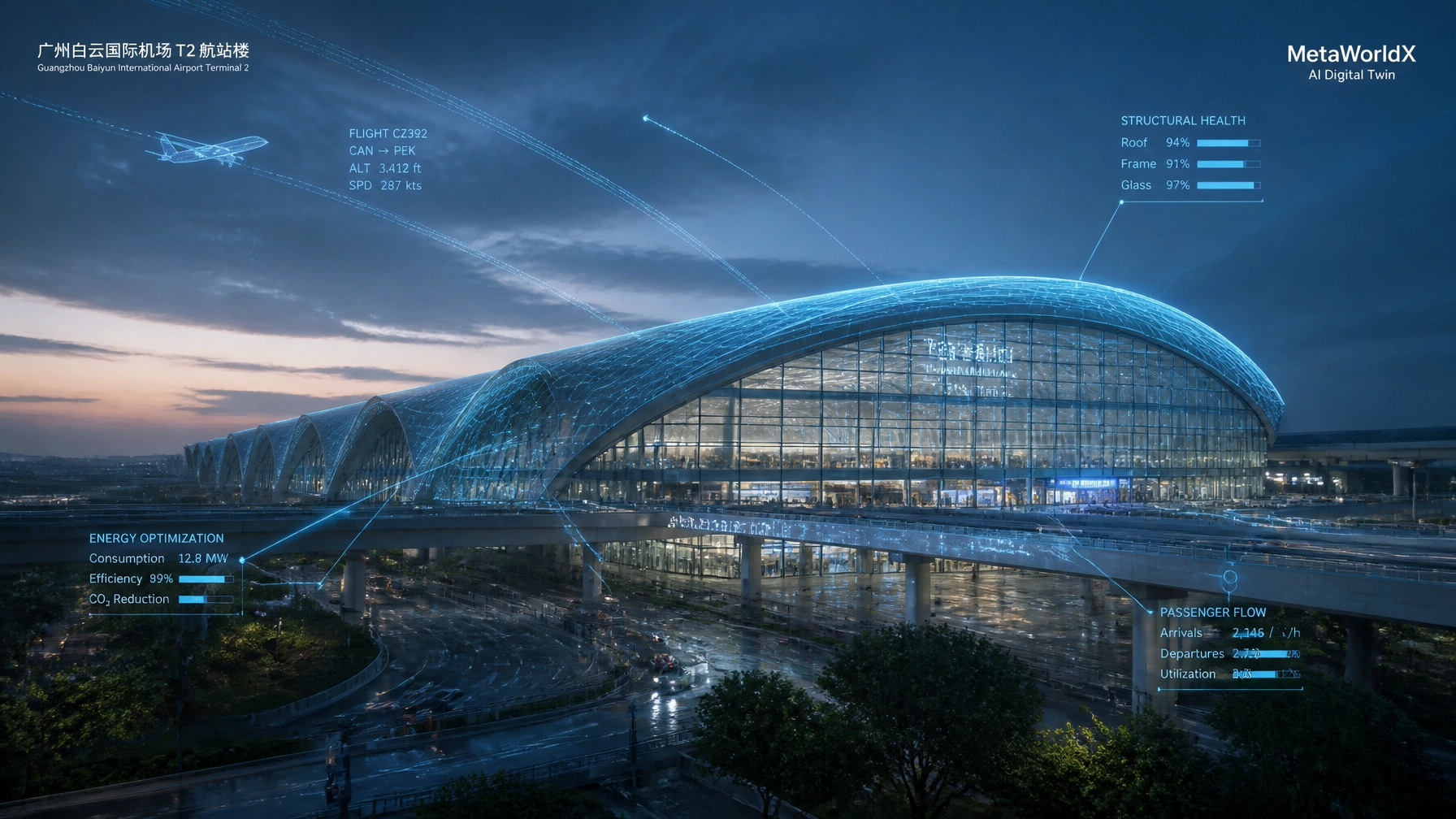
Guangzhou Baiyun International Airport (CAN) is more than just a transit point; it is a vital organ in the economic body of the Greater Bay Area. As the ninth busiest airport in the world, CAN serves as the primary gateway to Southern China, handling tens of millions of passengers annually. Navigating a facility of this scale requires more than just a boarding pass: it requires a strategy.
While travelers focus on gate numbers and flight times, a quiet revolution is happening behind the scenes. The next generation of airport management is shifting from reactive systems to proactive, AI-driven environments. At MetaWorldX, we are at the forefront of this transformation, developing AI digital twins that allow mega-hubs like Guangzhou to optimize every square meter of their infrastructure.
Navigating the Hub: T1, T2, and the Future T3
Guangzhou Baiyun is currently structured around two massive operational terminals, with a third on the horizon. Understanding which terminal governs your journey is the first step to a stress-free experience.
- Terminal 1 (Airport South): This is the original powerhouse of the airport. While it predominantly handles domestic flights, it still hosts several international carriers. It is connected to the city via the "Airport South" Metro station.
- Terminal 2 (Airport North): The crown jewel of CAN, Terminal 2 is the primary hub for China Southern Airlines and its major international partners (SkyTeam). It is designed with a more intuitive flow, concentrating many transfer facilities on the second floor. It is served by the "Airport North" Metro station.
- Terminal 3 (Under Development): Currently under construction, T3 represents the future of CAN’s expansion. Once complete, it will integrate with Metro Line 22, further cementing Guangzhou’s status as a global aviation leader.
The era of virtual cities is here. By mirroring these physical structures in a digital environment, airport operators can visualize complex passenger movements before they even happen.

Seamless Connectivity: Transfers and Transit
Moving between terminals at an airport that spans over 1.4 million square meters can be daunting. Fortunately, CAN offers several efficient ways to bridge the gap between T1 and T2.
Free Inter-Terminal Shuttle (Metro Line 3)
The most reliable method during daylight hours is the Metro. A dedicated one-stop shuttle runs between Airport South (T1) and Airport North (T2).
- Ride Time: Approximately 2 minutes.
- Interval: Every 5–6 minutes.
- Cost: Completely free for inter-terminal transfers.
24/7 Shuttle Bus
For those arriving late at night or carrying oversized luggage, a free shuttle bus operates around the clock. You can find boarding points at Gates 10/11/12 in T1 and Gate 42 in T2. Allow roughly 10–15 minutes for this journey.
Reaching Downtown Guangzhou
Metro Line 3 is the "lifeline" of the airport, reaching the central business districts of Tianhe and Zhujiang New Town in approximately 45–50 minutes. It is the most cost-effective and predictable way to enter the city, avoiding the unpredictable traffic of the North Second Ring Expressway.
Professional Travel Tips: Security, Payments, and Timing
To move through CAN like a seasoned professional, you must adhere to the specific operational standards of Chinese aviation.
- Arrival Windows: Arrive at least 2 hours early for domestic flights and 3 hours early for international departures. The scale of the terminals means walking distances to gates can be significant.
- Transfer Buffers: For international-to-domestic transfers, allow a minimum of 2.5 to 3.5 hours. This accounts for health declarations, immigration, and potential terminal changes.
- The Digital Wallet: Cash and international credit cards are often secondary to WeChat Pay and Alipay. Ensure these apps are set up and linked to a card before you land; they are essential for everything from coffee to metro tickets.
- Strict Security: China maintains rigorous security protocols. All liquids must be in containers of 100ml or less, and power banks must be in carry-on luggage, never in checked bags.
The MetaWorldX Advantage: AI Digital Twins in Mega-Hubs
At MetaWorldX, we believe that managing a mega-hub like Guangzhou Baiyun shouldn't rely on guesswork. Our Critical Infrastructure solutions leverage AI for airport operations to create a living, breathing model of the facility.

Optimizing Passenger Flow
Using an AI digital twin, operators can simulate "what-if" scenarios. If three international wide-body jets land simultaneously at T2, the digital twin predicts the exact bottleneck at immigration. This allows for the proactive reallocation of staff, reducing wait times and enhancing the passenger experience.
Baggage Handling and Logistics
Baggage systems are the unsung heroes of airport efficiency. MetaWorldX technology integrates IoT sensors across the conveyor network to monitor the health of the system in real-time. By applying predictive maintenance, we can identify a failing motor in the T1-to-T2 transfer tunnel before it causes a system-wide shutdown.
Security Integration
AI airport security is about more than just cameras; it’s about data synthesis. Our platform integrates with existing Chinese PSIM (Physical Security Information Management) systems to provide a unified "Single Pane of Glass" view. This enables faster decision-making and more coordinated responses to security incidents across the massive 1.4M sqm facility.
Moving Beyond BMS: The Predictive Airport
Traditional Building Management Systems (BMS) and SCADA are reactive; they tell you when something is broken. A MetaWorldX smart airport is prescriptive; it tells you how to optimize.
- HVAC Efficiency: Airports are massive energy consumers. Digital twins analyze outdoor temperatures, passenger density, and flight schedules to adjust cooling in real-time, significantly reducing carbon footprints.
- Infrastructure Resilience: For hubs like CAN, infrastructure longevity is key. Digital twins track the structural health of runways and terminal foundations, ensuring that maintenance is performed precisely when needed, minimizing operational downtime.
Our experience with projects like the Dubai Airport Digital Twin has proven that integrating real-time data with 3D simulations transforms complex information into actionable insights. This is the next evolution for airports moving beyond traditional silos of data.

Conclusion: Engineering a Smarter Journey
Navigating Guangzhou Baiyun (CAN) successfully is a blend of practical knowledge and advanced infrastructure. Whether you are catching the Metro Line 3 to the CBD or transferring between T1 and T2, the efficiency of your journey is increasingly supported by the invisible hand of AI.
At MetaWorldX, we are dedicated to making the world’s most complex spaces more interconnected, sustainable, and efficient. The technology powering the future of Southern China's mega-hub is the same technology we use to build Smart Cities globally.
Are you ready to transform your infrastructure into a predictive powerhouse? Explore our Digital Twin solutions today and see how we can help you make smarter, more impactful decisions for a rapidly changing world.