

Running an airport command center has never been more complex. Between managing passenger flows, coordinating ground crews, monitoring security threats, and keeping flights on schedule, your operations team juggles countless variables every single day. Traditional systems often leave you reacting to problems instead of preventing them.
AI digital twins are changing that dynamic entirely. These intelligent virtual replicas of your airport ecosystem pull real-time data from every corner of your operation, giving your command center unprecedented visibility and predictive capabilities. The result? Fewer surprises, faster responses, and smoother operations across the board.
This guide breaks down exactly how to integrate AI digital twins with your existing airport command center: step by step, without the technical jargon overload.
What Exactly Is an AI Digital Twin?
An AI digital twin creates a living, breathing virtual replica of your entire airport. It continuously ingests data from IoT sensors, cameras, operational databases, flight systems, and external sources like weather feeds. Unlike static dashboards or legacy monitoring tools, digital twins learn and adapt over time.
Think of it as having a real-time simulation running 24/7 that mirrors everything happening at your airport. When a gate assignment changes, the digital twin reflects it instantly. When passenger volumes spike at security, you see it in the simulation before lines start backing up in the physical world.
The "AI" component takes this further by analyzing patterns, predicting issues, and recommending actions before problems escalate.

Why Your Command Center Needs This Upgrade
Airport operations teams face a fundamental challenge: most systems were built to monitor individual functions in isolation. Baggage handling has its system. Security has another. Gate management runs on something else entirely.
AI digital twins unify these siloed data streams into a single source of truth. Your command center gains:
- Predictive visibility: Anticipate flight delays, gate conflicts, and resource bottlenecks before they disrupt operations
- Scenario modeling: Test staffing changes, gate reassignments, or emergency protocols in a risk-free virtual environment
- Collaborative decision-making: Unite airlines, ground handlers, and air traffic control with shared situational awareness
- Real-time coordination: Respond to changing conditions with full context, not fragmented information
Airports implementing digital twin command centers report 30-40% reductions in unexpected operational delays. That translates directly to happier passengers, lower costs, and fewer stressed-out team members.
Phase 1: Build Your Data Foundation
Every successful digital twin integration starts with data. You cannot simulate what you cannot measure.
Start With High-Impact Areas
Focus your initial sensor deployment and data integration on zones where real-time visibility delivers immediate operational value:
- Baggage handling systems: Track luggage from check-in through loading
- Security checkpoints: Monitor throughput rates and queue lengths
- Gate operations: Capture aircraft positioning, boarding progress, and turnaround times
- Parking and curbside areas: Measure vehicle flows and congestion patterns
Integrate Existing Systems
Your airport already runs dozens of operational systems. The goal is not to replace them but to connect them. Priority integrations typically include:
- Flight Information Display Systems (FIDS)
- Access control and security platforms
- Maintenance management databases
- Weather data feeds
- Airline operational systems
Establish Baselines and Alerts
Before your digital twin can predict problems, it needs to understand normal operations. Work with your team to define performance baselines for key metrics: average security wait times, typical gate turnaround durations, standard passenger flow rates during peak hours.
Then configure automated alerting thresholds so your command center receives notifications when metrics deviate from expected ranges.

Phase 2: Structure Your Unified Command Center
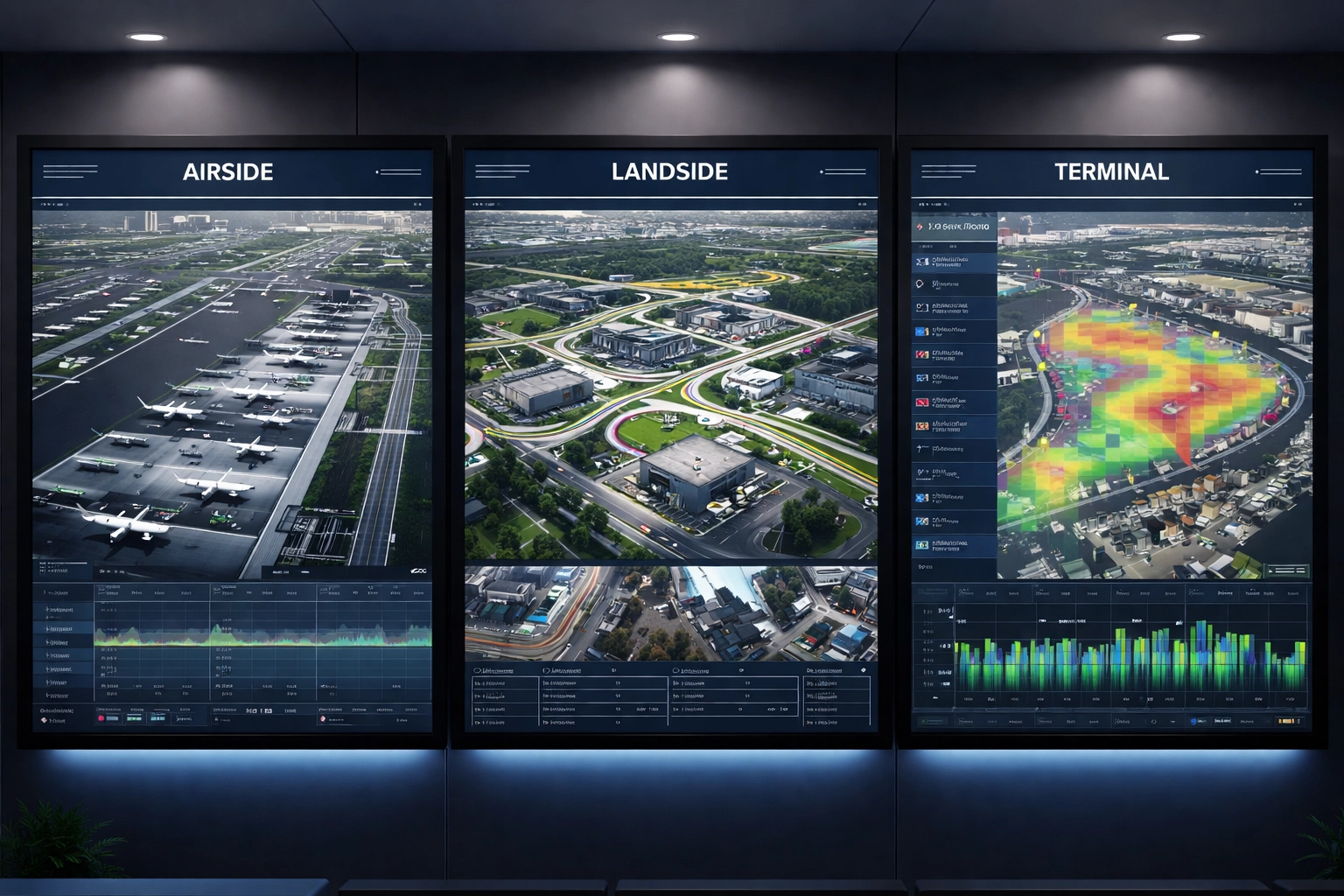
With data flowing into your digital twin platform, the next step is organizing that information for operational decision-making. Most airports benefit from structuring their command center view around three operational domains.
Airside Operations
This domain covers everything happening on the tarmac and runways:
- Real-time runway utilization and sequencing
- Gate assignments and aircraft positioning
- Ground service equipment tracking
- Weather impact monitoring and forecasting
Your digital twin should display current status while also projecting forward: showing where conflicts or delays are likely to emerge in the next 30, 60, or 90 minutes.
Landside Operations
Landside encompasses everything outside the terminal:
- Vehicle traffic patterns and congestion points
- Parking facility capacity and availability
- Pickup and drop-off zone utilization
- Ground transportation coordination
Integrating landside data helps your command center identify when passenger arrivals might overwhelm terminal capacity before it happens.
Terminal Operations
The terminal domain ties airside and landside together:
- Passenger flow through security and customs
- Retail and concession area density
- Gate hold room occupancy
- Wayfinding and crowd distribution
When all three domains feed into a unified digital twin, your command center sees the complete picture: how a delayed inbound flight affects gate availability, which impacts boarding times, which changes security throughput requirements.
Phase 3: Train Your Operations Team
Technology alone does not transform operations. Your team needs to understand how to interpret digital twin data and act on its insights.
Interface Training
Ensure every command center staff member can navigate the digital twin platform confidently. Cover core functions like:
- Viewing real-time operational status across all domains
- Setting up custom alerts for their area of responsibility
- Accessing historical data for trend analysis
- Generating reports for shift handoffs
Scenario Simulation Practice
One of the most powerful digital twin capabilities is running "what-if" simulations. Train your team to use this feature regularly:
- Model the impact of gate reassignments before making changes
- Test emergency response protocols in the virtual environment
- Simulate peak traffic scenarios to optimize staffing levels
Regular practice with simulations builds confidence and improves response times when real situations arise.
Cross-Functional Coordination
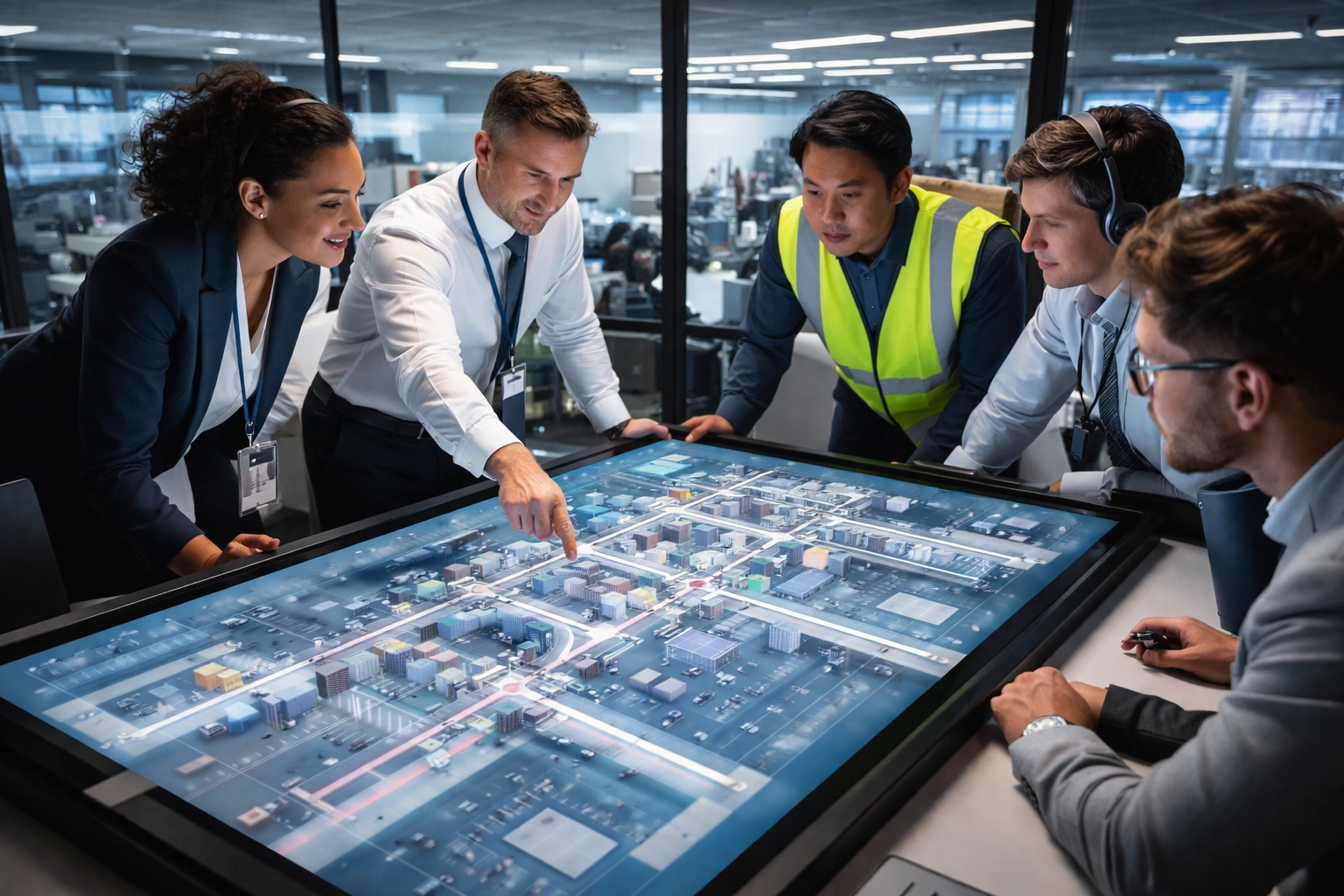
Digital twins enable collaborative decision-making across traditionally siloed teams. Establish protocols for how different stakeholders: airlines, ground handlers, security, retail operators: access and contribute to the shared operational picture.
Quick Wins for Immediate Impact
Not every feature needs to launch simultaneously. Prioritize capabilities that demonstrate value quickly to build organizational momentum.
Intelligent Crowd Management
Deploy real-time passenger flow analytics at security checkpoints and boarding gates. Use the data to dynamically adjust lane openings and staffing: reducing wait times without adding headcount.
Flow and Queue Analytics
Identify bottlenecks in your terminal layout through heat mapping and dwell time analysis. Small adjustments to signage or queue configurations often yield significant throughput improvements.
Smart Traffic Monitoring
Connect your digital twin to curbside and parking sensors. Give your command center early warning when congestion builds, allowing proactive communication with ground transportation providers.
Dispatch Integration
Link your digital twin directly to emergency dispatch systems. When incidents occur, responders instantly access relevant maps, camera feeds, and asset locations: cutting response times significantly.
Expected Outcomes
Once your digital twin integration matures, your command center will operate fundamentally differently. Instead of managing crises, your team will prevent them.
Improved Aircraft Turnaround Times
Real-time resource coordination means ground crews, fuel trucks, and catering arrive precisely when needed: not too early (wasting time) or too late (causing delays).
Dynamic Staffing Optimization
Predictive passenger volume forecasting enables you to right-size staffing levels throughout the day, reducing overtime costs while maintaining service levels.
Weather Disruption Mitigation
Early warning systems integrated with weather data help your team proactively adjust schedules, communicate with passengers, and reallocate resources before storms hit.
Enhanced Safety and Compliance
Predictive security monitoring identifies anomalies before they become incidents. Regulatory changes can be modeled in the digital twin to ensure smooth implementation.
Getting Started
The key to successful integration is starting focused and expanding systematically. Begin with data integration in one or two high-impact operational areas. Prove the value, train your team, then extend the platform across your airport.
At MetaWorldX, we specialize in helping airports and smart city operators implement AI digital twin solutions that deliver measurable results. Explore our projects to see how organizations are transforming their operations through intelligent digital twin platforms.
The future of airport operations is predictive, collaborative, and unified. Your command center can get there( one phase at a time.)