
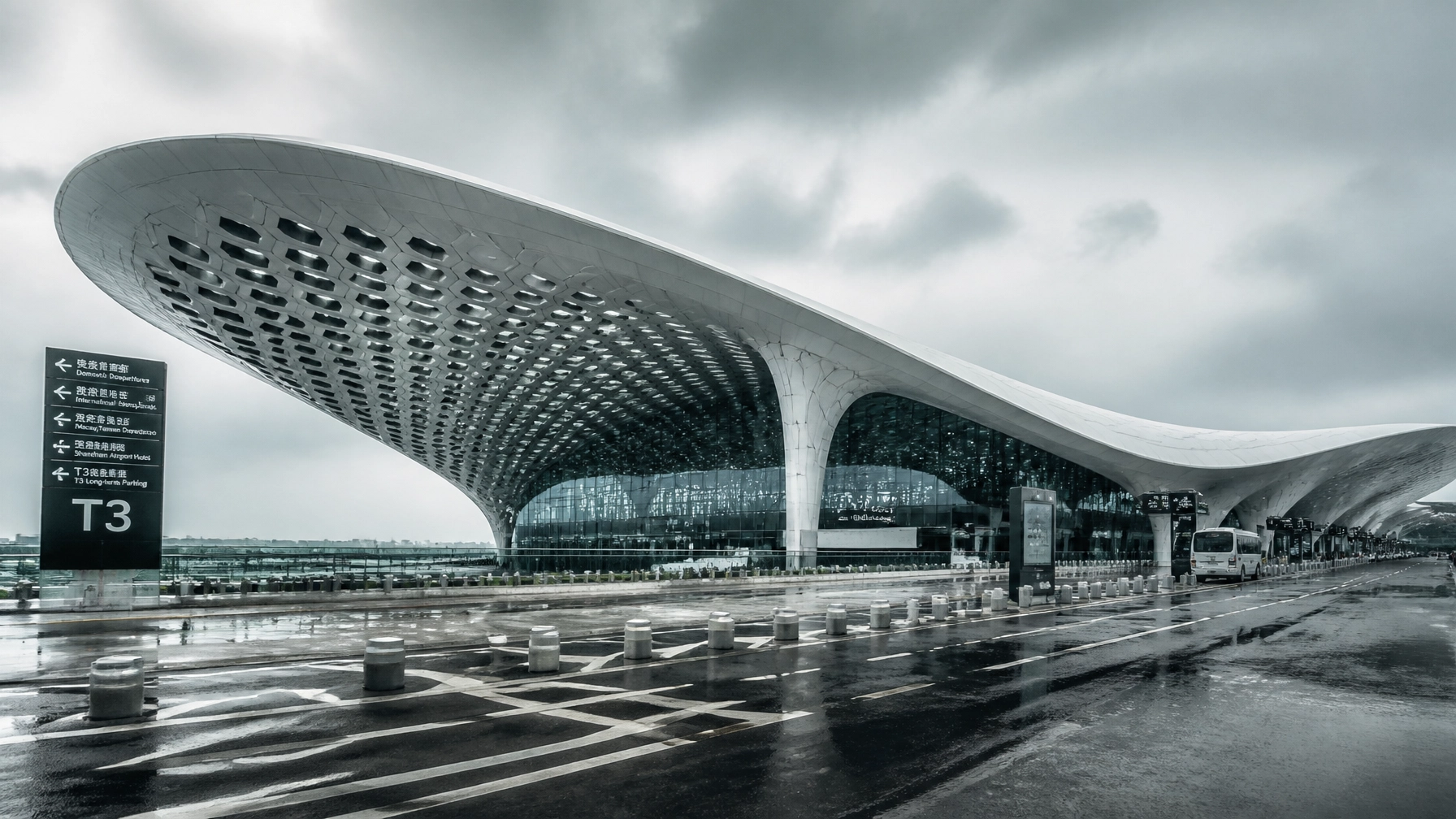
As China’s reigning capital of hardware innovation, electronics, and software development, Shenzhen demands an aviation gateway that matches its futuristic skyline. Enter Shenzhen Bao'an International Airport (SZX): an architectural masterpiece and one of the most technologically advanced aviation hubs in the world. Whether you are arriving for a tech conference in Nanshan, exploring hardware factories in Bao'an, or connecting to Hong Kong via high-speed rail, mastering this mega-hub requires both local insight and an understanding of the cutting-edge systems running behind the scenes.
In this comprehensive guide, we unpack the terminal layout, transit secrets, and the invisible technological backbone: including digital twin technology airports and AI for airport operations: that keeps millions of passengers moving with effortless precision.
1. Architectural Marvel: The Manta-Ray Gateway to China’s Tech Capital
The era of virtual cities is here. When world-renowned architects Massimiliano and Doriana Fuksas designed Terminal 3, they discarded traditional linear aviation layouts in favor of an organic, fluid geometry. Spanning over 450,000 square meters, the terminal's distinctive skin: a sweeping, double-layer honeycomb mesh of white metal and glass panels: evokes a manta ray gliding gracefully through coastal waters.
Beyond its striking aesthetic, this architectural skin serves a vital functional purpose. Thousands of triangular skylights pierce the roof envelope, flooding the 1.5-kilometer-long concourse with natural daylight while mitigating tropical solar heat gain. For travelers, navigating this light-filled cavern is an inspiring visual experience, setting the tone for a city defined by continuous innovation.
2. Terminal Layout & Navigation: From Floors B1 to L4

Understanding the vertical stratification of SZX Terminal 3 is essential to avoiding rushed sprints before boarding call. The terminal is structured across multiple levels designed for intuitive, seamless passenger throughput.
- Floor B1 – Ground Transportation & Metro Link: The subterranean heartbeat of the airport. Here you will find direct access to the Shenzhen Metro network, high-speed rail connections, and parking facilities.
- Floor L1 – Arrivals & Ground Transport: Dedicated to baggage claim, international arrivals, customs clearance, and ground transportation pick-up zones (taxis, ride-hailing services, and coaches).
- Floor L2 – Arrival Mezzanine & Inter-terminal Transit: Connecting corridors, automated people mover links, and transit transfer counters.
- Floor L3 – Departures & Check-In: The main ticketing and check-in hall. Featuring expansive self-service bag-drop kiosks and biometric check-in counters.
- Floor L4 – Security Screening & Boarding Gates: Premium lounges, duty-free retail, dining precincts, and departure gates stretching along the main concourse and satellite arms.
Walking Times & Transit Tips: Because the terminal concourse extends over a kilometer, allocate at least 20 to 25 minutes to walk from the central security checkpoint to the furthest boarding gates at the satellite fingers. Moving walkways are operational throughout, but business travelers should pack light or utilize airport buggy services if tight connections loom.
3. Ground Transportation: Seamless Multi-Modal Mobility
Leaving the terminal is remarkably frictionless, thanks to Shenzhen's world-class public transit infrastructure.
- Shenzhen Metro Line 11 (The Airport Express): Universally recognized as the smartest choice for travelers. Line 11 connects Bao'an Airport directly to downtown Futian and Nanshan districts in under 30 minutes. Trains feature dedicated business-class carriages with plush seating and ample luggage storage.
- Intercity Rail & High-Speed Connections: Seamless integration with regional rail links enables rapid transit to neighboring Greater Bay Area tech hubs like Guangzhou, Dongguan, and Huizhou.
- Taxis & Ride-Hailing: Organized pick-up zones on Floor L1 feature automated queue management systems, ensuring average wait times remain under 10 minutes even during peak evening rushes.
4. Practical Travel Tips for the Modern Flyer

Maximizing efficiency at SZX relies on digital readiness. Keep these practical pointers in mind before your departure:
- Embrace Biometric Processing: SZX utilizes advanced facial recognition at security checkpoints and boarding gates. Register your passport and biometric data at self-service kiosks upon arrival to bypass traditional queues.
- Leverage Super-Apps: WeChat and Alipay mini-programs are indispensable. From ordering food at terminal restaurants to booking ride-hails and translating announcements, these platforms streamline every facet of your journey.
- Self Bag-Drop Mastery: Use the decentralized check-in islands on Floor L3 to print your boarding pass and tag luggage independently in under 90 seconds.
5. Behind the Scenes: The AI Digital Twin Powering SZX Operations
While passengers experience smooth floors, rapid transit, and abundant natural light, the true marvel of Shenzhen Bao'an International Airport operates invisibly behind the scenes. Managing a mega-hub of 45+ million annual passengers requires unprecedented situational awareness. This is where advanced software ecosystems: similar to the pioneering frameworks engineered by MetaWorldX: transform complex urban infrastructure into intelligent, self-optimizing organisms.
Modern smart aviation hubs increasingly rely on a MetaWorldX digital twin to synchronize every physical asset with a real-time virtual counterpart. Here is how advanced digital twin technology and AI redefine airport management:
- Real-Time Passenger Flow Heatmaps: Using IoT sensors and computer vision, operations centers monitor crowd density across check-in halls and security checkpoints. AI algorithms predict bottlenecks 30 minutes before they occur, automatically adjusting staffing levels and dynamically routing passenger queues.
- Predictive Baggage Maintenance: Conveyor belts, sorters, and automated guided vehicles (AGVs) are monitored via vibration and thermal sensors. Predictive analytics anticipate mechanical wear before failure occurs, eliminating catastrophic luggage delays.
- Smart HVAC & Energy Efficiency: Given the sprawling glass facade of Terminal 3, environmental control is a monumental task. Digital twins integrate weather forecasting with solar gain models to autonomously regulate cooling loads, minimizing carbon emissions while preserving optimal thermal comfort.
- AI Airport Security & PSIM Integration: Security protocols leverage Physical Security Information Management (PSIM) integration. Automated threat detection, perimeter surveillance, and crowd anomaly detection feed directly into a unified command dashboard, empowering security personnel to neutralize incidents in seconds.
To explore how these scalable digital twin solutions apply beyond aviation into wider urban ecosystems, discover our smart cities services and critical infrastructure solutions.
6. Conclusion: Toward an Interconnected Smart Airport Future

Shenzhen Bao'an International Airport is far more than a transit node; it is a living blueprint for the future of global mobility. By blending breathtaking organic architecture with state-of-the-art transit links and intelligent operations, SZX proves that high-density travel can be both elegant and frictionless.
As the boundaries between physical infrastructure and software intelligence continue to dissolve, platforms like the MetaWorldX digital twin will lead the charge in crafting smarter, safer, and more sustainable aviation hubs worldwide. Whether you are navigating Terminal 3 for your next business venture or designing the next generation of smart urban spaces, the future of seamless mobility is already here.
Ready to transform how your organization monitors, simulates, and optimizes complex environments? Explore our innovative projects at MetaWorldX and discover our specialized smart buildings portfolio.