
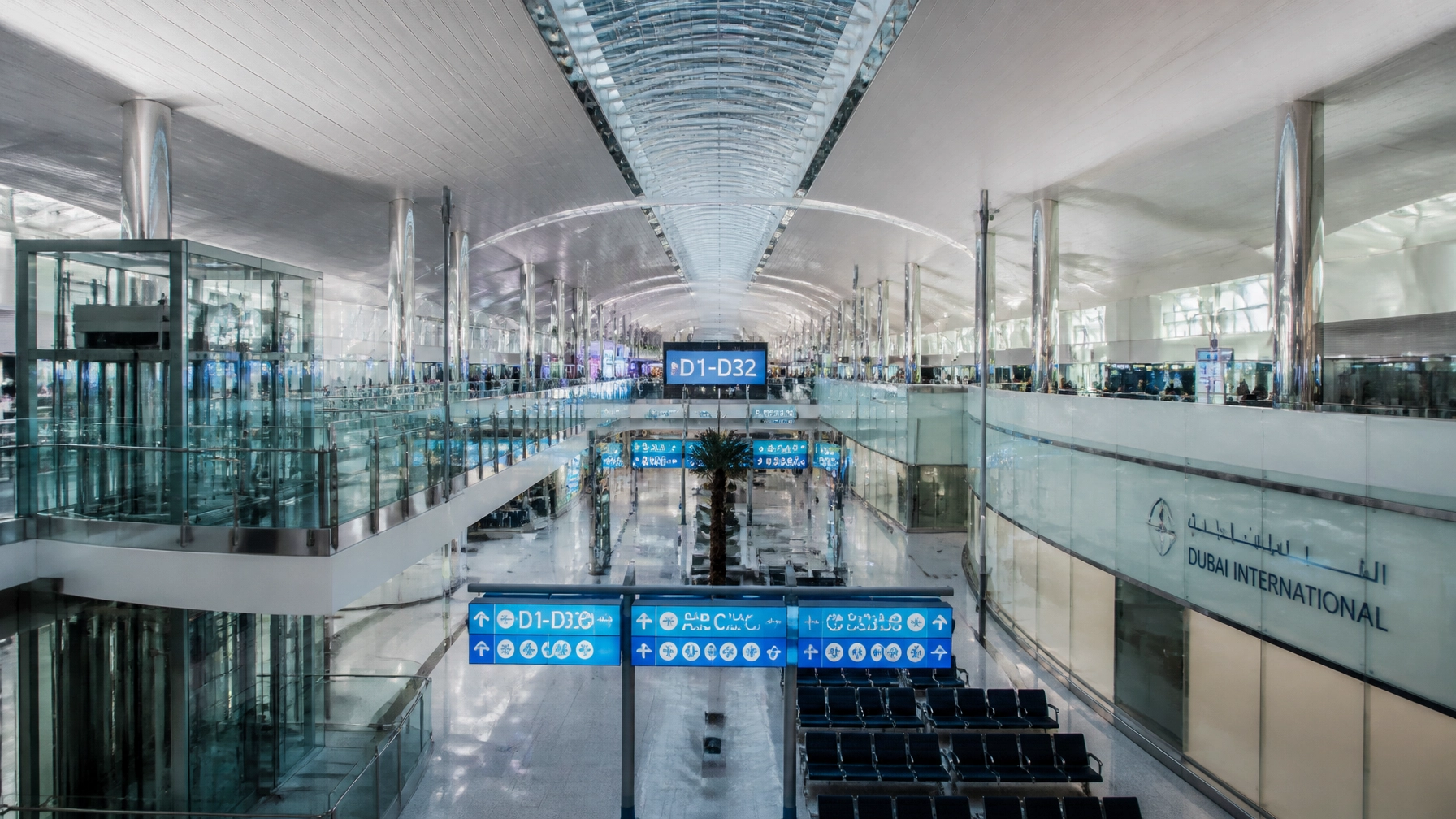
The era of virtual cities is here. As global travel continues to break historical records, bustling aviation hubs like Dubai International (DXB) handle hundreds of millions of passengers annually. Navigating the world’s busiest international gateway requires more than just luck: it demands precision, preparation, and an understanding of how cutting-edge smart infrastructure keeps millions moving seamlessly.
Behind the glass-and-steel facade of DXB lies a marvel of modern urban engineering: an advanced AI-powered digital twin ecosystem. Whether you are catching a connecting flight through Concourse A or arriving for a meeting in the UAE, mastering this mega-hub ensures stress-free transit. In this guide, we break down DXB’s terminal architecture, essential concourse strategies, and the technological backbone transforming airport operations.
1. Decoding DXB: Terminals and Concourse Architecture at a Glance
Understanding Dubai International begins with its distinct tripartite layout. The airport is organized into three primary terminal buildings and four main concourses, segmented by airline alliance and service model. Knowing your terminal before arriving at Airport Road is critical to avoiding delays.
- Terminal 1 (Concourse D): Serving over 60 international carriers, T1 is linked to Concourse D via an automated people mover. It handles major global airlines outside of the Emirates network.
- Terminal 2 (Low-Cost & Regional Hub): Situated on the opposite northern side of the airfield, T2 is physically separated from Terminals 1 and 3. It serves flydubai and various regional carriers. Crucially, T2 has no airside connection.
- Terminal 3 (Concourses A, B & C): A colossal facility dedicated almost exclusively to Emirates and select partners (such as Qantas). It is divided into three expansive concourses optimized for ultra-long-haul and A380 operations.
The layout of Dubai International defines your transit experience from the moment your taxi doors open. For deeper insights into global aviation navigation, explore our top 20 most visited airports guide.
2. Terminal 3 and Concourses A, B, and C: The Emirates Mega-Hub
As the crown jewel of DXB, Terminal 3 is one of the largest building structures on earth by floor area. Designed specifically to accommodate high-capacity wide-body aircraft like the Airbus A380, T3 functions as a streamlined city within a city.

Navigating the Emirates complex requires understanding how its three concourses interconnect:
- Concourse A: Purpose-built for A380 operations with dual-level boarding gates (A1–A24). It features luxury lounges and direct boarding bridges for First and Business Class passengers.
- Concourse B: The central beating heart of Terminal 3 (Gates B1–B32). It handles massive volumes of regional and economy departures, featuring extensive retail, dining, and family zones.
- Concourse C: A modern, highly efficient extension (Gates C1–C50) connected seamlessly to Concourse B via wide walkways and passenger travelators.
Intelligent spatial design ensures smooth passenger flow across millions of square feet. To discover how similar technologies optimize mega-hubs across North America, read our detailed analysis on how AI digital twins are redesigning airport operations.
3. Terminal 1 vs. Terminal 2: Knowing the Transfer Rules
One of the most common pitfalls for travelers is confusing Terminal 2 with the main T1/T3 complex. While Terminal 1 shares a unified airside transit zone with Terminal 3: allowing eligible passengers to move freely between Concourse D and Concourses A, B, and C without clearing immigration: Terminal 2 operates entirely independently.
- Airside Transfers (T1 & T3/Concourse D): If you are transferring between international carriers within T1 and T3, you remain airside. Internal trains and secure walkways get you to your next gate in 15 to 25 minutes.
- Landside Transfers (Involving Terminal 2): Because Terminal 2 sits 7 kilometers away on the northern side of the airfield with no airside link, any itinerary mixing T2 with T1 or T3 requires clearing immigration, collecting bags, taking a 20-to-30-minute shuttle bus or taxi, and re-checking for your onward flight.
Rigorous planning is essential when self-transferring across disconnected terminal zones. For strategies on managing complex multi-terminal layouts, review our guides on navigating major transport nodes such as London Heathrow (LHR) and Hartsfield-Jackson Atlanta (ATL).
4. The Hidden Power: How AI Digital Twins Keep DXB Flowing
Behind every smooth boarding call, baggage drop, and security queue at Dubai International is an invisible layer of real-time intelligence. Modern mega-airports generate petabytes of operational data every second: from passenger foot traffic and IoT sensor feeds to weather patterns and aircraft turnaround times.

At MetaWorldX, we pioneer enterprise-grade digital twin technology that transforms complex urban and industrial data into actionable insights. In an airport environment, an AI digital twin provides command centers with:
- Predictive Passenger Flow Modeling: Anticipating bottlenecks at immigration checkpoints and adjusting staffing levels proactively.
- Dynamic Gate Allocation: Simulating apron traffic and aircraft movements to minimize taxi delays and gate conflicts.
- Resource & Energy Optimization: Managing terminal climate control, lighting, and security systems for maximum sustainability and resilience.
Real-time simulation empowers operators to solve congestion before it impacts travelers. Discover our broader work in regional simulation and critical infrastructure through our case study on simulating critical utility grids in Dubai.
5. Pro Tips for a Flawless DXB Journey
Whether you are a seasoned business flyer or an occasional tourist, applying a few tactical rules of thumb will elevate your airport experience:
- Check Your Ticket Early: Always verify your exact terminal (T1, T2, or T3) on your boarding pass before booking ground transportation.
- Leverage Smart Gates: UAE residents and eligible passport holders can bypass traditional immigration queues using biometric Smart Gates upon arrival and departure.
- Allow Ample Buffer Time: If your journey involves Terminal 2 or a self-transfer, budget at least 3 hours to account for landside transfers and security re-screening.
- Utilize Airside Transit Trains: When moving between Concourse A and Concourse B/C in Terminal 3, follow signage directly to the Automated People Mover (APM) to save valuable walking time.
Mastering the details turns a hectic layover into an effortless transition. For further reading on how smart infrastructure is shaping future developments across the region, visit our insights on smart city pioneers from NEOM to Toronto.
Conclusion
Dubai International Airport stands as a testament to what is possible when visionary architecture meets advanced digital technology. From the sprawling A380 gates of Concourse A to the high-speed transit links connecting Terminal 1 and Terminal 3, every square meter is optimized for efficiency and safety. As AI digital twins continue to redefine how we design, monitor, and interact with complex urban spaces, the future of global aviation looks more connected and sustainable than ever.

Explore how MetaWorldX is revolutionizing critical infrastructure and smart cities worldwide. We invite you to discover our award-winning technology platforms, learn about our transformative enterprise solutions, and take the next step toward a smarter, more interconnected world. Visit MetaWorldX to learn more about our AI-powered digital twin capabilities today.