
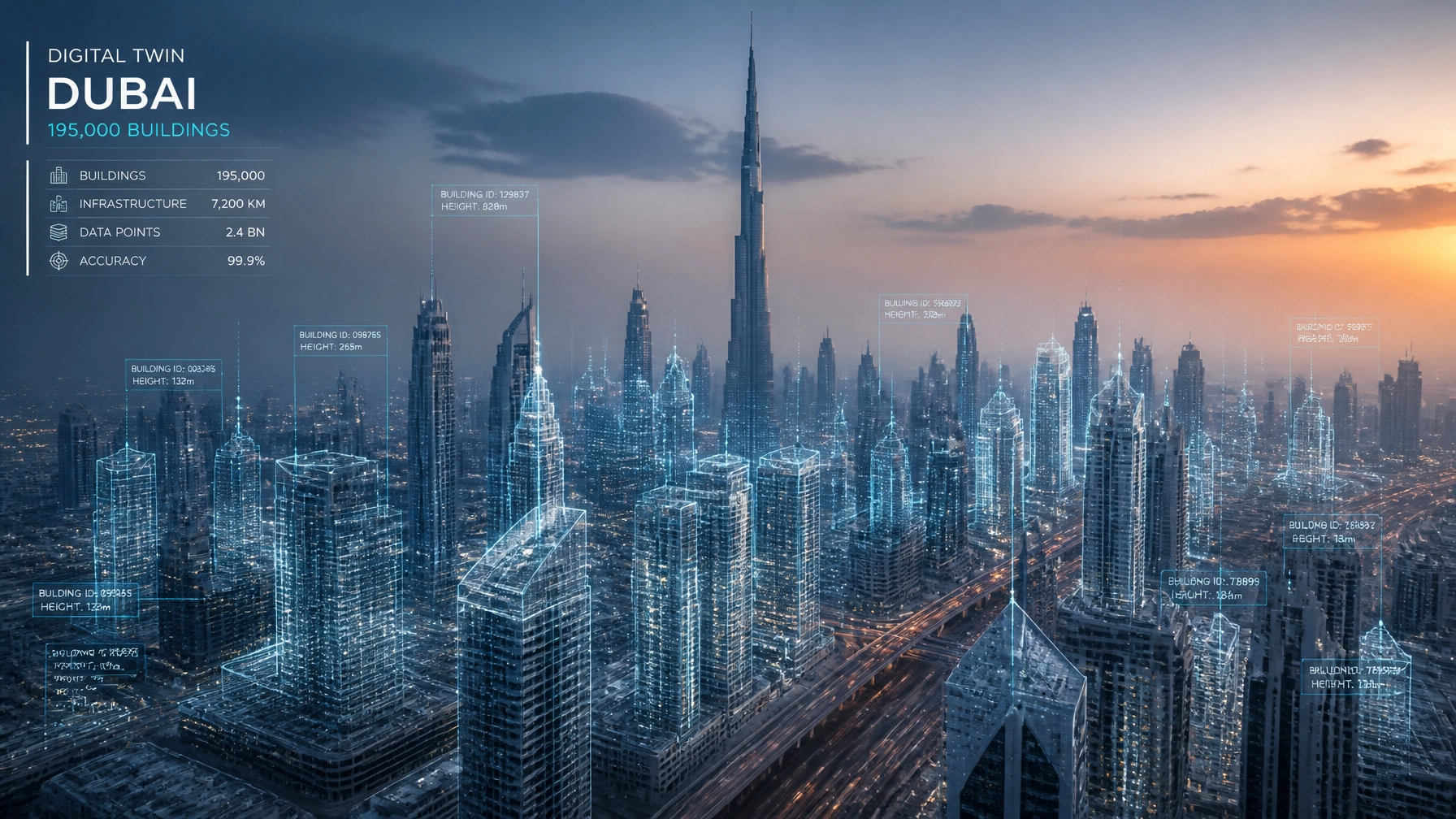
The era of virtual cities is no longer a concept of the future; it is a reality being built today. In July 2026, Dubai officially cemented its position as a global leader in urban innovation by launching a city-wide AI digital twin that encompasses over 195,000 buildings and 330,000 public facilities. This massive undertaking by the Dubai Municipality represents one of the most sophisticated integrations of spatial and operational data ever attempted.
Dubai has long been synonymous with architectural ambition. However, this new milestone shifts the focus from physical height to digital depth. By creating a 3D virtual replica of the entire emirate, Dubai is setting a new standard for how modern metropolises design, monitor, and protect their urban spaces.
The Massive Scale: Mapping a Metropolis in 3D
Dubai’s digital twin platform is not just a visual model; it is a living, breathing ecosystem of information. The project integrates more than 1,500 geospatial data layers, providing a comprehensive view of the city’s infrastructure.
The deployment includes:
- 195,000+ Buildings: Detailed 3D models of every structure in the emirate.
- 330,000+ Facilities: Real-time data points for hospitals, schools, and government offices.
- 280,000 Infrastructure Assets: Mapping utility networks, drainage systems, and transport links.
This smart city digital twin provides decision-makers with a unified spatial environment. It allows for the simulation and analysis of future scenarios, ensuring that every urban development choice is backed by rigorous, data-driven insights.
Climate Resilience: Solving the Rainfall Challenge
One of the most critical applications of the Dubai digital twin is climate adaptation. Recent shifts in regional weather patterns have made heavy rainfall events a priority for urban planners. The platform is explicitly designed to run complex rainfall simulations, allowing authorities to test the city’s resilience before a storm even hits.

The impact of predictive rainfall modeling includes:
- Flood Risk Identification: Pinpointing exactly which neighborhoods are prone to flooding under specific storm intensities.
- Infrastructure Stress Testing: Simulating how drainage and stormwater systems will perform during extreme events.
- Investment Optimization: Identifying where infrastructure upgrades are most needed to prevent future economic disruption.
By modeling these events in a virtual environment, Dubai can implement proactive strategies that safeguard property and lives, transforming a reactive emergency response into a proactive resilience strategy.
Precision in Public Safety: Evacuation Planning
Safety is the cornerstone of any smart city. Dubai’s digital twin goes beyond monitoring; it actively plans for the unthinkable. The platform supports advanced evacuation planning by simulating emergency scenarios across the city's dense urban landscape.

Using the smart city technology embedded in the digital twin, emergency services can:
- Test Evacuation Routes: Virtually simulate city-wide traffic behavior during a crisis to identify potential bottlenecks.
- Optimize Resource Deployment: Use real-time asset data to determine the fastest routes for emergency vehicles to reach hospitals and shelters.
- Conduct "What-If" Drills: Run high-stakes disaster simulations without ever disrupting the physical city.
This level of detail ensures that when every second counts, the city’s response is calculated, efficient, and lives are saved.
MetaWorldX in the Middle East: Powering the Vision
At MetaWorldX, we understand the complexities of managing large-scale urban environments. Our work in the region, including projects like the Dubai Airport Digital Twin, aligns perfectly with the emirate's vision of a fully interconnected virtual city.
Our MetaWorldX digital twin solutions are built on the same principles driving Dubai’s success:
- Predictive & Prescriptive Analytics: We don't just show you what is happening; we show you what will happen and how to optimize it.
- Seamless Integration: Our systems, such as TwinTalk, integrate effortlessly with existing PSIM and IoT ecosystems to provide a "single pane of glass" view.
- Scalable Architecture: From a single Smart Building to an entire smart city, our technology is built to handle the massive data loads required for city-scale simulations.

As a leader in digital twin technology, MetaWorldX empowers city planners and infrastructure operators to make smarter, more impactful decisions. By leveraging AI-driven simulations, we help cities like Dubai transition from traditional monitoring to strategic, future-ready management.
Strategic Impact: ROI and the Future of Urban Living
The investment in a digital twin of this scale delivers a significant return on investment (ROI) across multiple sectors. Beyond the obvious safety benefits, the economic and environmental efficiencies are profound.
Key benefits of a city-scale digital twin include:
- Operational Efficiency: Reducing the cost of infrastructure maintenance through predictive monitoring.
- Environmental Sustainability: Optimizing energy use across 195,000 buildings to meet net-zero goals.
- Enhanced Urban Planning: Shortening the development cycle for new projects by testing them in the virtual world first.
The era of virtual cities is here. Dubai’s commitment to a city-wide digital twin is a blueprint for the world. It proves that with the right technology and vision, cities can become safer, more efficient, and more resilient to the challenges of the 21st century.
Conclusion: A Vision for the Global North and South
Dubai is just the beginning of our "Top 20 Smart Cities" series. As we look at how other global hubs are adopting these technologies, it is clear that the digital twin city is the ultimate tool for 2026 and beyond. Whether it’s managing critical infrastructure or designing a more sustainable urban future, the virtual world is now the proving ground for the physical one.
Interested in how digital twin technology can transform your city or facility? Explore our Dubai initiatives or learn more about our Public Safety & Health solutions today.