
Part 37 of the “50 Ways MetaWorldX Physical AI Is Transforming the World” series.
The elevator is one of the most visible points of interaction between people and a tall building. When it works well, movement feels effortless. When it fails, the entire building experience changes: queues form, lobbies become crowded, accessibility suffers, and facility teams receive complaints before they receive useful operational insight.
Traditional elevator banks still rely heavily on static rules and preconfigured dispatch logic. These systems can manage predictable traffic, but they struggle when demand changes rapidly across a tower, hospital, airport, transit hub, or mixed-use development.
The future of vertical transport is adaptive, predictive, and simulation-driven.
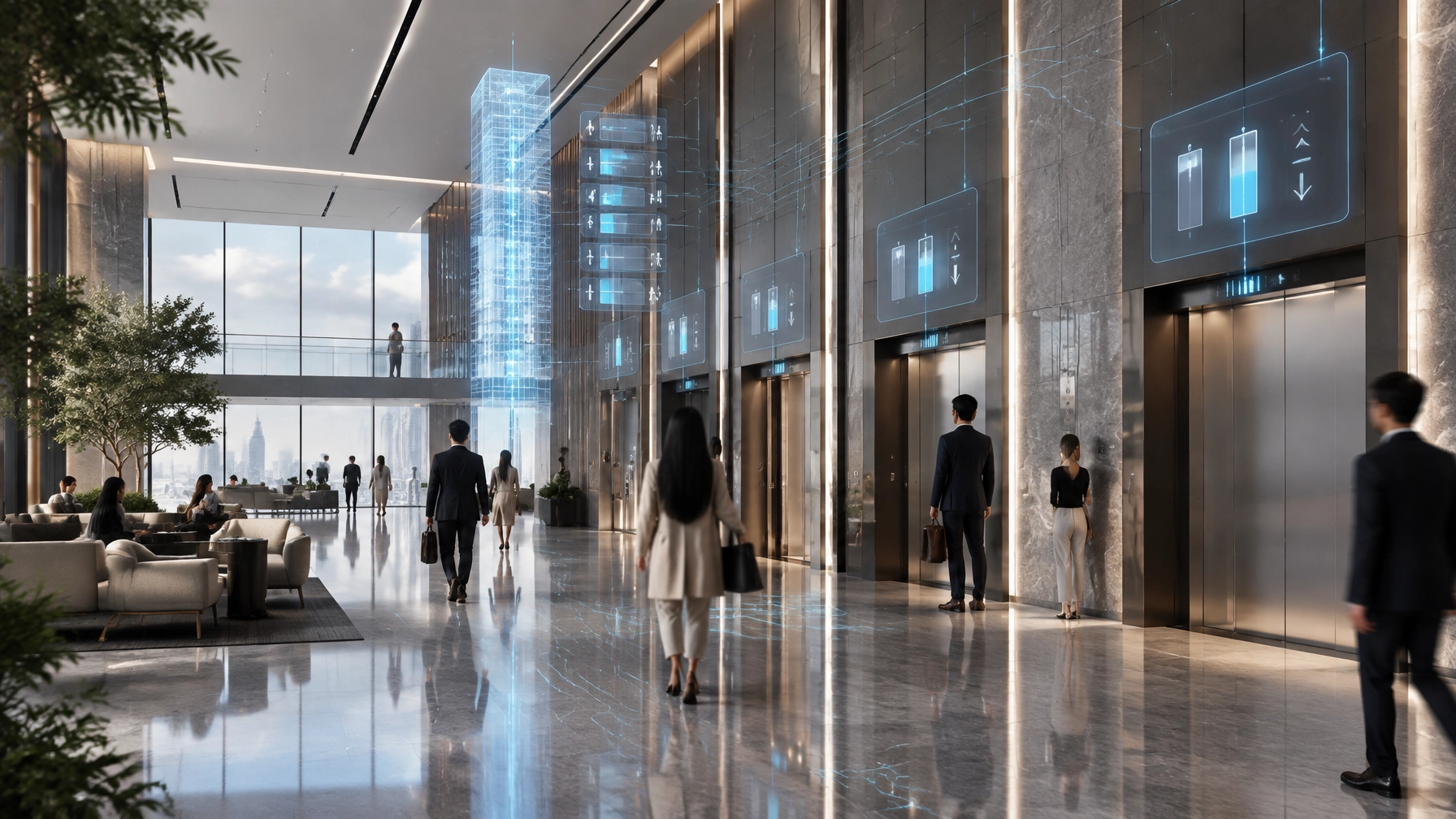
With the MetaWorldX Physical AI platform, elevator operations become part of a connected AI digital twin: a live, three-dimensional model that helps facility teams understand what is happening, predict what will happen next, and test better decisions before applying them in the physical building.
The Challenge: Elevator Demand Is Dynamic, but Dispatch Often Is Not
Vertical transport demand changes by the minute. A static dispatching strategy cannot always respond effectively to:
- Morning up-peak traffic in office towers
- Lunchtime inter-floor movement
- Hotel check-in and check-out surges
- Hospital bed, gurney, staff, and visitor traffic
- Airport passenger waves between terminals, parking, and concourses
- Event arrivals and post-event egress
- Mixed-use traffic moving between residences, offices, retail, and amenities
When elevator systems cannot adapt, building operators face several connected problems:
-
Long waiting times and crowded lobbies
A demand spike on several floors can overwhelm a dispatch strategy designed for average conditions. -
Poor accessibility
People using wheelchairs, mobility aids, hospital beds, or equipment may face longer waits and less predictable service. -
Energy waste
Idle or oversized cab movements consume energy. Repeated stops, empty trips, and poorly coordinated dispatching also increase mechanical wear. -
Weak emergency readiness
Facility teams may not know how a vertical transport system will perform when one bank is offline, an evacuation is underway, or access zones change suddenly. -
Missed service-level commitments
Premium offices, luxury residences, hotels, and hospitals often operate against expectations for availability and response. A few minutes of delay can affect tenant, patient, or guest satisfaction. -
Limited operational visibility
Many teams discover a problem only after complaints arrive. They may not have a unified view of cab positions, door cycles, ride times, waiting times, faults, or demand patterns.
The issue is not simply the number of elevators. It is the lack of a shared, real-time operating picture.
The MetaWorldX Solution: A Digital Twin for Vertical Transport
MetaWorldX creates an AI digital twin of the elevator and vertical transport system inside a full 3D digital twin of the building.
This model connects the physical movement of people, assets, and elevator cabs with the wider building environment. It can integrate data from:
- Elevator controllers and telemetry
- Destination dispatch systems
- Building Management Systems (BMS)
- Access control and turnstiles
- IoT sensors and occupancy systems
- Security and Physical Security Information Management (PSIM) platforms
- Maintenance and asset management systems
The result is a more complete view of how vertical transport supports the building as a whole.
Facility teams can see where cabs are located, how long doors remain open, which floors generate the most demand, how long passengers wait, and whether a developing fault could affect service. The system also connects this operational data to predictive and prescriptive analytics.
Predictive analytics explains what is likely to happen. Prescriptive analytics recommends what to do about it.
From Traffic Forecasting to Prescriptive Dispatch
The MetaWorldX Physis AI platform can analyze historical and real-time data to identify recurring and emerging traffic patterns.
For example, the system may recognize:
- An approaching morning up-peak in a commercial tower
- A surge in inter-floor traffic during lunch
- Increased gurney movement after scheduled hospital procedures
- Passenger flows building before a major event
- A change in occupancy caused by a new tenant
- Reduced service capacity because one elevator bank is under maintenance
The digital twin can then evaluate dispatch strategies such as:
- Pre-positioning cabs before demand arrives
- Adjusting elevator zoning between low-, mid-, and high-rise floors
- Grouping passengers through destination dispatch
- Prioritizing accessibility or clinical transport requirements
- Reducing unnecessary empty trips
- Coordinating elevator availability with access-control rules
- Reallocating service when a cab or bank is offline
Rather than relying on a fixed rule for every situation, operators gain a system that continuously compares operational conditions with service objectives.
Research into intelligent vertical transportation highlights the value of destination dispatch, IoT monitoring, predictive maintenance, and simulation. Industry guidance from organizations such as the Council on Tall Buildings and Urban Habitat also emphasizes the importance of matching vertical transport design and operation to actual building demand.
Real-Time Monitoring Beyond the Elevator Lobby
A digital twin gives facility teams visibility that conventional dashboards often lack.
Within the MetaWorldX environment, operators can monitor:
- Live cab positions and movement
- Waiting times by floor and time period
- Ride and journey times
- Door-open and door-cycle performance
- Number of stops per trip
- Traffic direction and demand intensity
- Elevator availability and bank status
- Abnormal vibration, motor behavior, or door performance
- Energy consumption and idle periods
This creates a single operational picture across the building. An elevator delay can be analyzed alongside occupancy, access-control events, event schedules, hospital workflows, or airport passenger movement.
It also supports predictive maintenance. Door motors, drive systems, and other components can show performance changes before a nuisance breakdown occurs. Maintenance teams can prioritize intervention based on condition and operational impact, rather than relying only on fixed intervals or reactive service calls.

Scenario Planning: Test the Building Before the Building Is Tested
One of the most valuable capabilities of digital twin technology is the ability to simulate scenarios in a realistic 3D environment.
Facility teams can model:
-
A slammed lobby
What happens if a large office population enters within a short period? -
A full evacuation
How do people move through stairs, protected areas, and designated elevator protocols? Where could congestion develop? -
A bank taken offline for maintenance
Can the remaining elevators maintain acceptable service? Which floors experience the greatest impact? -
A new tenant occupancy plan
How will a different distribution of people across floors affect up-peak and inter-floor traffic? -
An airport passenger surge
Can vertical transport handle simultaneous movement between parking, check-in, security, gates, and transit connections? -
Hospital patient and gurney traffic
How should elevators be allocated to preserve clinical reliability, privacy, and accessibility?
These scenarios support better capital planning as well. Before adding new elevators, changing a lobby layout, modifying access-control policies, or revising maintenance windows, decision-makers can compare alternatives in simulation.
The goal is not to replace professional engineering, code compliance, or emergency procedures. It is to give those teams a more accurate environment for testing assumptions.
A Practical Example: A 60-Storey Mixed-Use Tower
Consider a 60-storey tower combining offices, a hotel, and private residences: similar in complexity to the premium developments reshaping cities such as Toronto, Dubai, and NEOM.
The tower has separate elevator groups, shared amenities, loading areas, retail floors, and controlled-access zones. In the morning, office demand rises sharply. During the afternoon, hotel guests and visitors create different traffic patterns. In the evening, residents return while hotel and restaurant activity increases.
A MetaWorldX AI digital twin could:
- Forecast demand by building zone and time
- Simulate alternative elevator zoning strategies
- Coordinate access-control permissions with destination dispatch
- Monitor service performance for each user group
- Identify when one bank’s maintenance schedule would create unacceptable delays
- Test event or emergency scenarios before they occur
- Recommend energy-saving standby strategies during low-demand periods
The same model could support a hospital where elevator availability directly affects patient care, or an airport where passenger movement must remain reliable despite highly variable demand.

Human-in-the-Loop Governance Matters
Physical AI should improve decision-making without placing critical building operations on unmanaged automation.
MetaWorldX uses a human-in-the-loop governance approach. The system can identify a problem, forecast its impact, and recommend a dispatch or maintenance strategy. Facility teams remain responsible for reviewing and approving material reconfiguration.
This approach provides:
- Clear operational accountability
- Greater trust in AI recommendations
- Better alignment with safety policies and building codes
- Controlled testing of new dispatch strategies
- A record of decisions and outcomes
- Flexibility for facility teams to apply local knowledge
The AI supports the operator. It does not remove the operator from the process.
Expected Outcomes and ROI
Results will depend on building design, baseline performance, traffic patterns, elevator controls, and implementation quality. However, a well-calibrated deployment can establish measurable operating targets such as:
- 20–35% lower waiting times during peak periods
- Approximately 15–25% lower elevator energy consumption
- Fewer nuisance breakdowns through predictive maintenance on doors, motors, and drives
- Faster and more informed evacuation planning through simulation
- Improved accessibility performance and service consistency
- Higher tenant, patient, guest, and passenger satisfaction
- Better visibility into service-level performance and maintenance priorities
These benefits extend beyond the elevator system. Smoother vertical movement can reduce lobby congestion, improve tenant experience, support energy goals, and strengthen the resilience of the entire building.
Vertical Transport Is a Smart City Use Case
Elevators are often treated as isolated building equipment. In reality, they are part of the wider urban operating system.
They connect public transit to towers, hospitals to emergency services, airports to passenger networks, and mixed-use developments to the surrounding city. That makes elevator optimization one of the most practical physical AI use cases for smart buildings and AI for critical infrastructure.
With the MetaWorldX Physical AI platform, organizations can move from reactive elevator management to continuous operational intelligence: combining digital twin technology, real-time 3D simulation, IoT integration, predictive and prescriptive analytics, and accountable human governance.
The result is not simply faster elevators. It is a more responsive, accessible, efficient, and resilient built environment.
Explore the MetaWorldX Physical AI and digital twin platform, learn more about smart building solutions, and discover how connected simulation can help transform the next generation of towers, hospitals, airports, and urban infrastructure.
Continue the series with Use Case #36: Parking Management Systems and Use Case #35: Terminal Passenger Flow Optimization.