
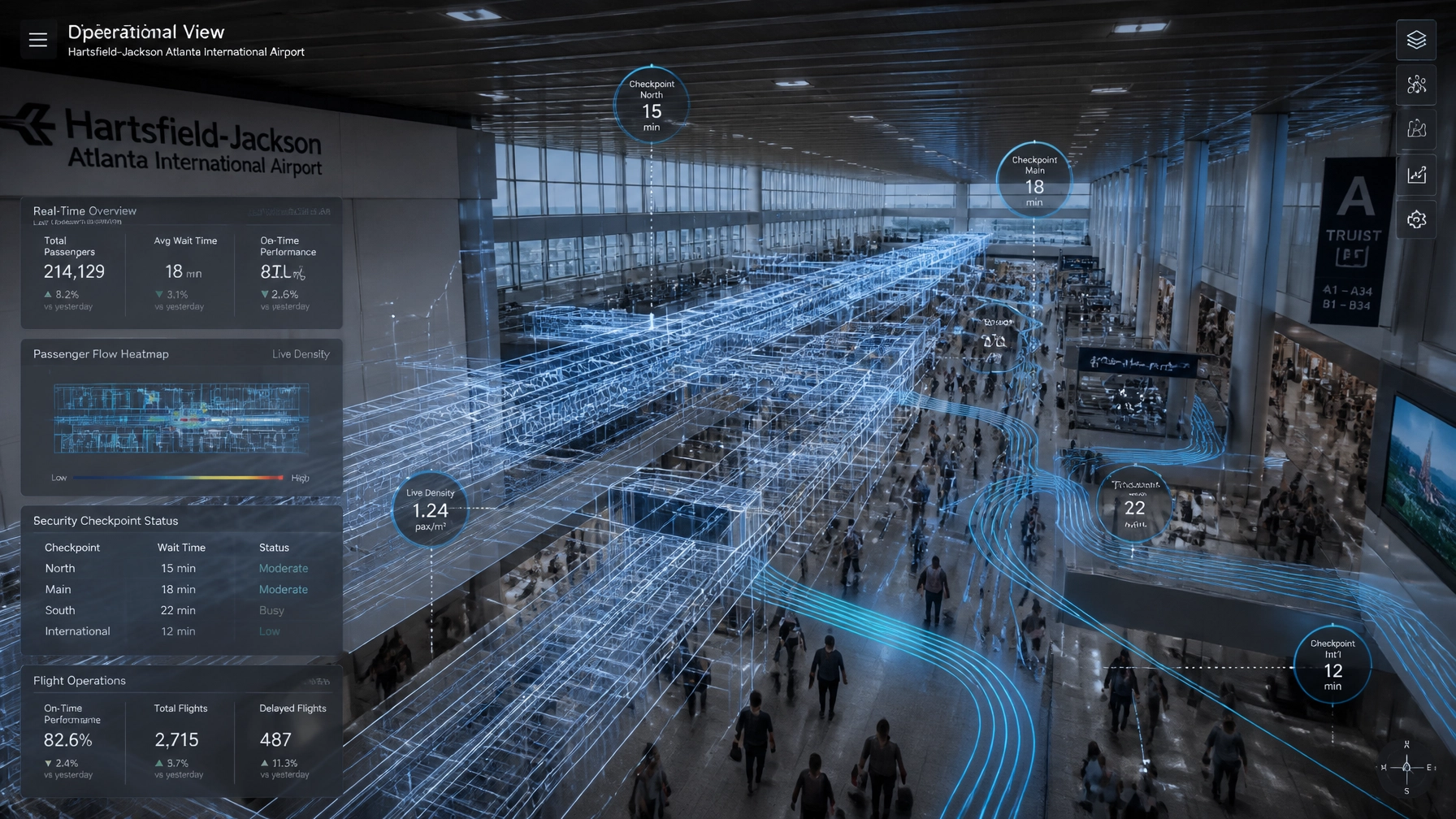
Stepping into Hartsfield-Jackson Atlanta International Airport (ATL) is a lesson in high-velocity logistics. As the world’s busiest airport, ATL handled a record-breaking 106.3 million passengers in 2025, serving as the primary gateway for global commerce and travel. Managing a facility of this scale requires more than just efficient staffing; it demands a sophisticated, invisible intelligence layer.
Behind the bustling terminals and departing flights, MetaWorldX digital twin technology is becoming the standard for optimizing such complex environments. By creating a high-fidelity virtual replica of physical infrastructure, airport operators can now visualize, simulate, and predict operational needs in real-time. Whether you are a traveler navigating the concourses or a decision-maker overseeing critical infrastructure, understanding the anatomy of ATL is the first step toward mastering the modern travel experience.
ATL at a Glance: The World’s Most Connected Hub
Hartsfield-Jackson is designed with a remarkably efficient, linear layout that facilitates high-volume movement across its massive footprint. Despite its size, the airport’s "spine and rib" structure makes navigation surprisingly intuitive once you understand the basic geometry.
- Two Primary Terminals: The Domestic Terminal (West) and the Maynard H. Jackson Jr. International Terminal (East).
- Seven Concourses: Arranged parallel to each other, these include Concourses T, A, B, C, D, E, and F.
- 193 Gates: A sprawling network capable of handling hundreds of aircraft movements simultaneously.
- Linear Connectivity: All concourses are connected underground by a single transportation corridor.
The era of virtual cities and intelligent hubs is here, and ATL’s layout is perfectly suited for the AI-driven digital twin transformations currently reshaping the industry.
Terminal by Terminal: Domestic vs. International
Understanding where your journey begins is critical, as the Domestic and International terminals are located on opposite sides of the airfield and are not connected by foot.
The Domestic Terminal
Located on the west side of the airport, the Domestic Terminal is divided into North and South sections.
- Check-in: The North side generally hosts international carriers and non-Delta domestic airlines, while the South side is the dedicated home of Delta Air Lines.
- The Atrium: A central hub featuring dining, retail, and access to the MARTA (Metropolitan Atlanta Rapid Transit Authority) station, providing a direct rail link to downtown Atlanta.
Maynard H. Jackson Jr. International Terminal (Concourse F)
Situated on the east side, this terminal handles all international arrivals and departures.
- Concourse F: This is the most modern part of the airport, featuring expansive duty-free shopping and elite lounges.
- Pro Tip: If you are arriving from the city, ensure your ride drops you at the correct terminal. If you end up at the Domestic side with an international flight, you must take a 15-minute shuttle bus to reach the International Terminal.
Getting Around: The Plane Train and Beyond
The lifeblood of ATL is its underground transit system, which ensures that even the furthest gate is only a few minutes away.

The Plane Train
This automated people mover (APM) is legendary for its efficiency. It runs 24/7, arriving every two minutes, and connects the Domestic Terminal (Concourse T) through Concourses A, B, C, D, E, and finally Concourse F (International).
- Frequency: Every 2 minutes.
- Speed: It takes approximately 15 minutes to travel from the Domestic Terminal to the International Terminal.
The Transportation Mall
For those who prefer to walk, the Transportation Mall is a pedestrian corridor running parallel to the Plane Train. It features moving sidewalks and serves as a gallery for rotating art installations, including the stunning "Flight Paths" simulated forest canopy between Concourses A and B.
The SkyTrain
Distinct from the Plane Train, the SkyTrain is located outside the secure area. It connects the Domestic Terminal to the Gateway Center (hotels and convention space) and the Rental Car Center (RCC).
Navigating Security Checkpoints
ATL's security system is one of the most advanced in the world, utilizing AI airport security protocols to manage massive crowds.
- Main Checkpoint: Located in the Domestic Atrium, this is the largest and is open 24/7.
- North & South Checkpoints: Open typically from 4:00 AM to 9:00 PM. The South checkpoint is frequently the dedicated hub for TSA PreCheck and CLEAR members.
- International Terminal Checkpoint: Open from 4:30 AM to midnight, specifically for those departing from Concourse F.
Strategic Tip: Always check the live wait times on the ATL website or app before arriving. Choosing the North or South checkpoint over the Main checkpoint can often save you 15–20 minutes during peak morning rushes.
Connection Tips for Smooth Transitions
With thousands of flights daily, gate changes are frequent. Effective navigation requires staying informed and allowing for realistic transit times.
- Domestic-to-Domestic: Aim for a minimum of 55 minutes. ATL is huge, and walking from one end of a concourse to the Plane Train can take 10 minutes alone.
- Domestic-to-International: Allow at least 1 hour. You may need to transit from Concourse T all the way to Concourse F.
- International-to-Domestic: Allow 1.5 to 2 hours. You must clear Customs and Border Protection (CBP), reclaim checked bags, and re-clear security.
The Golden Rule: Always check the overhead monitors the moment you step off your plane. At ATL, a gate change can mean moving from Concourse A to Concourse D in a matter of minutes.
Amenities: Refuel and Recharge
ATL has moved beyond standard airport fare, offering local Atlanta favorites and premium relaxation zones.
- Local Flavors: Don’t miss Paschal's (Concourse C) for soul food, Grindhouse Killer Burgers (Concourse D & T), or the award-winning One Flew South (Concourse E).
- Minute Suites: Located in Concourse B, these are private retreats where you can nap, work, or shower during long layovers.
- Connectivity: The airport offers free, high-speed WiFi throughout all terminals, supported by robust smart building infrastructure.
The Digital Twin: The Invisible Intelligence Powering ATL
While travelers see the moving sidewalks and the Plane Train, the real magic happens behind the scenes through a massive data ecosystem. Currently, ATL utilizes platforms like Databricks for data intelligence, Xovis sensors for passenger flow monitoring, and GIS mapping for asset management.

However, the future of aviation lies in the MetaWorldX digital twin evolution. This next-generation approach unifies disparate systems: IoT sensors, security feeds, HVAC status, and baggage handling: into a single, immersive 3D environment.
Why AI for Airport Operations Matters:
- Scenario Simulation: Before a major holiday surge, operators can run "what-if" simulations to see how security bottlenecks will form and redistribute staff accordingly.
- Predictive Maintenance: Instead of waiting for an escalator or baggage belt to break, the digital twin uses AI to predict mechanical failure based on vibration and heat data, allowing for repairs before disruptions occur.
- Optimized Resource Allocation: MetaWorldX technology enables real-time gate utilization adjustments, ensuring aircraft spend less time idling and passengers spend less time waiting for a gate to open.
By integrating AI for airport operations, Hartsfield-Jackson is not just the busiest airport; it is becoming the smartest.
Conclusion: Shaping the Future of Travel
Navigating Hartsfield-Jackson Atlanta like a pro requires a blend of practical knowledge and an appreciation for the technology making it possible. From the rhythmic efficiency of the Plane Train to the visionary digital twin technology airports are adopting, ATL is a testament to human engineering and AI-driven optimization.

As we look toward a more interconnected world, MetaWorldX remains at the forefront, transforming complex urban and industrial spaces into actionable, intelligent insights. Whether you are catching a flight or managing a global hub, the future is digital, 3D, and predictive.
Experience the future of infrastructure today. Explore how MetaWorldX is revolutionizing the world’s most complex environments.