
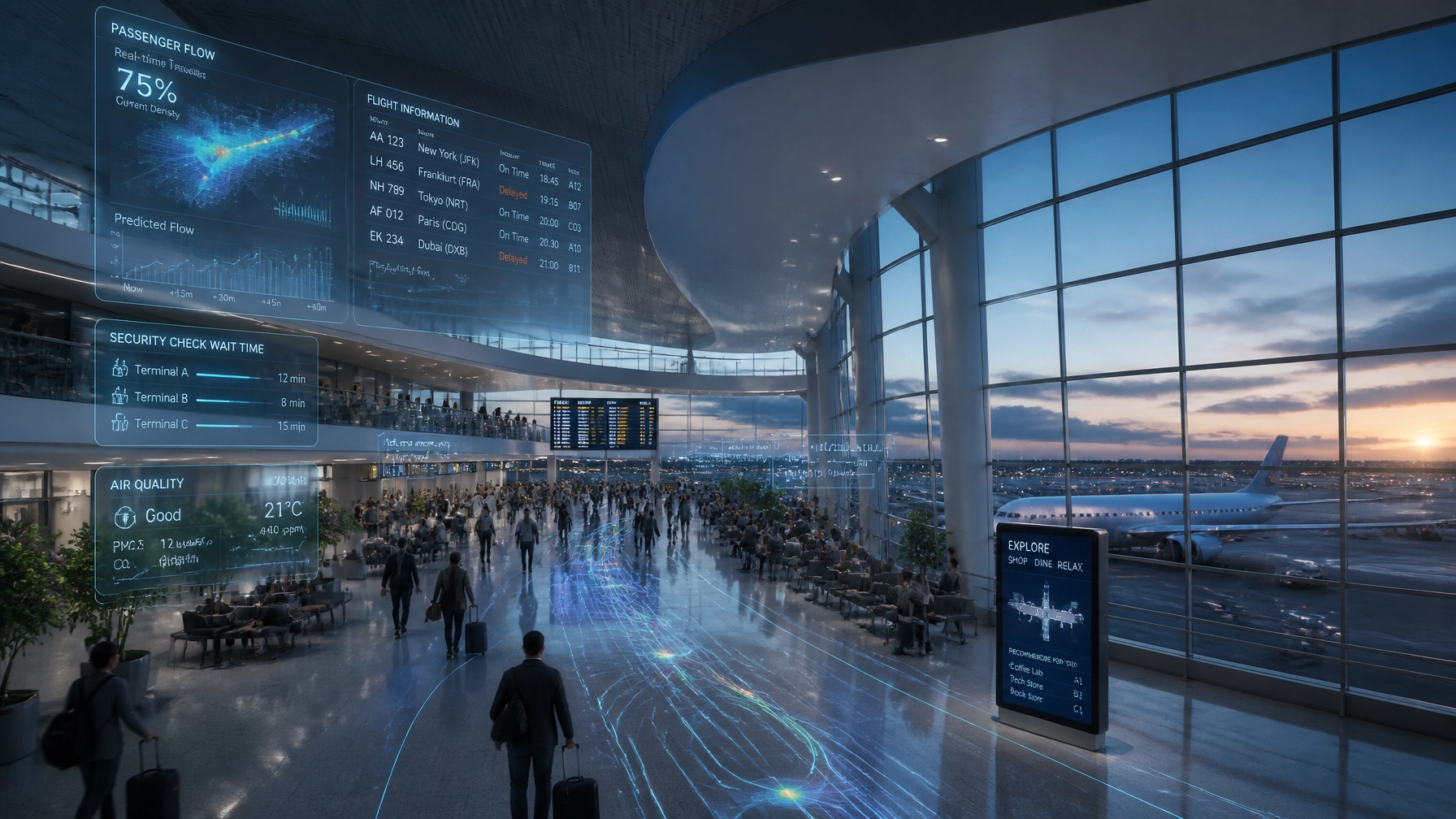
Navigating the world's most visited airports can feel like a marathon through a shifting maze. From the sprawling concourses of Atlanta to the multi-terminal complexity of London Heathrow, the passenger experience is often defined by a race against the clock. But beneath the surface of these bustling hubs, a silent revolution is taking place.
At MetaWorldX, we aren’t just watching the evolution of travel; we’re building the digital infrastructure that makes it possible. By deploying AI digital twin airports, we are transforming chaotic terminals into living, breathing ecosystems that predict problems before they happen.
This post serves as the master guide to our 20-part series, where we break down the navigation of the world’s top 20 airports while revealing how digital twin technology airports are quietly making your journey smoother, safer, and more sustainable.
The Era of Virtual Cities is Here
An airport is more than a transit point; it is a complex city that never sleeps. Managing millions of passengers, thousands of flights, and petabytes of data requires more than just reactive management. It requires foresight.
MetaWorldX digital twin technology creates a 1:1 virtual replica of the physical airport environment. By integrating IoT sensors, real-time camera feeds, and historical data, we allow airport operators to "see" into the future. Whether it’s simulating a sudden power grid failure or optimizing the temperature in Terminal 3, our AI-driven insights ensure that the physical world stays in sync with the digital plan.
Why Digital Twins Matter for Your Next Flight:
- Reduced Wait Times: Predictive models help staff open security lanes before a bottleneck forms.
- Reliable Baggage: AI monitors the "health" of conveyor belts to prevent the mechanical failures that lead to lost luggage.
- Enhanced Safety: Security teams use 3D simulations to identify vulnerabilities and respond to incidents in seconds.
Navigating the Giants: A Preview of the Top 20 Hubs
Over the next 20 days, we will dive deep into specific guides for the world's busiest airports. Here is a look at the heavy hitters and how MetaWorldX technology is setting the standard for their future operations.
1. Hartsfield–Jackson Atlanta (ATL) – The Volume King
Handling over 108 million passengers, ATL is a masterclass in efficiency. Navigating the "Plane Train" between concourses is essential.
- The AI Edge: Using AI for airport operations, ATL can simulate passenger surges from delayed flights to redirect ground transportation and minimize curb-side congestion.
2. Dubai International (DXB) – The Global Gateway
A premier hub for international connections. Navigating Terminal 3: the world’s largest airport terminal by floor area: requires precision.
- The AI Edge: MetaWorldX has deep roots in the region, including projects in Dubai and NEOM. At DXB, digital twins optimize HVAC efficiency, ensuring that even in 40°C heat, the terminal remains a cool, energy-efficient oasis.
3. London Heathrow (LHR) – The Multi-Terminal Challenge
With four active terminals and a complex security landscape, LHR demands early arrival.
- The AI Edge: AI airport security tools integrated into a digital twin allow LHR to run "what-if" scenarios for terminal-to-terminal transfers, ensuring that security checks are scaled dynamically based on real-time flight arrival data.
4. Dallas–Fort Worth (DFW) – The Sprawling Metropolis
Spanning five terminals and its own zip code, DFW is massive.
- The AI Edge: MetaWorldX smart airport solutions focus on predictive maintenance for the Skylink train system, ensuring that the critical link between terminals has zero downtime.
4 Pillars of the AI-Powered Airport Experience

To understand how a MetaWorldX digital twin improves your travel, we have to look at the four critical systems operating behind the scenes.
1. Passenger Flow & Wait-Time Prediction
The most stressful part of any trip is the unknown. How long is the security line? Will I make my connection? By using LiDAR and video analytics, digital twins visualize passenger density in real time.
- The Impact: Airport command centers can see a heat map of the terminal. If a crowd is forming at Check-in Area B, the AI suggests re-routing passengers to Area C or deploying more staff immediately.
2. AI-Driven Airport Security
Security is about more than just scanners; it’s about situational awareness. Our digital twins integrate with existing PSIM and access control systems to provide a unified 3D view of the airport perimeter.
- The Impact: In the event of a breach, security teams don't look at 2D maps. They interact with a 3D model that shows the exact location of the alert, the nearest officer, and the fastest response route.
3. Predictive Baggage Handling

A baggage handling system (BHS) is a massive mechanical beast. A single motor failure can cause a cascade of delays.
- The Impact: Using sensors to monitor vibration and temperature, the AI digital twin airport identifies when a motor is likely to fail days before it actually does. This allows for "predictive maintenance" during off-peak hours, ensuring your bags always make it to the plane.
4. HVAC & Environmental Efficiency

Airports are some of the world's largest energy consumers. Keeping a glass-walled terminal cool in the summer is an expensive, carbon-heavy task.
- The Impact: By correlating passenger density with outdoor weather data, the digital twin adjusts the HVAC system in real time. If Concourse A is empty for three hours, the system scales back cooling, saving up to 15-25% in energy costs without ever compromising passenger comfort.
The Command Center: Where Data Becomes Action

The true power of a digital twin is realized in the command and control center. This is where MetaWorldX technology takes fragmented data: from baggage, security, HVAC, and flight schedules: and weaves it into a single, actionable narrative.
The result is a proactive airport. Instead of reacting to a broken escalator or a long queue, the airport anticipates these issues. It’s the difference between managing a crisis and preventing one.
Scaling Beyond the Terminal
The vision at MetaWorldX doesn't stop at the airport gate. We view airports as the "smartest" districts of a much larger smart city. The lessons we learn in optimizing a terminal in Toronto or a runway in Dubai are the same lessons we apply to smart cities and critical infrastructure globally.
From NEOM to Toronto, we are proving that when you can simulate the world, you can perfect it.
What to Expect in This Series:
Over the next 20 posts, we will provide:
- Terminal-by-Terminal Guides: The best places to eat, sleep, and work.
- Connection Short-cuts: How to navigate the world’s most confusing layouts.
- Tech Spotlights: Deeper dives into how specific airports are using AI and MetaWorldX tech to change the way you fly.
The future of flight is predictable. It’s time we stop guessing and start navigating with the power of the digital twin.
Are you ready to see how the world’s busiest hubs are being rebuilt for the 21st century? Stay tuned for Part 1: Navigating Hartsfield–Jackson Atlanta (ATL) with AI Precision.
Explore more about our visionary technology and how we are shaping the future of urban design at MetaWorldX.com.