
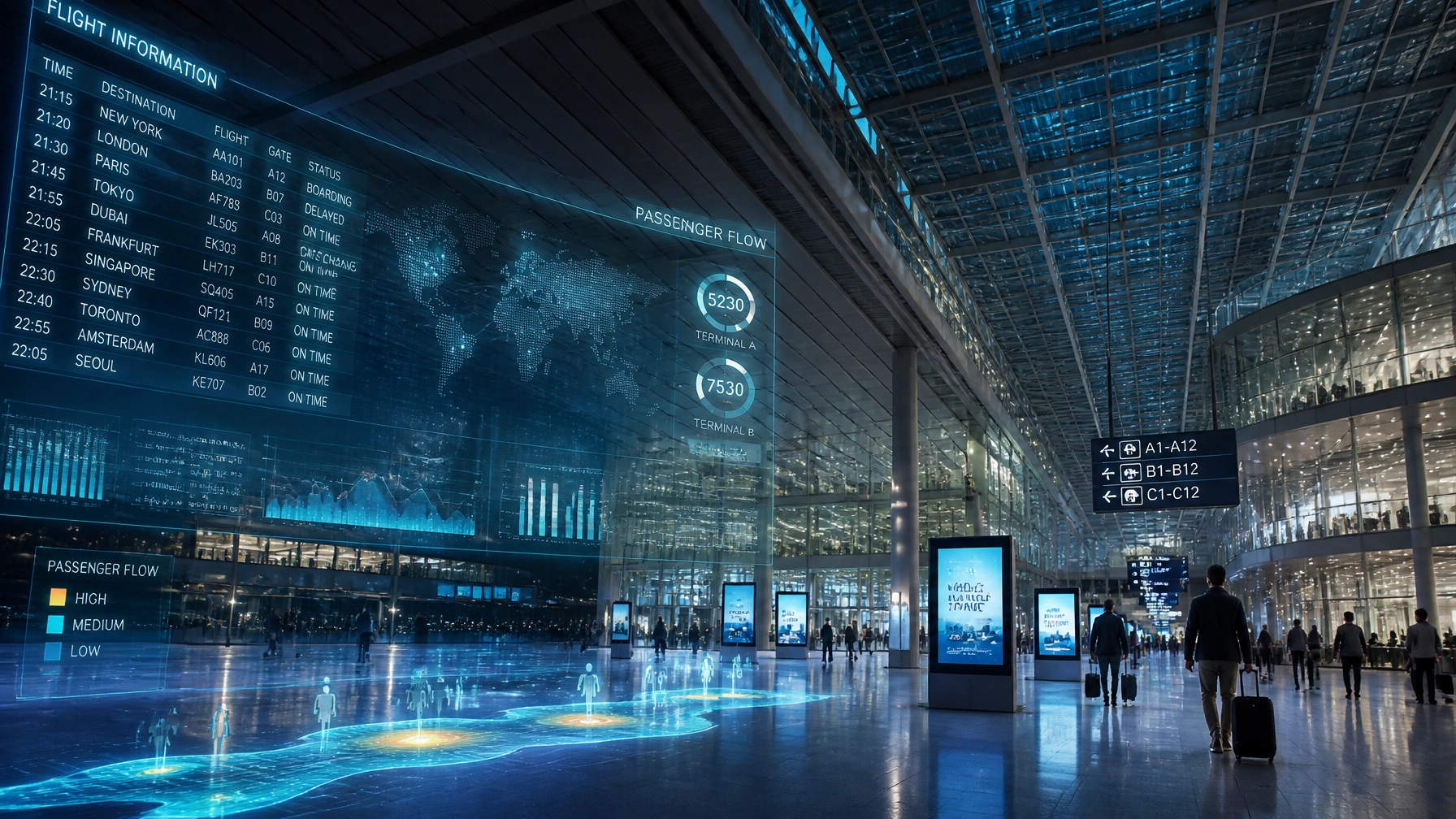
Navigating the world's busiest airports can often feel like a descent into chaos. Between the winding security lines, terminal-spanning trains, and the sheer scale of modern aviation infrastructure, the passenger experience is frequently defined by stress. However, behind the glass facades and sprawling runways, a technological revolution is taking place.
At MetaWorldX, we are at the forefront of this transformation. By creating AI-powered digital twins, we enable airport operators to visualize, simulate, and optimize every square inch of their facility in real-time. From predictive maintenance on jet bridges to autonomous security monitoring, the "Smart Airport" is no longer a concept: it is the new operational standard.
This guide provides 20 navigation shortcuts for the world's busiest hubs, while revealing how digital twin technology is working behind the scenes to make your journey seamless.
1. Hartsfield–Jackson Atlanta (ATL) – The Efficiency Master
Navigation Tip: Use the Plane Train even if your gate feels close. ATL’s parallel concourse layout (A-F) is vast; the underground automated mover is significantly faster than walking the long corridors.
Digital Twin Insight: With over 100 million passengers annually, ATL uses digital twins to manage Passenger Flow Optimization. By simulating "what-if" scenarios for security surges, operators can redistribute staff before bottlenecks even form.
2. Dubai International (DXB) – The International Gateway
Navigation Tip: If you are flying Emirates, you are likely in Terminal 3. Look for the purple "Connections" signage immediately upon landing; it is the fastest route through the world’s largest airport terminal.
Digital Twin Insight: MetaWorldX has actively deployed solutions at Dubai hubs. Our digital twins integrate with HVAC systems to manage Thermal Intelligence, reducing cooling energy waste by up to 15% in the desert heat while ensuring passenger comfort.
3. Dallas Fort Worth (DFW) – The Circular Hub
Navigation Tip: Utilize the Skylink train (inside security). It connects all five terminals in a loop, with a maximum travel time of 9 minutes between any two points.
Digital Twin Insight: DFW's massive footprint requires Predictive Maintenance. Digital twins monitor the health of the Skylink tracks and cars, identifying wear and tear before a mechanical failure disrupts thousands of connections.
4. Tokyo Haneda (HND) – The Punctuality King
Navigation Tip: For a quick trip to central Tokyo, the Tokyo Monorail is often more scenic and frequent than the Keikyu Line. It offers a direct view of the bay.
Digital Twin Insight: Haneda relies on precision. AI-driven digital twins optimize Baggage Handling Systems, simulating the fastest routes for luggage to ensure that bags reach the carousel before passengers reach the arrival hall.
5. London Heathrow (LHR) – The Alliance Anchor
Navigation Tip: Know your terminal by airline alliance. Terminal 2 is for Star Alliance, Terminal 3 for Oneworld (mostly), and Terminal 5 is the exclusive home of British Airways.
Digital Twin Insight: LHR uses digital twins for Scenario Planning. If a storm delays flights, the "What-If" machine simulates the impact on gate availability three hours in advance, preventing tarmac gridlock.
6. Denver International (DEN) – The Underground Arteries
Navigation Tip: The security bridge to Concourse A is a hidden gem. It allows you to walk to your gate and see the airfield, avoiding the often-crowded underground train.
Digital Twin Insight: DEN’s unique tent-roof architecture presents HVAC challenges. Digital twins help operators balance temperature zones across the massive open floor plans, ensuring energy efficiency in Colorado’s fluctuating climate.
7. Istanbul Airport (IST) – The Mega-Terminal
Navigation Tip: Wear comfortable shoes. IST is one of the world's largest single-terminal buildings. If your gate is at the far end of a pier, budget at least 15-20 minutes for walking.
Digital Twin Insight: IST utilizes AI-Driven Security. Digital twins integrate with PSIM (Physical Security Information Management) to detect unauthorized entries or "wrong-way" movements in high-traffic corridors instantly.
8. Chicago O’Hare (ORD) – The Multi-Modal Connector
Navigation Tip: The Airport Transit System (ATS) has been fully modernized. Use it to reach the Multi-Modal Facility for car rentals and the Metra train into the city.
Digital Twin Insight: ORD manages complex winter operations. Digital twins allow for Critical Infrastructure Resilience, simulating snow clearing patterns to keep runways open during blizzards.
9. Indira Gandhi International (DEL) – The Tech-Savvy Transit
Navigation Tip: Use the DigiYatra app for a paperless and biometric entry. It significantly reduces time spent at the first three checkpoints.
Digital Twin Insight: DEL is a leader in sustainability. Digital twins track the carbon footprint of ground support equipment in real-time, helping the airport reach its "Net Zero" goals.
10. Shanghai Pudong (PVG) – The Satellite Specialist
Navigation Tip: PVG features the world's largest satellite terminal. If your gate is in S1 or S2, follow the signs for the underground MRT: it's only a 2.5-minute ride from the main terminal.
Digital Twin Insight: PVG uses digital twins for Infrastructure Intelligence, monitoring the structural health of the massive glass-and-steel satellite structures through IoT sensor integration.
The Power of Integration: Why Digital Twins Matter
The era of virtual cities is here. When we transform an airport into a smart hub, we aren't just creating a map; we are creating a living, breathing digital nervous system.

11. Los Angeles International (LAX) – The Horseshoe Loop
Navigation Tip: During peak hours, the "LAX-it" shuttle is the only way to reach rideshares and taxis. Follow the green signs from the arrivals level.
Digital Twin Insight: LAX is undergoing a multi-billion dollar modernization. MetaWorldX technology allows developers to simulate the impact of construction on traffic flow, ensuring that the "horseshoe" remains functional during upgrades.
12. Guangzhou Baiyun (CAN) – The Dual Terminal Hub
Navigation Tip: Terminal 1 and Terminal 2 are not connected airside. Ensure you check your terminal before arrival, or use the free airport shuttle/metro to swap terminals.
Digital Twin Insight: CAN uses digital twins to manage Jet Bridge Efficiency. By predicting maintenance needs for the bridge hydraulics, they reduce downtime by 35%, ensuring planes can dock and depart on schedule.
13. Incheon International (ICN) – The Relaxation Destination
Navigation Tip: If you have a long layover, head to the "Transfer Lounge" for free showers, nap zones, and even a traditional craft gallery.
Digital Twin Insight: ICN uses AI to monitor Public Health and Safety. Digital twins track air quality and ventilation throughout the terminal, automatically adjusting airflow in high-density areas.
14. Paris Charles de Gaulle (CDG) – The Circular Puzzle
Navigation Tip: Terminal 1 is a series of "satellites." Follow the "CDGVAL" light rail to move between Terminals 1, 2, and 3: it is free and runs every few minutes.
Digital Twin Insight: CDG is notorious for complex baggage routing. Digital twins provide a Real-Time Visibility Layer, allowing staff to track the "health" of the conveyor belts and prevent jams before they occur.
15. Singapore Changi (SIN) – The Jewel of the East
Navigation Tip: You don't need to clear immigration to see the Jewel if you are just transiting, but you do need to pass through it to use the T2/T3 link bridge.
Digital Twin Insight: Changi is a world leader in Smart Building simulations. Their digital twin tracks the environmental efficiency of the indoor waterfall and gardens, optimizing water usage and cooling.
16. John F. Kennedy International (JFK) – The AirTrain Shortcut
Navigation Tip: For Terminal 4 (Delta and many internationals), the AirTrain is mandatory from the Long Island Rail Road (LIRR) at Jamaica Station. It is the only way to avoid the Van Wyck Expressway traffic.
Digital Twin Insight: JFK's redevelopment is a massive undertaking. Digital twins enable Project Monitoring, allowing stakeholders to see a 3D overlay of "Planned vs. Actual" progress for the new Terminals 1 and 6.
17. Suvarnabhumi Airport (BKK) – The Runway View
Navigation Tip: The observation deck on the 7th floor is often empty and offers incredible views of the terminal’s architecture and the runways.
Digital Twin Insight: BKK uses digital twins for Emergency Response Optimization. By simulating fire drills or medical emergencies in a virtual environment, security teams can reduce response times by up to 20%.
18. Frankfurt Airport (FRA) – The Transit Giant
Navigation Tip: FRA is a "walking airport." If your connection is tight, use the SkyLine train to jump between Pier A/Z and Pier B/C.
Digital Twin Insight: FRA integrates digital twins with Predictive Analytics for their massive cargo operations, ensuring that the movement of goods is as optimized as the movement of people.
19. Amsterdam Schiphol (AMS) – The One-Terminal Wonder
Navigation Tip: Schiphol is essentially one giant building. This means you never need a train to change gates: just follow the yellow signs and budget enough walking time.
Digital Twin Insight: Schiphol uses digital twins to manage Pavement Intelligence. By monitoring the runways and taxiways for cracks or heat stress via AI, they can perform maintenance at night without disrupting the daily flight schedule.
20. Madrid Barajas (MAD) – The Architectural Marvel
Navigation Tip: Terminal 4 (and 4S) is a 20-minute walk from the other terminals. If you are flying Iberia, you will almost certainly be in the architecturally stunning T4.
Digital Twin Insight: The bamboo ceilings of T4 are beautiful but require specific climate control. Digital twins manage the HVAC efficiency, ensuring the natural materials are preserved while keeping the vast space comfortable for travelers.
The Vision: A Smarter Way to Fly
The transition from reactive to proactive management is what defines the MetaWorldX approach. Whether it's managing the power grid of a simulated city or the passenger flow of a global hub, digital twins are the backbone of future infrastructure.
By integrating AI-driven insights with real-time data ecosystems, we enable cities and airports to make smarter, more impactful decisions. The result is not just a more efficient airport: it is a better experience for the millions of people who pass through them every day.
Explore how MetaWorldX is redefining critical infrastructure. Whether you are managing an airport, a medical campus, or a smart city, the future of operations starts with a digital twin.
Contact us today to see a demo of the MWX platform.