
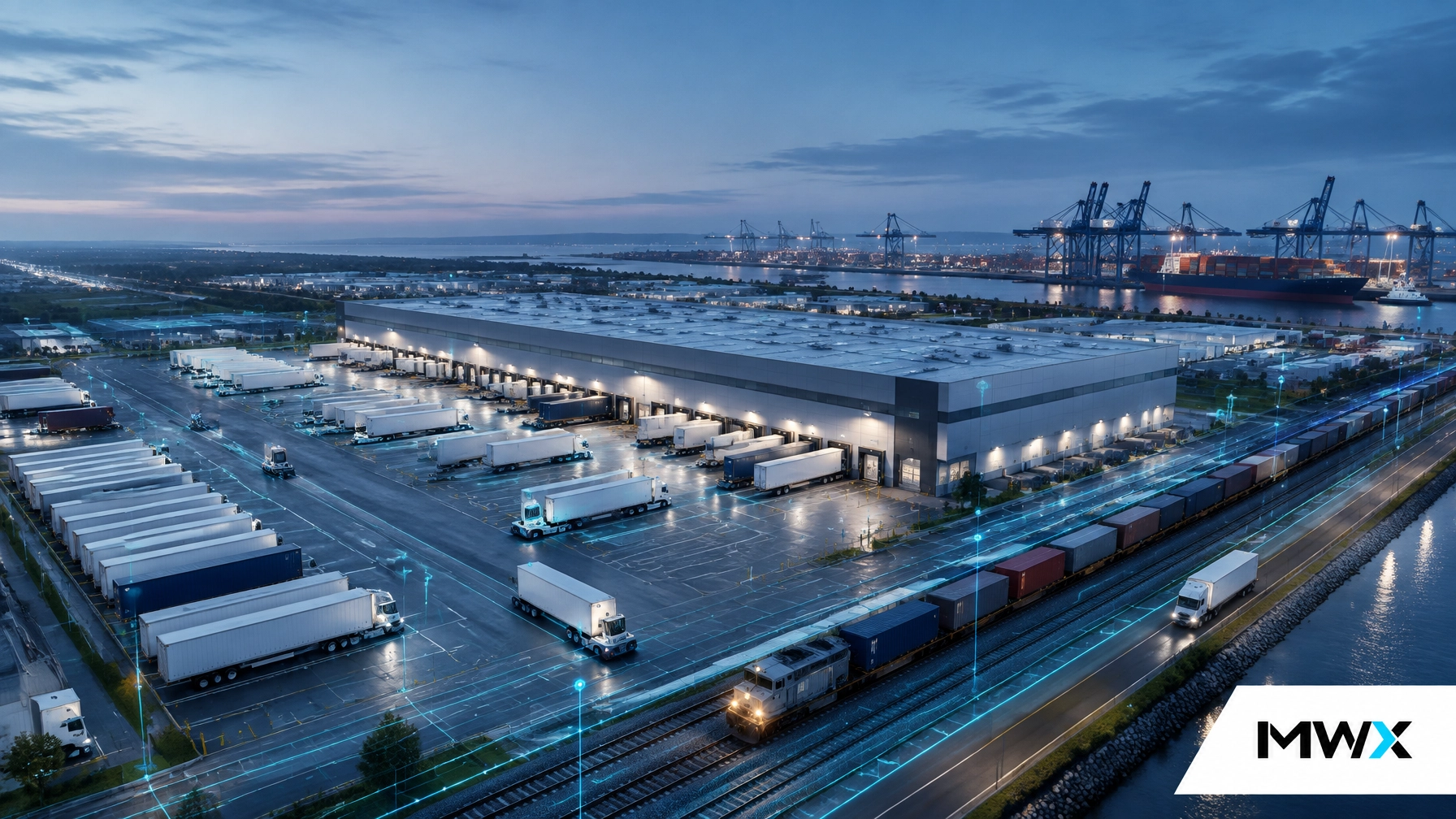
The era of intelligent logistics hubs is here.
Warehouses, distribution centers, freight yards, and intermodal terminals are no longer isolated facilities. They are dynamic ecosystems where vehicles, inventory, labor, equipment, security systems, and energy infrastructure must work together in real time.
Yet many logistics operators still manage these environments through disconnected systems and manual processes. The result is limited end-to-end visibility, rising detention costs, congested yards, underused dock doors, and reactive exception handling.
Use Case #42 in the series “50 Ways MetaWorldX Physical AI Is Transforming the World” shows how an AI digital twin can turn a logistics hub into a visible, predictable, and continuously optimized operation.
The Logistics Hub Problem: Complexity Without Visibility
A modern logistics hub generates enormous volumes of operational data. WMS records inventory movements. TMS platforms manage shipments and carrier appointments. YMS systems track trailers and yard locations. Cameras, RFID readers, telematics, access control, and IoT devices monitor physical activity.
The challenge is that these systems often operate independently.
A planner may know that a truck has arrived, but not whether its assigned door is available. A yard manager may see a trailer on a camera feed, but not know that its paperwork is incomplete. A warehouse supervisor may see rising outbound demand, without visibility into labor availability or congestion developing at the gate.
This creates several recurring operational problems:
- Opaque end-to-end visibility: Teams cannot easily connect a shipment’s arrival, yard position, dock assignment, inventory status, and departure time.
- Trailer dwell and detention: Trailers remain on-site longer than planned, increasing carrier penalties, demurrage, and yard pressure.
- Dock door contention: Multiple loads compete for the same doors while other doors remain idle or poorly utilized.
- Yard congestion: Manual checks and inaccurate trailer locations create unnecessary moves, queues, and safety risks.
- Disconnected technology: WMS, TMS, YMS, security, access control, BMS, and IoT platforms produce fragmented views.
- Unpredictable resource allocation: Labor, forklifts, yard tractors, cranes, and other equipment are assigned reactively.
- Exception-driven management: Teams respond to late arrivals, no-shows, equipment failures, and weather disruption only after performance has deteriorated.
The result is not simply slower logistics. It is reduced resilience across critical infrastructure, transportation networks, and the wider supply chain.
How MetaWorldX Physical AI Creates a Living Model of the Hub
MetaWorldX Physical AI begins by creating an AI digital twin of the logistics environment.
This is more than a static 3D model. It is a living operational representation of the hub, continuously updated with real-world data from:
- WMS, TMS, and YMS platforms
- IoT sensors and dock equipment
- RFID and geolocation systems
- Fleet telematics and GPS
- Cameras and computer vision
- Gate, access control, and security systems
- BMS and facility energy systems
- Labor, appointment, inventory, and equipment data
The platform brings this information into a shared spatial and operational context. Planners can see where trailers, containers, forklifts, yard tractors, inventory, and people are located, and understand how each movement affects the rest of the operation.

This provides real-time monitoring across four connected operating layers:
- Yard: Trailer positions, queues, parking capacity, gate activity, and internal traffic flow.
- Docks: Door availability, appointment windows, loading progress, service times, and congestion.
- Inventory and assets: Product locations, material movements, container status, equipment utilization, and exceptions.
- Facility infrastructure: Lighting, HVAC, refrigeration, access control, safety systems, and energy consumption.
The key advantage is integration without rip-and-replace. MetaWorldX can work with existing PSIM, access control, BMS, IoT, WMS, TMS, and YMS environments rather than forcing operators to replace systems that already support daily operations.
The physical AI layer connects what the hub already knows with what the operation needs to decide next.
From Monitoring to Prediction and Prescriptive Action
Visibility is essential, but visibility alone does not optimize a logistics hub. MetaWorldX adds predictive and prescriptive analytics to identify what is likely to happen and recommend how operators should respond.
The AI digital twin can help predict:
- Early and late carrier arrivals
- Carrier no-shows and appointment risks
- Dock service duration
- Trailer dwell-time overruns
- Yard occupancy and queue buildup
- Labor and equipment shortages
- Bottlenecks caused by inventory waves
- Impacts from weather, maintenance, or access restrictions
- Energy demand associated with changing operating patterns
It can then recommend actions such as:
- Reassigning a shipment to a more suitable dock door
- Pre-positioning a trailer closer to a high-priority door
- Staging additional yard tractors before a predicted surge
- Adjusting labor allocation between receiving and outbound operations
- Rescheduling appointments to prevent a yard capacity breach
- Prioritizing loads with a high probability of missing delivery commitments
- Modifying HVAC and lighting schedules around actual occupancy and throughput
This is the difference between a dashboard and an intelligent operating system. A dashboard reports that congestion exists. Physical AI identifies the likely cause, forecasts the consequences, and proposes a practical response.
Scenario Planning Before Operational Change
Logistics leaders routinely face decisions that are difficult to test in the physical world:
- How will the hub perform during peak season?
- What happens if 15% of carriers arrive late?
- Can the facility handle a temporary labor shortage?
- Where should additional staging capacity be placed?
- How would a revised yard layout affect traffic?
- What is the operational impact of a storm or port closure?
- Can a new cross-dock process increase throughput without adding doors?
MetaWorldX uses real-time 3D simulation to test these scenarios before changes are made on-site.
Operators can compare alternative dock allocations, traffic routes, labor plans, yard configurations, and operating schedules inside the digital twin. They can evaluate peak-season surges, carrier no-shows, weather disruption, equipment outages, layout reconfiguration, and changes to inventory flow.
This supports more confident decisions while limiting disruption to live operations.
For port-adjacent campuses, airports, and major infrastructure projects, the same approach can model interactions across warehouses, access roads, rail sidings, terminals, security perimeters, and public infrastructure. That makes the technology relevant to logistics environments connected to Toronto, Dubai, NEOM, airports, seaports, and large-scale urban developments.
Human-in-the-Loop Governance
Automation must support operational expertise, not remove accountability from the people responsible for safety, service, and continuity.
MetaWorldX therefore enables human-in-the-loop governance. The platform recommends an action, explains the operational factors behind it, and allows an authorized planner or manager to approve, modify, or reject the recommendation.
For example, if the twin predicts a yard bottleneck, a planner can review:
- The trailers contributing to the forecast
- The available dock doors and time windows
- Labor and equipment constraints
- Priority shipments and service commitments
- Alternative actions and their expected impacts
The final decision remains with the people who understand contractual obligations, safety rules, customer priorities, and local operating conditions.

This governance model creates a practical path to adoption. It combines award-winning technology and advanced analytics with clear operational control.
A Practical Before-and-After Example
Consider a port-adjacent distribution campus serving regional retailers and manufacturers. The campus includes a 500,000-square-foot warehouse, 40 dock doors, a trailer yard, cross-dock lanes, and direct connections to a seaport and regional highway network.
Before implementing a unified digital twin, the campus experiences:
- Manual yard checks several times per shift
- Average trailer dwell of 14.2 hours
- Frequent door conflicts during inbound waves
- Dock utilization of approximately 62%
- Overtime caused by late-arriving loads
- Demurrage and detention costs from delayed departures
- Limited coordination between the warehouse, yard, security, and carrier teams
MetaWorldX connects the campus’s WMS, TMS, YMS, telematics, cameras, access control, IoT sensors, and BMS into a 3D operational twin. The platform forecasts arrivals, identifies likely dwell-time exceptions, simulates door assignments, and recommends labor and equipment staging plans.
In an illustrative modeled scenario, the operating team could target:
| Metric | Before | After Optimization |
|---|---|---|
| Average trailer dwell | 14.2 hours | 10.4 hours |
| Trailer detention events | Baseline | 18% reduction |
| Dock door utilization | 62% | 78% |
| Throughput per square foot | Baseline | 25% improvement |
| Overtime hours | Baseline | 15% reduction |
| Demurrage and detention cost | Baseline | 22% reduction |
| On-time outbound departures | 91% | 96% |
| Facility energy consumption | Baseline | 12% reduction |
These figures represent a planning example, not a guaranteed customer outcome. Actual results depend on data quality, facility design, operating rules, labor agreements, carrier behavior, and implementation scope.
However, the operational logic is clear: reducing unnecessary movement, preventing avoidable queues, improving door utilization, and coordinating facility systems can create measurable financial and sustainability benefits.
Research from logistics digital twin initiatives has also reported meaningful improvements in dock queue time, warehouse flow, and energy efficiency. For example, one fulfillment operation reported a 22% reduction in average dock queue time after using digital twin analysis to resequence work waves. Broader logistics research and industry analysis continues to show how simulation, IoT, and AI can improve throughput while reducing idle travel and facility energy use.

The Future of Logistics Is Predictive, Connected, and Resilient
The next generation of logistics hubs will not be defined only by warehouse size, automation levels, or the number of dock doors. Competitive advantage will increasingly come from how intelligently the entire physical system can respond to change.
MetaWorldX Physical AI helps organizations move from:
- Manual yard checks to continuous spatial awareness
- Reactive exception handling to predictive intervention
- Fixed schedules to adaptive resource allocation
- Disconnected systems to a unified operational view
- Physical trial and error to comprehensive scenario planning
- Facility-level optimization to network-aware decision-making
For government entities, infrastructure operators, logistics providers, airport authorities, port operators, and large-scale property developers, this creates a foundation for more efficient and resilient operations.
The logistics hub of the future will not simply move goods faster. It will understand its own condition, anticipate disruption, and help people make better decisions before delays become failures.
To explore how MetaWorldX applies digital twin technology, Physical AI, and real-time simulation to logistics, smart city use cases, and AI for critical infrastructure, visit metaworldx.com.