
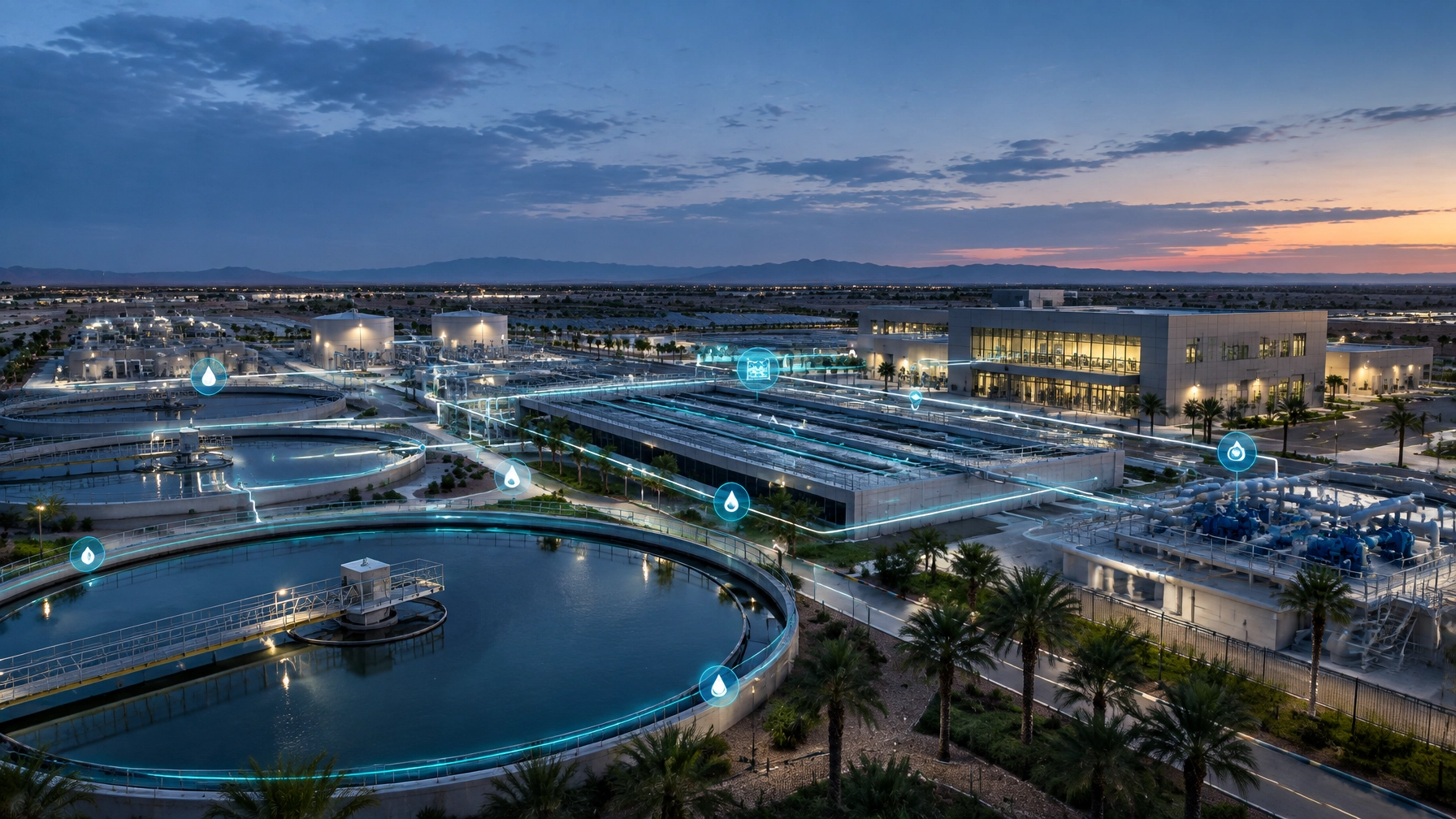
Part 39 of the “50 Ways MetaWorldX Physical AI Is Transforming the World” series
Clean water depends on infrastructure that must operate continuously, safely, and efficiently. Yet many treatment plants still rely on aging assets, fragmented data, manual inspections, and operating practices built around fixed assumptions.
That model is becoming increasingly difficult to sustain.
Influent quality changes by the hour. Energy prices fluctuate. Extreme weather can overwhelm hydraulic capacity. Equipment failure can interrupt treatment at the worst possible moment. At the same time, utilities face rising expectations to reduce operating costs, conserve water, lower emissions, and maintain strict regulatory compliance.
The future of water treatment is predictive, connected, and continuously optimized.
With MetaWorldX Physical AI, water and wastewater utilities can combine real-time operational data, AI-powered digital twins, 3D simulation, and human expertise to make better decisions across the entire treatment process.
The Water Treatment Challenge: Complexity Without Visibility
Treatment plants are among the most important forms of critical infrastructure. They also rank among the most complex to operate.
A single facility may contain intake systems, clarifiers, filters, aeration basins, chemical dosing equipment, pumps, reservoirs, sludge handling assets, and discharge points. Each component affects the others. A small change in influent conditions can create a chain reaction across energy use, chemical demand, throughput, and effluent quality.
Common challenges include:
-
Aging treatment infrastructure
Many plants operate with equipment designed decades ago. Operators may understand the assets deeply, but limited instrumentation and disconnected systems make it difficult to see the plant as one coordinated environment.
-
Fluctuating influent quality
Rainfall, industrial discharge, seasonal changes, population growth, and upstream network conditions can change flow, turbidity, organic loading, temperature, and nutrient levels. Static operating settings cannot respond efficiently to every condition.
-
Energy-intensive aeration and pumping
Aeration is often one of the largest energy consumers in biological wastewater treatment. Pumps also require substantial power, particularly when operators run equipment conservatively to protect capacity and reliability.
-
Chemical dosing guesswork
Coagulants, disinfectants, polymers, ferric compounds, and other treatment chemicals are frequently adjusted using historical settings, periodic sampling, or operator experience. Overdosing increases cost and can create new process complications. Underdosing can threaten water quality.
-
Regulatory compliance risk
Compliance depends on maintaining multiple quality parameters within defined limits. By the time a laboratory result identifies a problem, the underlying conditions may already have changed.
-
Unplanned equipment failure
Blowers, pumps, mixers, valves, and dosing systems can degrade gradually before failing. Without predictive monitoring, maintenance teams may discover a problem only after performance has declined or service has been interrupted.
-
Water loss and process inefficiency
Leaks, overflows, inefficient backwashing, poor pump coordination, and avoidable process variation can waste treated water and increase the cost of every unit produced.
The central problem is not a lack of data. It is the lack of a unified operational intelligence layer that can turn data into timely, practical decisions.

How MetaWorldX Physical AI Optimizes Water Infrastructure
Physical AI connects intelligence to the physical world.
For a treatment plant, this means understanding how real assets behave, how process conditions interact, and how operational decisions affect future outcomes. Rather than simply reporting what happened, the system can help explain what is happening, predict what is likely to happen next, and recommend what operators can do about it.
MetaWorldX Physical AI brings together five capabilities.
1. Predictive and prescriptive analytics
Predictive analytics forecasts future conditions. It can identify likely changes in influent loading, effluent quality, energy demand, or equipment performance.
Prescriptive analytics goes further by evaluating possible actions and recommending the most effective response. For example, it can assess:
- Blower airflow and dissolved oxygen setpoints
- Pump combinations and operating schedules
- Coagulant, polymer, ferric, or disinfectant dosage
- Sludge return and wasting rates
- Filter backwash timing
- Maintenance priorities for pumps, blowers, and mixers
These recommendations can account for multiple constraints at once: water quality, energy consumption, chemical cost, asset availability, hydraulic capacity, and regulatory thresholds.
2. A real-time 3D simulation of the plant
A dashboard can show readings. A real-time 3D digital twin can show the relationship between those readings and the physical plant.
MetaWorldX can represent treatment units, tanks, pumps, pipes, valves, control rooms, and surrounding infrastructure in a navigable digital environment. Sensor data can be linked to the relevant asset or process area, allowing teams to understand where an issue is occurring and how it may affect the wider facility.
This visual context is especially valuable during abnormal conditions. An operator can move from a plant-wide view to a specific pump, basin, or dosing point without relying on disconnected screens or manually assembled information.
3. IoT and existing system integration
Water utilities have already invested heavily in operational technology. A practical Physical AI platform must work with that environment rather than forcing a complete replacement.
MetaWorldX is designed to integrate with existing:
- SCADA and control systems
- IoT sensors and sensor networks
- Historians and operational databases
- Building management systems
- Access control and security platforms
- PSIM and command-and-control environments
- Laboratory and maintenance data sources
This approach helps utilities use existing infrastructure more effectively while adding a connected intelligence layer. It also supports a broader view of critical infrastructure, linking a treatment plant with reservoirs, pumping stations, distribution networks, emergency operations, and nearby public assets.
4. Scenario planning before action
Treatment decisions often involve trade-offs. Increasing aeration may improve biological performance but increase energy consumption. Reducing chemical dosing may lower costs but create compliance risk. Taking a pump offline may support maintenance but reduce redundancy.
MetaWorldX enables comprehensive what-if scenario planning in the AI digital twin.
Teams can evaluate questions such as:
- What happens if influent flow increases by 20%?
- How will a storm event affect turbidity and treatment capacity?
- Which pumps should operate during a high-demand period?
- What is the effect of reducing aeration in one basin?
- How would a planned blower outage affect resilience?
- Can chemical dosage be reduced while maintaining quality targets?
- What happens if a critical sensor becomes unavailable?
The value is not merely seeing a simulation. It is comparing possible actions before applying them to a live physical process.

5. Human-in-the-loop governance
Water treatment is a safety-critical operation. Automation should strengthen professional judgment, not remove accountability from the people responsible for public health and environmental protection.
MetaWorldX supports human-in-the-loop governance by giving operators and managers the ability to:
- Review recommendations before implementation
- Understand the assumptions behind an alert or forecast
- Compare alternative scenarios
- Approve, modify, or reject proposed actions
- Define operating boundaries and escalation rules
- Maintain an auditable record of decisions
This governance model allows utilities to adopt AI responsibly. Teams can begin with monitoring and recommendations, validate performance, and gradually introduce higher levels of automation where appropriate.
A Practical Example: A Municipal Water Treatment Utility
Consider a municipal utility serving a growing city with an aging treatment plant. The facility experiences daily variations in influent flow and quality, while its blowers and pumps operate according to conservative schedules. Chemical dosing is adjusted by operators using a combination of laboratory results, historical patterns, and experience.
The utility deploys MetaWorldX Physical AI as an intelligence layer connected to its SCADA, IoT sensors, energy meters, laboratory data, and maintenance systems.
The platform creates a real-time 3D model of the plant and begins tracking:
- Influent flow, turbidity, temperature, and loading
- Dissolved oxygen and nutrient conditions
- Blower and pump performance
- Chemical consumption
- Tank levels and hydraulic capacity
- Effluent quality indicators
- Vibration, runtime, and equipment health signals
The digital twin identifies that the plant is regularly over-aerating during lower-load periods. It also detects that two pumps are being operated in a combination that provides reliability but consumes more energy than necessary.
The system recommends a revised aeration strategy, more efficient pump sequencing, and a narrower chemical dosing range. Operators review the recommendations in the 3D simulation, test them against several influent scenarios, and approve a controlled implementation.
During a heavy rainfall event, the platform forecasts increased hydraulic and contaminant loading. It alerts the operations team before quality indicators approach critical thresholds and provides response options, including changes to aeration, pumping, chemical dosing, and process routing.
This is the practical distinction between monitoring and Physical AI: the system does not simply display a problem. It helps the utility understand the problem, evaluate possible responses, and act with greater confidence.
Outcomes and ROI: Turning Efficiency Into Resilience
Every plant will have different baseline conditions, instrumentation, and regulatory requirements. Actual results must be measured against the utility’s own operational data. However, research and industry examples indicate that AI-enabled optimization can produce meaningful improvements in several areas.
Energy savings
Optimized aeration and pump scheduling can reduce unnecessary power consumption. Published examples have reported blower energy reductions in the range of 17% and pump-specific energy reductions of approximately 10% under defined operating conditions.
Chemical cost reduction
More accurate dosing reduces over-application while protecting treatment performance. Research and industry case studies have reported chemical savings of approximately 13% in selected applications, with some digital twin approaches identifying even greater opportunities for targeted reagent reduction.
Reduced downtime
Predictive maintenance can identify performance deterioration before a blower, pump, mixer, or valve fails. Maintenance teams can prioritize work based on condition and consequence rather than fixed schedules alone.
Stronger compliance performance
By forecasting effluent conditions and testing response strategies in advance, utilities can reduce the risk of crossing regulatory thresholds. The result is greater process stability, clearer operational accountability, and improved readiness for unusual events.
Improved water quality and reduced water loss
Continuous visibility helps utilities identify process variation, leakage, overflow risk, inefficient backwashing, and other sources of avoidable loss. Better control supports consistent water quality while improving the value obtained from every unit of treated water.

From Treatment Plants to Smarter Water Systems
Water treatment optimization is one part of a much larger smart city opportunity.
The same digital twin approach can connect treatment facilities with reservoirs, distribution networks, flood management systems, hospitals, airports, ports, and emergency response operations. Cities such as Toronto, Dubai, and NEOM demonstrate the growing importance of connected infrastructure models that help decision-makers understand complex urban systems in context.
For a command-and-control center, the treatment plant becomes more than an isolated facility. It becomes a live, data-rich component of the city’s resilience strategy.
MetaWorldX’s award-winning technology is built around this wider vision: integrating physical assets, operational data, AI, and real-time simulation to support smarter decisions across critical infrastructure and smart city use cases.
The Next Standard for Water Infrastructure
The water sector cannot afford to operate solely through historical averages and reactive maintenance. Aging assets, uncertain conditions, climate pressures, and rising demand require a more adaptive model.
The next generation of treatment plants will not simply process water. They will learn from every operational signal, test decisions before applying them, and continuously improve how resources are used.
MetaWorldX Physical AI provides the foundation for that transition through an integrated Physical AI platform, real-time 3D simulation, predictive and prescriptive analytics, seamless system integration, and accountable human oversight.
To explore how digital twin technology can support water infrastructure, critical infrastructure, and broader smart city transformation, visit MetaWorldX.