
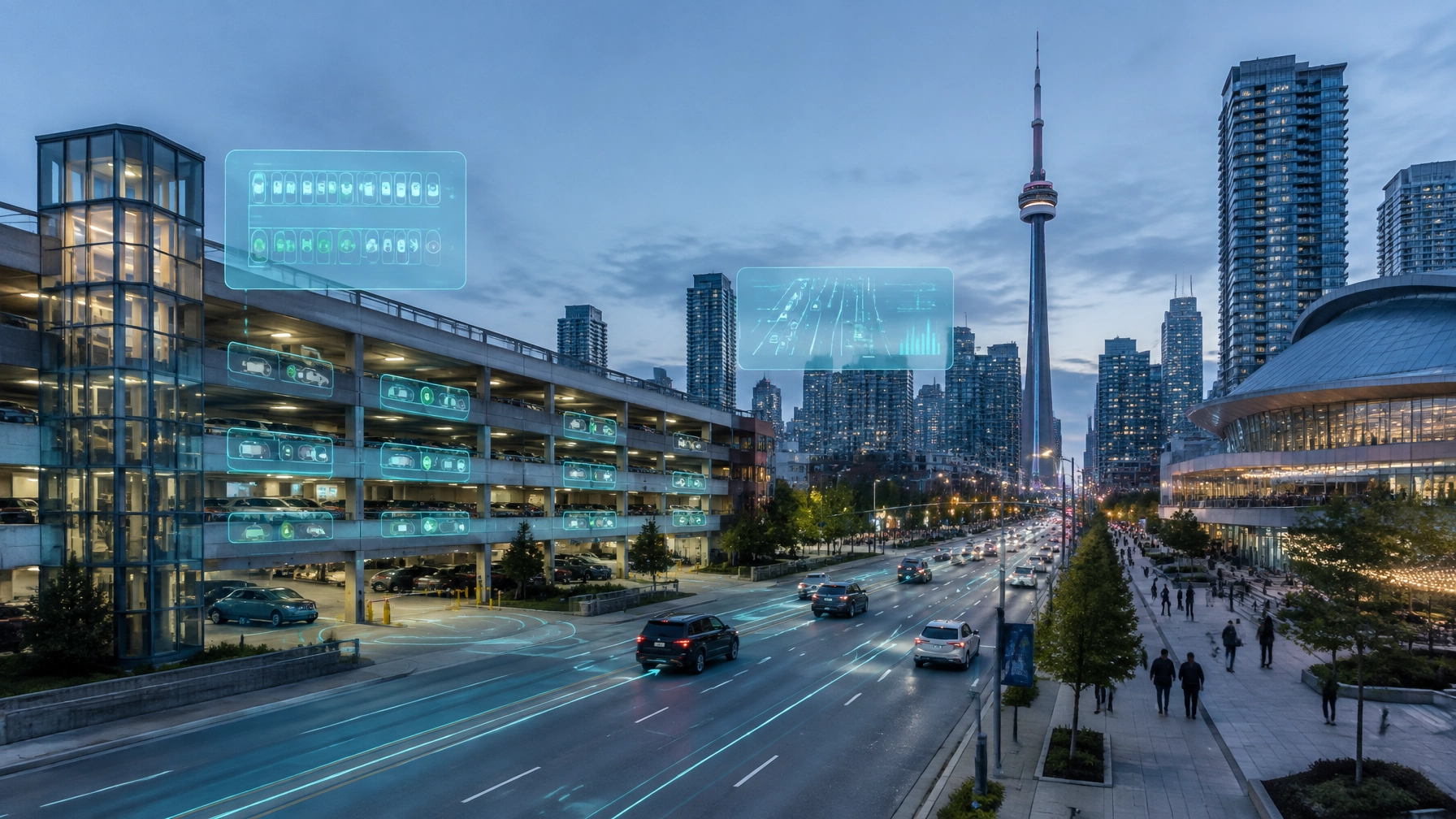
The future of parking is not simply finding more spaces. It is coordinating the spaces, streets, buildings, vehicles, people, and events that make urban mobility work.
Parking is a deceptively complex component of city infrastructure. A single district may include on-street spaces, garages, loading zones, accessible bays, EV chargers, private developments, hospitals, hotels, and event venues. Each asset generates data. Each has different operating rules. Together, they create a constantly changing mobility system.
MetaWorldX Physical AI brings these elements into one intelligent operating picture. Through an AI digital twin, real-time sensing, predictive analytics, and prescriptive decision support, cities and property operators can move from reactive parking management to coordinated, proactive mobility.
The parking problem is a mobility problem
In high-demand urban areas, parking friction affects more than the driver looking for a space.
Research frequently cites the estimate that up to 30% of vehicles in congested downtown areas may be searching for parking during busy periods. The figure varies by location and methodology, but the operational impact is clear: cruising creates localized congestion, additional emissions, unpredictable travel times, and pressure on surrounding streets. The Federal Highway Administration notes that the widely repeated 30% figure should be treated as context-specific rather than a universal citywide average.
The challenge extends across several dimensions:
- Wasted time and fuel: Drivers circle blocks or move between garages without reliable information about availability.
- Poor utilization: One garage may be nearly full while another nearby has substantial unused capacity.
- Revenue leakage: Inconsistent enforcement, outdated pricing, unoccupied reservable spaces, and fragmented payment systems reduce revenue per space.
- Event surge chaos: Arenas, stadiums, convention centres, and entertainment districts can overwhelm entrances and exits within minutes.
- Accessibility friction: Accessible spaces may be occupied, difficult to locate, or poorly connected to real-time guidance.
- EV charging pressure: Drivers need information about both parking availability and charger availability, including expected dwell time.
- Operational fragmentation: Parking systems often operate separately from access control, building management, traffic operations, and public safety platforms.
The core issue is not a lack of data. It is a lack of shared operational intelligence.

How MetaWorldX Physical AI coordinates parking operations
Physical AI applies intelligence to environments where decisions have real-world consequences. It connects digital information to physical assets, human activity, and operational workflows.
MetaWorldX creates a live digital representation of a parking ecosystem, whether that ecosystem serves a downtown district, airport, hospital campus, port, stadium, or large mixed-use development.
1. Build an AI digital twin of parking assets
The digital twin can represent:
- Individual parking spaces and zones
- Multi-level garages and ramps
- Entry and exit lanes
- Accessible parking and priority areas
- EV chargers and charging bays
- Loading areas and curbside restrictions
- Nearby streets, intersections, and pedestrian routes
- Connected buildings, facilities, and public spaces
This model provides a 3D operational view rather than a collection of disconnected dashboards. Operators can see how a blocked ramp, full garage, event arrival wave, or charger outage may affect the surrounding network.
MetaWorldX’s broader digital twin platform combines real-time monitoring, simulation, IoT data, and AI-powered insight to support this type of connected decision-making.
2. Integrate occupancy and infrastructure data
A parking digital twin becomes valuable when it reflects current conditions. MetaWorldX can integrate data from existing systems, including:
- IoT occupancy sensors
- Camera-based occupancy detection
- ANPR and LPR systems
- Parking management and payment platforms
- Access control and gate systems
- PSIM platforms
- Building management systems
- Traffic signals and road sensors
- EV charging management platforms
- GIS and BIM environments
This interoperability is critical. Cities and operators do not need to discard every system already in place. Instead, MetaWorldX can help connect those systems into a more comprehensive data ecosystem.
The objective is one operational view of parking, not another isolated application.
3. Forecast demand before the pressure arrives
Historical occupancy patterns can reveal how parking demand changes by:
- Hour of day
- Day of week
- Weather conditions
- Holidays
- School schedules
- Construction activity
- Airport and hospital demand
- Concerts, games, and conferences
- Retail and residential activity
Predictive analytics can then forecast where demand is likely to build and when capacity may become constrained.
For example, an operator could identify that a downtown garage will reach capacity shortly before an arena event, while a nearby facility will remain underused. The system can support early action: adjust signage, recommend alternate facilities, reserve accessible capacity, modify entry sequencing, or communicate pricing changes.
Forecasting turns parking from a point-in-time reaction into a planned operating strategy.
4. Recommend actions through prescriptive analytics
Prediction answers what is likely to happen. Prescriptive analytics helps determine what should happen next.
MetaWorldX Physical AI can support operational recommendations such as:
- Route arriving vehicles to facilities with the highest probability of availability
- Balance demand across multiple garages
- Adjust dynamic pricing within approved policy limits
- Prioritize short-term, accessible, resident, or event parking
- Reallocate staff to entrances, exits, or enforcement hotspots
- Direct EV drivers toward available chargers with suitable dwell times
- Trigger alerts when queues or occupancy thresholds are exceeded
- Coordinate parking guidance with nearby traffic conditions
The system does not need to make every decision autonomously. In complex public environments, human oversight remains essential.
Real-time simulation for events and exceptional conditions
Parking networks often fail at the moments when demand is least predictable. A normal weekday operating model may not prepare an operator for a sold-out concert, a road closure, a severe weather event, or a simultaneous hospital and stadium surge.
MetaWorldX uses real-time 3D simulation and scenario planning to test possible outcomes before implementing a response.
Operators can examine questions such as:
- What happens if an arena releases 10,000 vehicles within 30 minutes?
- Which garage exits create the longest queues?
- How does a closed access road change arrival patterns?
- Where should traffic marshals or public safety personnel be positioned?
- Can accessible spaces and emergency routes remain protected?
- How many EV chargers will be available after a large arrival wave?
- Which combination of pricing, signage, and routing best balances capacity?
A simulated scenario gives decision-makers a shared visual language. Transportation teams, property managers, security leaders, event organizers, and public safety agencies can evaluate the same operational picture.

Example: an arena event in a downtown Toronto district
Consider an illustrative downtown Toronto entertainment district with several commercial garages, residential towers, on-street parking, restaurants, and an arena.
On an ordinary evening, the district may operate efficiently. On an event night, demand changes rapidly:
- Arriving vehicles concentrate on a small number of streets.
- One garage fills earlier because drivers prefer its location.
- Drivers unfamiliar with the area slow down to search for alternatives.
- Ride-hailing vehicles compete with private cars near the venue.
- EV drivers queue for a limited number of chargers.
- Accessible parking demand increases.
- Exit traffic peaks at the same time as restaurant and residential activity.
A MetaWorldX parking digital twin could combine occupancy data, access control events, traffic conditions, event schedules, and historical patterns. Several hours before the event, predictive analytics could identify likely capacity pressure.
The operator could then use the platform to:
- Publish route guidance toward underused facilities
- Adjust approved event pricing to balance demand
- Protect accessible and priority spaces
- Direct EV drivers to chargers with expected availability
- Position staff at likely queue-forming entrances
- Model exit strategies before the event concludes
- Monitor the district in real time and revise recommendations
This example is not about replacing local expertise. It is about giving operators better foresight and a more complete operating picture.
The same approach can support Dubai mixed-use developments, airport parking complexes, hospitals, ports, stadium districts, and large-scale projects in NEOM: environments where parking is closely connected to security, access, passenger flow, and infrastructure resilience.
Human-in-the-loop governance matters
Parking decisions can affect affordability, accessibility, public trust, and local traffic patterns. For that reason, effective Physical AI should support accountable human governance.
MetaWorldX can help organizations define:
- Which decisions may be automated
- Which actions require operator approval
- What pricing or routing rules apply
- How accessible spaces are protected
- How recommendations are logged and reviewed
- Which teams receive alerts
- How exceptions are handled during emergencies
AI can surface patterns and recommend actions, while authorized teams retain control over policy, priorities, and public-facing decisions.
The strongest parking systems combine machine intelligence with human judgment.

Measuring the operational and financial impact
A parking management transformation should be evaluated through measurable outcomes. Relevant indicators include:
- Reduced average search and cruising time
- Lower vehicle queues at garage entrances and exits
- Higher utilization across the full parking network
- Increased revenue per available space
- Fewer payment, access, and enforcement exceptions
- Better availability of accessible parking
- Improved EV charger utilization and turnover
- Reduced event-related congestion
- Faster response to incidents and equipment failures
- Lower fuel use and emissions associated with unnecessary circulation
The business case will differ between a city, airport, hospital, developer, or infrastructure operator. However, the principle remains consistent: when operators understand demand earlier and coordinate assets more effectively, every space can create more value.
The next generation of urban mobility is coordinated
Parking is one of the most visible daily interactions between people and urban infrastructure. When it works poorly, drivers experience frustration and cities absorb the cost through congestion, emissions, and inefficient land use. When it works intelligently, parking becomes part of a broader, more connected mobility system.
MetaWorldX Physical AI brings together AI digital twin technology, IoT integration, predictive and prescriptive analytics, real-time 3D simulation, and human-in-the-loop governance. It helps cities and organizations understand not only where vehicles are parked, but how parking decisions influence streets, buildings, events, safety, accessibility, and sustainability.
This is one of the practical physical AI use cases shaping smarter cities: turning complex, fragmented infrastructure data into timely decisions in the real world.
Explore how MetaWorldX is building the intelligence layer for more resilient cities and critical infrastructure at metaworldx.com.