
This is post #35 in the “50 Ways MetaWorldX Physical AI Is Transforming the World” series.
An airport terminal is a living system. Passenger arrivals, security processing, immigration, gate changes, aircraft schedules, staffing levels, retail activity, and weather disruptions continuously influence one another.
When those interactions are managed reactively, small delays can quickly become operational crises. A late inbound aircraft creates a passenger surge. A security lane closes. A queue expands. Staff are redeployed after congestion has already formed. Connecting passengers begin to miss flights, while airport teams absorb overtime and increasingly urgent decisions.
The next generation of airport operations will not wait for congestion to appear. It will predict, simulate, and manage passenger flow before disruption reaches the terminal floor.
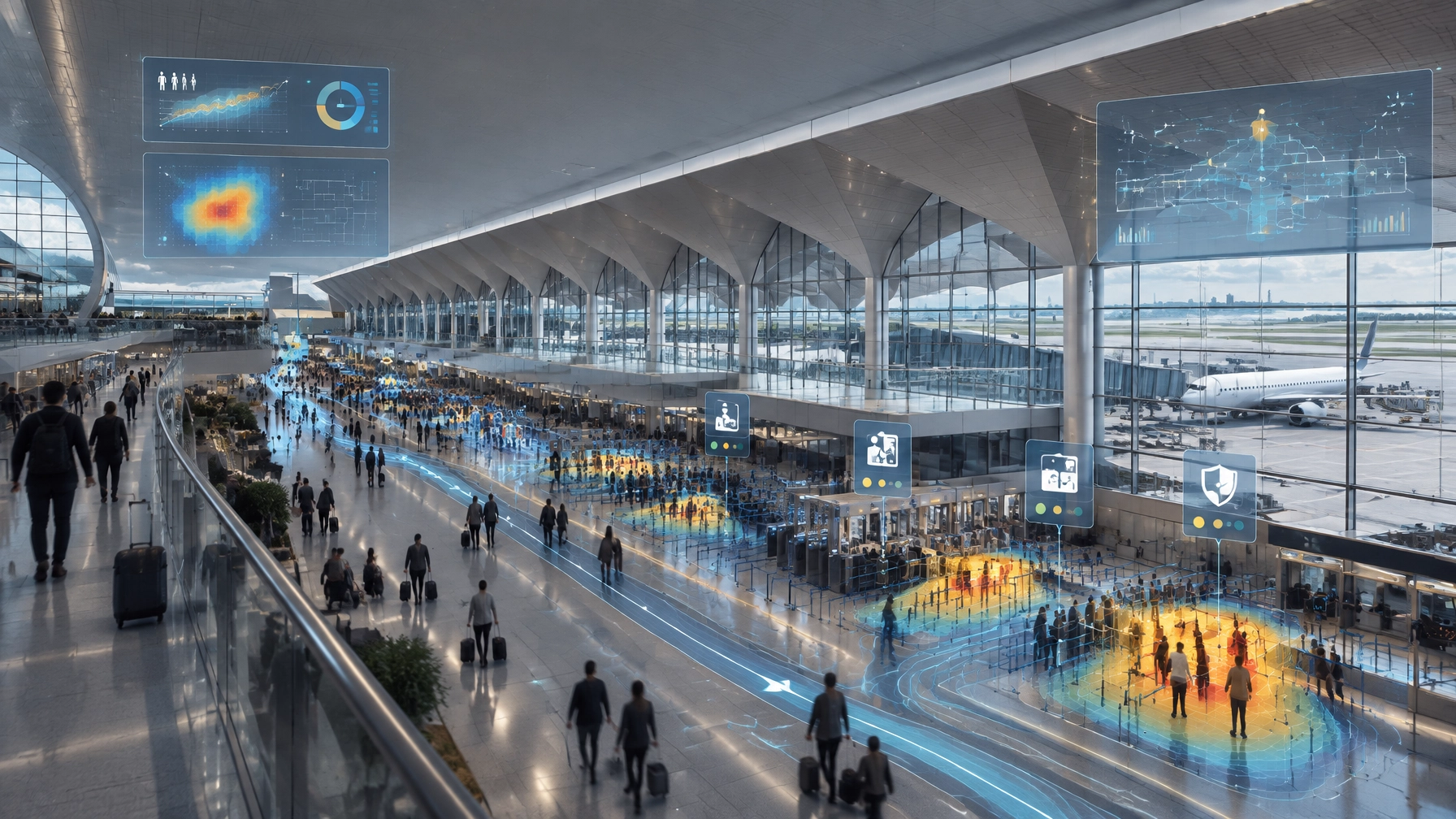
MetaWorldX Physical AI enables that shift through an AI digital twin of the airport terminal: combining live operational data, predictive analytics, prescriptive recommendations, and real-time 3D simulation.
The passenger flow problem: congestion is expensive at every level
Terminal congestion is not simply an inconvenience. It affects safety, airline performance, airport revenue, workforce efficiency, and public confidence.
The most visible pressure points typically include:
- Security and immigration queues that grow faster than teams can respond.
- Mismatch between staffing and demand peaks, with too few officers during surges and excess capacity during quieter periods.
- Missed connections caused by unpredictable processing and walking times.
- Gate-area crowding when passengers arrive early because they are uncertain about downstream queues.
- Disrupted retail and concession activity when passengers spend their entire dwell time waiting in line.
- Overtime and operational stress caused by emergency staff call-ins and last-minute lane openings.
- Reactive decision-making, where teams respond to current conditions without seeing what is likely to happen next.
Industry guidance from organizations such as IATA and ACI Europe emphasizes the importance of monitoring passenger flows, managing queues, and aligning terminal resources with demand.
Yet monitoring alone is not enough. Airport leaders need to understand not only where passengers are now, but where they will be in 30 minutes, two hours, or at the moment a disrupted flight arrives.

How MetaWorldX Physical AI transforms terminal operations
A terminal digital twin turns fragmented airport data into a shared operational picture, and a forward-looking decision system.
MetaWorldX builds the AI digital twin from the terminal’s existing physical, operational, and data environment. The platform can connect relevant information from:
- Flight schedules, aircraft types, load factors, and arrival profiles.
- Check-in, bag drop, security, immigration, and boarding timestamps.
- Passenger-counting systems, cameras, LiDAR, and other IoT sensors.
- Gate assignments, minimum connection times, and transfer routes.
- Staff rosters, qualifications, lane availability, and operating constraints.
- Access control, PSIM, building management systems, and facility data.
- Weather, disruption, emergency, and infrastructure-status feeds.
This integration creates a continuously updated 3D representation of the terminal. Operational teams can see passenger density, queue length, predicted wait times, available capacity, and emerging risks in a single environment.
1. Predictive analytics forecasts demand before queues form
The system analyzes historical and live data to forecast passenger volumes at specific locations and time windows.
For example, it can estimate:
- Passenger arrivals at security over the next 15, 30, 60, or 120 minutes.
- Immigration demand created by a group of arriving wide-body aircraft.
- Transfer passenger volumes moving between terminals or concourses.
- Queue lengths and expected wait times under current staffing.
- The number of passengers at risk of missing a connection.
- The likely impact of a delayed flight, gate change, or weather diversion.
This gives airport operations teams time to act while options are still available.
The operational advantage is simple: forecast the queue, not just the queue length.
2. Prescriptive analytics recommends the next best action
Prediction identifies what may happen. Prescriptive analytics recommends how to respond.
Depending on airport policies and operating constraints, MetaWorldX Physical AI can recommend:
- Opening or closing security and immigration lanes.
- Moving qualified staff between checkpoints.
- Adjusting staffing levels at check-in, transfer security, or boarding.
- Re-routing passengers through alternative processing points.
- Prioritizing tight-connection passenger groups.
- Issuing targeted wayfinding or operational alerts.
- Coordinating with airlines, gate teams, and terminal control rooms.
The airport retains control over decisions. Recommendations can be reviewed, approved, modified, or rejected by authorized personnel.
This human-in-the-loop governance is essential in critical infrastructure. AI should improve situational awareness and decision quality while preserving accountability with airport leaders and operating teams.
3. Real-time 3D simulation tests disruption scenarios
A 3D digital twin allows airport teams to test operational decisions before implementing them in the physical terminal.
Examples include:
- Security lane failure: What happens if two lanes close during a morning departure bank?
- Weather diversion: How will an unexpected arrival wave affect immigration, baggage claim, and landside transport?
- Wide-body arrival surge: Can existing staffing absorb several large aircraft arriving within 20 minutes?
- Gate reassignment: How will passenger walking times and transfer routes change?
- Emergency response: Which routes preserve safe movement while keeping critical access points available?
Airport leaders can compare scenarios by queue time, passenger density, connection risk, staffing requirements, and downstream effects.
MetaWorldX already applies this operating model through its Dubai Airport digital twin project, which integrates airport data, security, baggage handling, and IoT inputs for situational awareness, simulation, predictive insights, and resource optimization.

Worked example: a large international hub
The following is an illustrative modeled scenario, using a Toronto Pearson- or Dubai International-style hub during a concentrated morning departure and transfer period. It is intended to show how the system could translate operational intelligence into measurable results, not to represent a published customer performance claim.
Operating conditions
During a three-hour peak period, the airport experiences:
- 18,000 departing and connecting passengers.
- 24 scheduled security lanes, with staffing that changes by time of day.
- Multiple wide-body arrivals feeding transfer security and immigration.
- A 20-minute disruption caused by a closed security lane.
- High passenger demand concentrated around a small number of departure banks.
Before MetaWorldX Physical AI
Under a largely reactive operating model:
- Peak security wait time reaches 22 minutes.
- Peak transfer immigration wait time reaches 31 minutes.
- Approximately 4.8% of connecting passengers are classified as at risk of missing their onward flight.
- Staffing efficiency is estimated at 68%, reflecting uneven deployment across the peak.
- Overtime increases as supervisors call in additional staff after queues expand.
- Passengers spend less time in retail and concessions because they are uncertain how long processing will take.
With the terminal AI digital twin
The digital twin receives flight, passenger, staffing, and sensor data several hours ahead. It forecasts the arrival wave, identifies the likely queue impact of the lane closure, and recommends opening a designated reserve lane before congestion reaches its maximum.
The airport team approves the recommendations and adjusts passenger routing for selected transfer groups.
The modeled result is:
- Peak security wait time reduced from 22 minutes to 11 minutes.
- Peak transfer immigration wait time reduced from 31 minutes to 16 minutes.
- At-risk connecting passengers reduced from 4.8% to 2.1%.
- Staffing efficiency increased from 68% to 82%.
- Overtime demand reduced by approximately 18% during the modeled peak.
- Passenger dwell distributed more evenly across terminal retail and concession zones.
The important change is not merely that more staff are deployed. It is that staff, lanes, information, and passenger routes are coordinated before the bottleneck becomes severe.
Measuring the outcome: the airport-wide ROI
Passenger flow optimization creates value across multiple operating and commercial metrics.
Reduced waiting and improved service reliability
Shorter, more predictable queues improve the passenger experience and help airports meet service-level targets. They also make it easier for passengers to plan their journey through the terminal.
Potential measures include:
- Average and peak wait time by checkpoint.
- Percentage of passengers within the target service level.
- Queue-length volatility during demand peaks.
- Passenger processing throughput per lane and per staff hour.
Fewer missed connections
For hub airports, connection reliability is a strategic performance indicator. The digital twin can combine walking times, processing times, gate locations, and flight schedules to identify connection risk.
This supports earlier interventions, such as opening transfer lanes, prioritizing vulnerable passenger groups, or coordinating with gate operations.
Higher retail and concession conversion
When passengers are trapped in queues, they do not have meaningful dwell time. When flow becomes more predictable, passengers can move through retail, food, and service areas without fearing that a purchase will jeopardize their connection.
The objective is not to delay passengers. It is to create better-distributed dwell, with commercial activity occurring naturally along a reliable journey.
Lower overtime and better workforce planning
Predictive demand forecasts allow airports to align staffing with actual need. Teams can plan for surges rather than repeatedly reacting to them.
This can reduce:
- Unplanned overtime.
- Emergency call-ins.
- Underutilized lane capacity.
- Excessive supervisor intervention.
- Inefficient movement of staff between terminal zones.

From airport monitoring to airport intelligence
Terminal passenger flow optimization is one of the most practical physical AI use cases for critical infrastructure.
It connects the digital and physical worlds:
- Sensors and operational systems describe what is happening.
- Predictive analytics forecasts what is likely to happen next.
- Prescriptive analytics identifies viable interventions.
- 3D simulation tests the consequences of each option.
- Human decision-makers govern and execute the response.
- Live feedback improves the model over time.
This architecture also supports broader MetaWorldX critical infrastructure solutions and smart city use cases, where transportation, emergency response, buildings, utilities, and public safety systems must operate as connected environments.
The result is more than a visualization platform. It is an operational intelligence layer that helps airports move from reactive congestion management to proactive flow orchestration.
The future of airport operations is predictive
Airports are becoming increasingly complex. Passenger volumes fluctuate, aircraft arrive in concentrated waves, security requirements evolve, and disruptions can spread across the terminal in minutes.
A static dashboard cannot fully represent that complexity. An AI digital twin can.
By integrating PSIM, access control, BMS, IoT, flight operations, staffing, and passenger movement data, MetaWorldX Physical AI helps airport teams understand the whole system, test decisions in a real-time 3D environment, and act with greater confidence.
The future terminal will not simply process more passengers. It will anticipate demand, protect connections, optimize resources, and create a more reliable experience for everyone who passes through it.
Explore how MetaWorldX digital twin technology is helping cities, airports, and critical infrastructure operators turn real-world complexity into clearer, faster, and more sustainable decisions.