
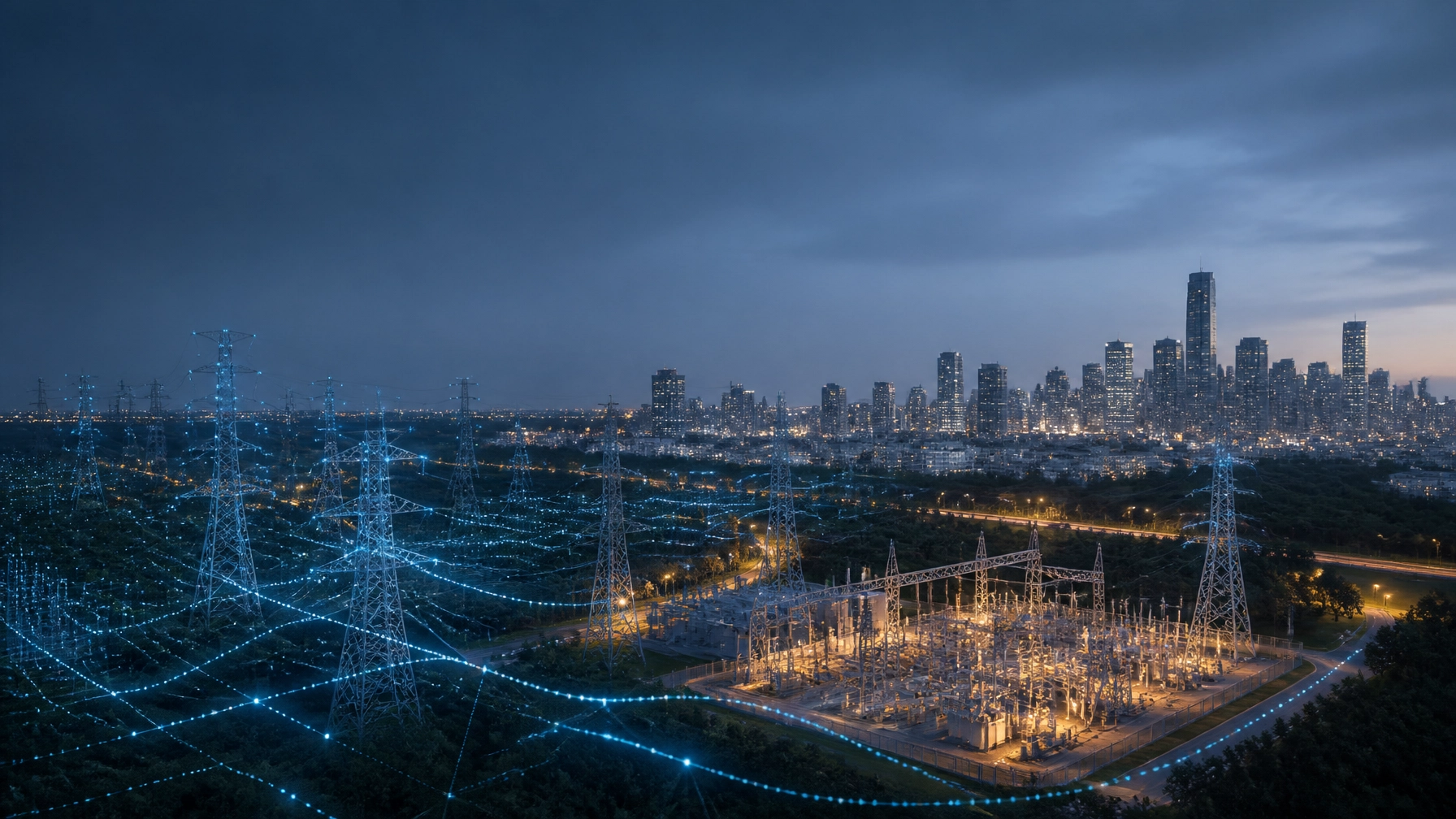
Part 6 of 50 Ways MetaWorldX Physical AI Is Transforming the World
The future of energy resilience is not simply repairing failures faster. It is seeing them earlier, understanding their consequences, and choosing the best intervention before disruption spreads.
Power grids are becoming more complex precisely when cities and industries can least afford instability. Aging transformers, overloaded feeders, extreme weather, distributed energy resources, electric vehicle charging, and increasingly interconnected infrastructure all create new points of vulnerability.
Traditional grid management remains essential, but it is often reactive. Operators respond to alarms, dispatch crews after equipment fails, and analyze the root cause once power has already been interrupted.
MetaWorldX Physical AI changes that operating model. By combining an AI digital twin, IoT data, predictive and prescriptive analytics, and real-time 3D simulation, energy organizations can move from outage response to outage prevention.
The Grid Resilience Challenge: Aging Infrastructure Meets Rising Complexity
Grid resilience is the ability to prepare for disruption, limit its impact, adapt during an event, and restore service quickly afterward. It differs from reliability, which primarily measures how consistently power is delivered under normal conditions.
Modern grids face several connected challenges:
-
Aging assets
Transformers, overhead conductors, substations, breakers, and underground cables may operate well beyond their original design assumptions. Failure risk increases when older equipment faces heat, moisture, vibration, overloads, or repeated switching events.
-
Extreme weather
Heatwaves increase cooling demand. Storms and ice can damage lines. Flooding can affect substations, while wildfires and high winds threaten transmission corridors. The U.S. Department of Energy identifies weatherization, monitoring and control technologies, advanced modeling, distributed energy resources, and grid hardening among the tools that can enhance resilience.
-
Cascading outages
A local fault can become a system-wide event when power flows shift unexpectedly. One failed transformer or feeder may overload neighboring assets, trigger additional protection events, and disconnect critical facilities.
-
Reactive maintenance
Fixed maintenance schedules do not always reflect the actual condition or operational importance of an asset. A lower-cost component in a critical location may represent greater risk than an expensive asset with redundancy around it.
-
Growing interdependencies
Power supports hospitals, airports, ports, telecommunications, transportation, water systems, and smart buildings. When electricity fails, the disruption can spread across essential services.
The result is a clear strategic requirement: grid operators need a live, system-wide view of risk: not isolated alarms from disconnected systems.

How MetaWorldX Physical AI Creates a Living Model of the Grid
A conventional software dashboard may display measurements. A digital twin technology platform goes further: it connects those measurements to a dynamic virtual representation of physical assets, environments, and relationships.
The MetaWorldX Smart Cities platform can integrate complex urban data ecosystems into a common operational environment. Applied to energy infrastructure, a Physical AI platform can connect:
- SCADA and utility control systems
- IoT sensors and smart meters
- GIS and geospatial asset records
- Building Management Systems (BMS)
- Physical Security Information Management (PSIM) platforms
- Access control and security systems
- Weather, environmental, and flood-risk data
- Maintenance management and work-order systems
- Distributed energy resources, batteries, and microgrids
This integration does not require organizations to discard their existing technology investments. Instead, MetaWorldX can provide a decision layer that brings operational data together and makes it easier to understand.
The digital twin becomes the operational context around every signal. An abnormal transformer temperature is no longer just an alert. It can be viewed alongside feeder demand, nearby critical facilities, weather conditions, maintenance history, and available alternate power paths.
From Prediction to Prescription: Preventing Failures Before They Spread
Predictive analytics helps answer: What is likely to happen?
Prescriptive analytics adds the next question: What should we do about it?
MetaWorldX Physical AI can support both.
1. Identify high-risk assets
AI models can analyze equipment condition, load history, environmental exposure, inspection records, and failure patterns. The system can then highlight assets that require inspection, derating, replacement, or additional monitoring.
For example, it may identify a transformer that is not yet operating outside its limits but shows a combination of rising thermal stress and increasing peak demand.
2. Rank interventions by consequence
Not every asset has the same operational importance. A failure affecting a hospital, airport, water treatment plant, or emergency operations center carries a different consequence from one affecting a non-critical load.
The twin can help decision-makers compare strategies such as:
- Replacing a transformer
- Hardening a feeder
- Adding automated switches
- Rerouting power flows
- Deploying battery storage
- Expanding a microgrid
- Scheduling vegetation management
- Pre-positioning restoration crews
3. Recommend real-time response actions
During an event, the platform can model switching options, available capacity, crew locations, critical loads, and alternative supply routes. Operators can evaluate a recommended action before implementing it.
This is where human-in-the-loop governance matters. MetaWorldX Physical AI is not intended to remove accountable professionals from critical decisions. It gives authorized operators clearer evidence, faster scenario comparisons, and a shared operating picture.
AI accelerates judgment; governance protects it.
Real-Time 3D Simulation for Outage Drills and Scenario Planning
A resilient grid cannot be tested only when a real emergency occurs. It must be exercised in advance.
MetaWorldX provides real-time 3D simulation and comprehensive scenario planning that can support both long-term infrastructure investment and operational drills.
A utility, municipality, or critical infrastructure operator could simulate:
- A substation failure during peak cooling demand
- Multiple feeder outages after a severe storm
- Flooding around a critical electrical facility
- A cyber-physical disruption affecting monitoring systems
- Sudden demand from electric vehicle charging
- Loss of renewable generation during a peak period
- Islanding a hospital or airport microgrid
- A cascading failure across interconnected substations
The value is practical. Teams can test procedures, validate communications, identify missing data, and discover where an apparently small fault could create a disproportionate impact.

A Dubai Power Grid Failure Simulation: Seeing the Cascade Before It Happens
Consider a representative scenario exercise for a rapidly growing city such as Dubai.
The simulation begins with a localized failure at a major substation during a period of high cooling demand. The initial fault appears manageable. However, as the digital twin recalculates power flows, it identifies several consequences:
- Neighboring feeders begin approaching their thermal limits.
- A secondary protection event becomes more likely.
- Critical buildings in the affected zone face reduced redundancy.
- Traffic, public safety, water, and building systems may lose operational capacity if restoration priorities are unclear.
- Maintenance and emergency crews require different routes because of congestion and partial infrastructure disruption.
The system can then compare response options in the virtual environment:
- Reconfigure feeder connections
- Prioritize critical loads
- Dispatch mobile generation or storage
- Isolate the affected segment
- Adjust non-critical demand
- Pre-position restoration teams
- Coordinate with building and public safety operations
The “wild” result in this kind of exercise is often not a dramatic visualization. It is the speed at which a local event can become a multi-system problem: and the number of interventions available when operators identify the risk early.
This is a modeled scenario, not a claim about a completed Dubai outage event. The purpose is to demonstrate how a city-scale AI digital twin can expose cascading dependencies before they are encountered in the physical world.
MetaWorldX’s existing work in smart cities and infrastructure: including its Dubai Silicon Oasis project: illustrates how urban environments can be represented as connected, data-rich systems. The same principle can be extended to power networks and critical energy assets.
Toronto and the City-Scale Energy Picture
Toronto provides another relevant context for digital twin technology. The Toronto Digital Twin project demonstrates how city-scale data can support urban planning, infrastructure understanding, and more informed decision-making.
For a city such as Toronto, a power resilience twin could help evaluate:
- Winter storms and ice accumulation
- Summer heat and peak electricity demand
- Dense high-rise building loads
- Transit and public facility dependencies
- Distributed solar, batteries, and microgrids
- Construction and redevelopment impacts
- Restoration priorities across neighborhoods
Energy resilience is not only a utility issue. It is a city operating issue. The more closely energy data can be connected to buildings, transportation, public safety, and critical services, the more effectively leaders can manage both routine operations and disruption.
Measuring ROI: The Resilience Metrics That Matter
The business case for AI for critical infrastructure should be measurable. A successful program can track improvements across four categories.
Reliability and restoration
- SAIDI: Average total outage duration per customer
- SAIFI: Average outage frequency
- CAIDI: Average restoration time
- Time to detect and isolate a fault
- Time to restore priority customers
- Critical-load uptime during an event
Asset performance
- Reduction in unplanned equipment failures
- Increased maintenance completed before failure
- Extended useful life of high-value assets
- Improved utilization of existing capacity
Operational efficiency
- Fewer unnecessary truck rolls
- Better crew dispatch and routing
- Faster outage impact assessment
- Reduced manual data reconciliation across systems
Capital planning
- Avoided cascading failures
- Better prioritization of hardening investments
- Reduced emergency repair costs
- More effective placement of storage, microgrids, and distributed generation
The strongest ROI may come from an outage that never occurs: or a cascade that is stopped before it reaches critical services. Digital twins make those avoided costs visible through scenario comparison and risk-based planning.
The Next Era of Grid Resilience Is Connected, Simulated, and Human-Guided
The power grid of the future will not be defined only by new wires, substations, or generation assets. It will also be defined by its intelligence: how quickly it can sense change, model consequences, recommend action, and coordinate people across organizations.
MetaWorldX Physical AI brings these capabilities together through:
- AI-powered digital twins
- Predictive and prescriptive analytics
- IoT and real-time data integration
- 3D visualization and simulation
- Comprehensive outage scenario planning
- Seamless connections to SCADA, BMS, PSIM, access control, and existing operational systems
- Human-in-the-loop governance for accountable decisions
For governments, utilities, infrastructure operators, airports, hospitals, ports, and property developers, resilience is becoming a defining measure of long-term performance.
The grid does not have to wait for the next outage to reveal its weaknesses.
Explore the MetaWorldX platform and discover how digital twin technology can help transform complex infrastructure data into safer, faster, and more resilient decisions.