
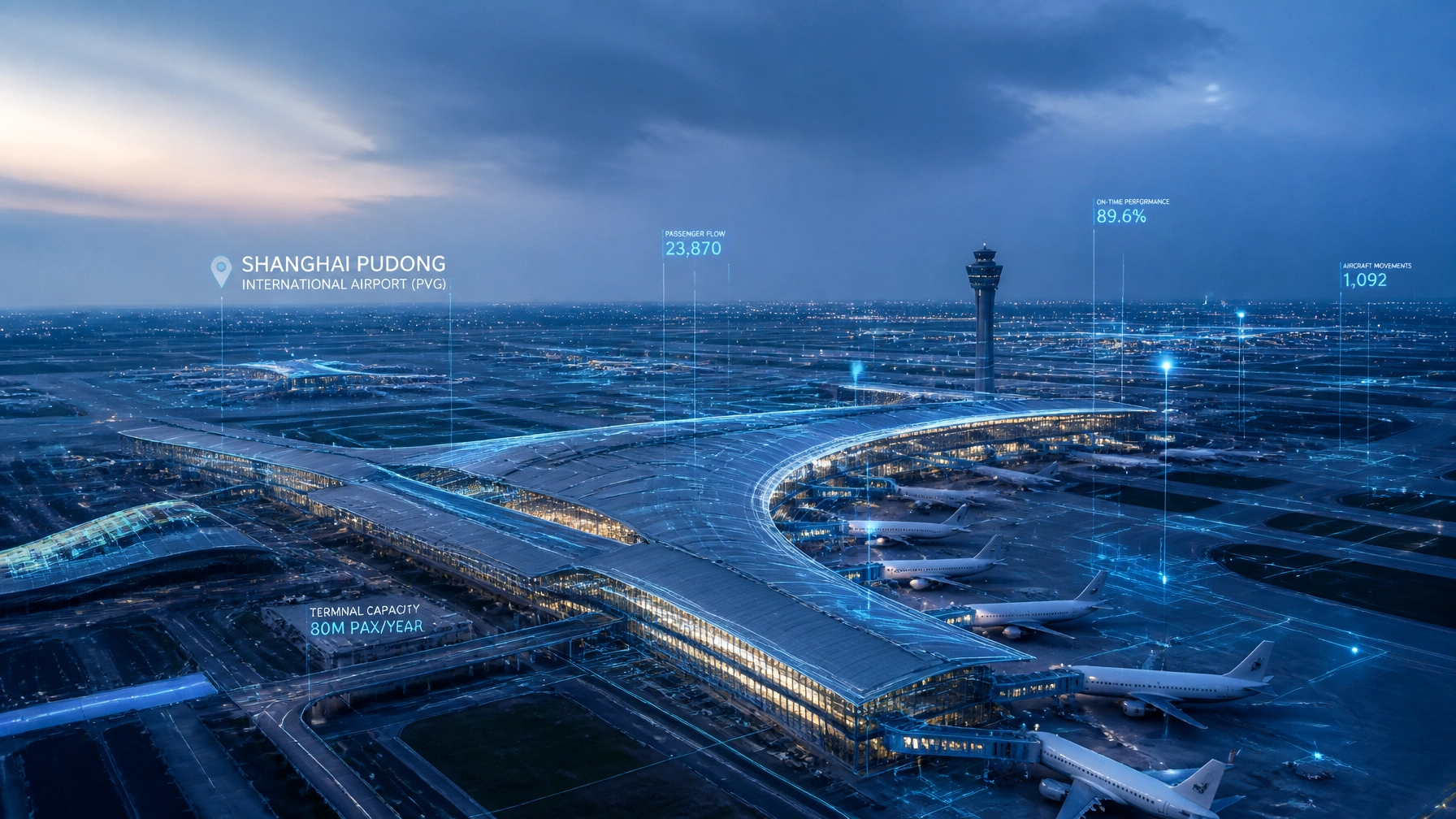
Shanghai Pudong International Airport (PVG) has officially cemented its status as a global aviation titan. In 2025, the hub handled a staggering 85 million passengers, ranking as the fifth-busiest airport in the world and the busiest in China. As it scales toward becoming a primary gateway for Asia, PVG isn't just growing in size: it is evolving into one of the world's most sophisticated "Smart Airports."
Navigating this massive complex requires more than just a boarding pass; it requires a strategy. From the legendary 430km/h Maglev train to the cutting-edge "Airport Brain" digital twin technology powering its operations, here is everything you need to know to navigate PVG like a pro.
The Layout: Deciphering Terminals 1, 2, and the Satellite Hall
PVG is divided into two primary terminals and a massive, H-shaped Satellite Hall. Understanding where your airline resides is the first step to a stress-free transit.
- Terminal 1 (T1): The primary hub for SkyTeam members, led by China Eastern and Shanghai Airlines. It remains the older but highly efficient core of the airport.
- Terminal 2 (T2): Home to Star Alliance, Oneworld, and Air China. This terminal is generally larger and hosts a vast majority of international non-Chinese carriers.
- Satellite Hall (S1 & S2): One of the world’s largest satellite terminal complexes. Note that S1 and S2 are concourses only. You must complete check-in, security, and immigration in T1 or T2 before taking the Automated People Mover (APM) to your gate.
Pro Tip: If your gate starts with "G" or "H," you are heading to the Satellite Hall. Budget an extra 20–30 minutes for the APM transit and walking time.
Moving Around: APM, Shuttles, and Pedestrian Links
Getting between terminals at an airport of this scale can be daunting, but PVG offers seamless transit options for both airside and landside travelers.
- The APM (Automated People Mover): This underground train connects T1 to S1 and T2 to S2. It runs every 2–3 minutes and takes approximately 2 minutes to travel between the main terminal and the satellite.
- Inter-Terminal Shuttle Bus: For landside travelers needing to move between T1 and T2 (e.g., for a terminal change before check-in), a free shuttle operates every 10–15 minutes from the arrivals level (1F).
- The Pedestrian Walkway: If you prefer to stretch your legs, a covered walkway connects T1 and T2. It is a 15-minute walk and passes by the Maglev and Metro stations.
"The era of virtual cities is here, and it starts with the airport."
Ground Transport: The Maglev vs. Metro Line 2
Shanghai offers two distinct rail experiences to get you into the city, depending on your priority: speed or budget.

- The Maglev (Magnetic Levitation): This is the fastest commercial train in the world. It whisks you from PVG to Longyang Road station in just 7–8 minutes. At 50 RMB (roughly $7 USD), it is a futuristic experience every traveler should try once.
- Metro Line 2: For a direct and budget-friendly route to Lujiazui, People’s Square, or Jing’an Temple, the Metro is your best bet. While it takes about 60 minutes to reach central Shanghai, it is highly convenient for those with lighter luggage.
Transport Summary: Use the Maglev for the thrill and speed; use the Metro for cost-efficiency and direct city-center access.
The "Airport Brain": How AI and Digital Twins Run PVG
Behind the scenes of the 85 million annual passengers lies a complex digital ecosystem. In partnership with Huawei and Fudian Smart Tech, Shanghai Airport Group launched the "Airport Brain" Joint Innovation Lab. This initiative uses AI digital twin airports technology to transform raw data into operational intelligence.
Key Technological Innovations at PVG:
- 3D Indoor Modeling: A complete digital twin of the terminals allows operators to monitor passenger flow in real-time, preventing bottlenecks before they happen.
- Intelligent Flight Sequencing: Utilizing A-CDM (Airport Collaborative Decision Making) and digital twin simulations, PVG has reduced aircraft pushback delays by an average of 2 minutes. This efficiency saves over 9,000 tons of fuel annually.
- Smart Energy Management: The digital twin integrates 19 different systems: including HVAC, lighting, and heating: to optimize energy consumption across the massive facility.
- Automated Stand Allocation: With the ADB SAFEGATE AODB upgrade, over 80% of aircraft stand allocations are now handled automatically by AI, optimizing apron space.
By integrating critical infrastructure data with real-time video analytics, the Airport Brain provides a 360° view of every aircraft taxiing and every vehicle on the tarmac.
MetaWorldX: The Next Frontier for Smart Airports
While the current "Airport Brain" is a monumental achievement, the future of aviation lies in even deeper integration. At MetaWorldX, we envision the next evolution of smart airports where disparate systems are unified into a single, immersive 3D environment.

Our digital twin technology enables airport operators to move beyond reactive monitoring into predictive and prescriptive analytics.
- Predictive Maintenance: AI models can predict when a baggage handling belt or an escalator in T3 will fail before it happens, minimizing downtime.
- Scenario Planning: Before breaking ground on the upcoming Terminal 3 expansion, MetaWorldX allows stakeholders to simulate years of passenger growth, security protocols, and environmental impacts in a virtual space.
- Integrated Security: By unifying access control, PSIM, and AI-driven video analytics, we create a more resilient AI airport security framework that protects passengers without compromising flow.
We have already explored these concepts in high-stakes environments like our Dubai Airport project, proving that a unified digital twin is the key to managing the world's most complex hubs.
Final Travel Tips for PVG
Before you head to the gate, keep these logistical essentials in mind:
- 144-Hour Visa-Free Transit: If you are from one of the 54 eligible countries and have an onward ticket to a third country, you can explore Shanghai and the surrounding provinces for up to 6 days without a visa.
- Stay Connected: T2 arrivals host China Mobile and China Unicom counters where you can grab a local SIM card: essential for using local ride-hailing and payment apps.
- VAT Refunds: If you’ve been shopping in the city, look for the VAT refund counters located in the departures hall before you clear security.
PVG is a marvel of modern engineering and digital innovation. Whether you are marveling at the architecture of the Satellite Hall or moving at 430km/h on the Maglev, you are participating in the future of global travel.
Experience the Future of Infrastructure
Are you ready to see how digital twins are transforming the world's busiest hubs? Explore MetaWorldX’s solutions and discover how we are building the foundation for smarter, more sustainable cities and airports.
"Transforming complex data into actionable insights for a more interconnected world."