
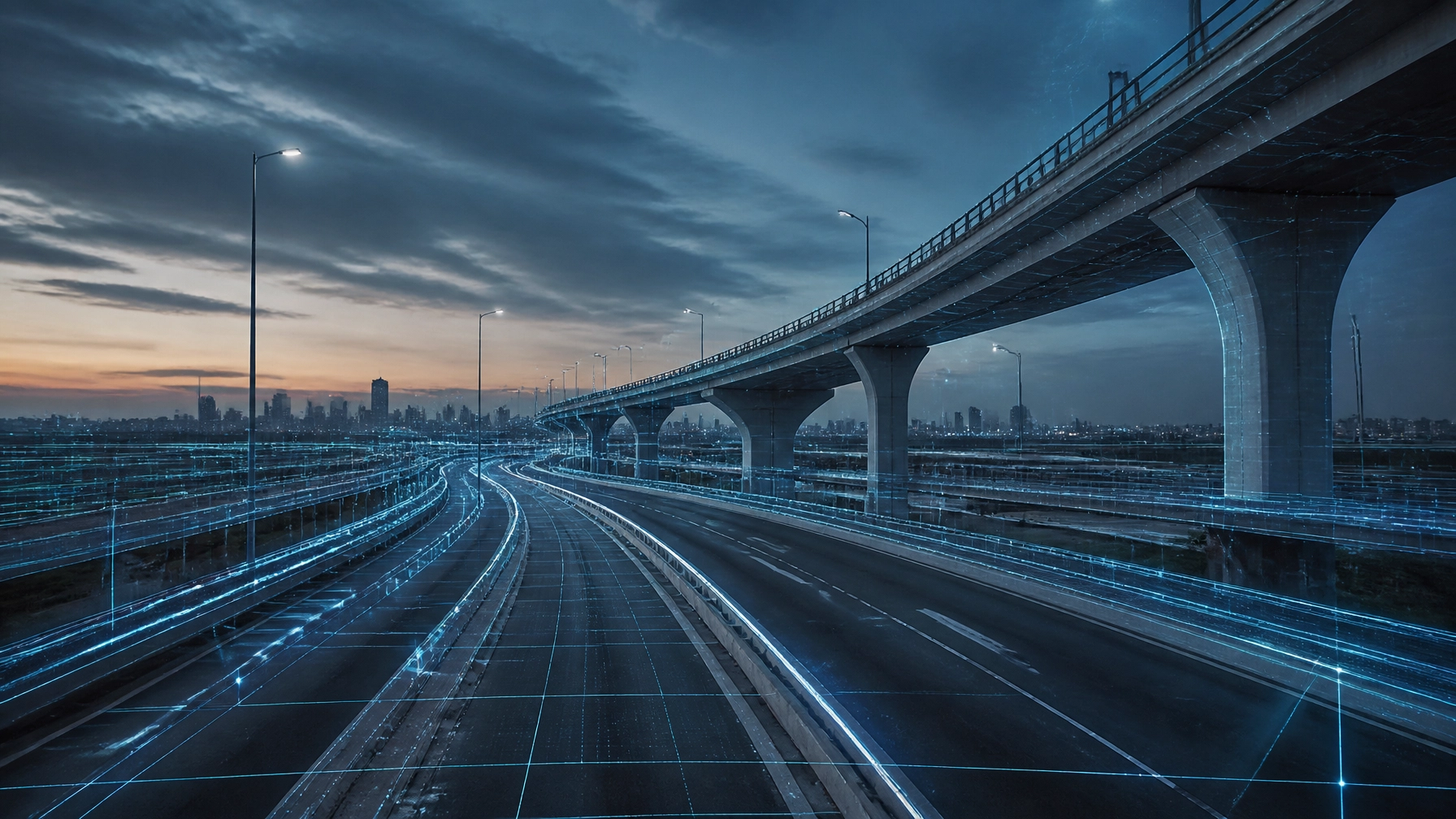
For decades, highway management has been a game of "wait and see." We wait for the crash to be reported, wait for the traffic to back up, and then wait for the cleanup to finish. But as we move into 2026, the paradigm is shifting. We aren't just reacting to the road anymore: we’re predicting it.
At MetaWorldX, we believe that the era of virtual cities is here. By creating high-fidelity, AI-powered digital twins of critical transportation infrastructure, we are helping highway operators and city planners transition from reactive monitoring to proactive orchestration. It’s no longer just about the pavement; it’s about the massive streams of data flowing above it.
Here are five ways AI-driven digital twins are ending the era of the highway gridlock.
1. Real-Time Incident Detection: Seeing the Unseen in Milliseconds
Traditional highway monitoring relies heavily on human eyes watching a wall of CCTV feeds. Even the most attentive operator can miss a stalled vehicle or a piece of debris in a blind spot. MetaWorldX’s digital twins change the game by fusing live camera feeds with IoT sensor data and LiDAR to create a "living model" of the road.
This system doesn't just record video; it understands it. AI algorithms analyze every pixel in real-time, identifying anomalies: like a sudden drop in speed or a vehicle stopped in a live lane: within milliseconds. By the time a human operator would have noticed the issue, the digital twin has already flagged the incident, pinpointed its exact GPS coordinates, and suggested a response plan.
The result? Faster detection leads to faster clearance. When incidents are identified instantly, secondary crashes: often more severe than the initial event: are significantly reduced. This is a core pillar of our Public Health & Safety solutions, ensuring that highways are not just faster, but safer for everyone.

2. Predictive Traffic Modeling: Forecasting the "What-If"
What if you could see a traffic jam forming two hours before the first car taps its brakes? That is the power of predictive modeling. Unlike traditional simulations that look at historical averages, MetaWorldX’s digital twins use hybrid twin technology: a combination of physics-based models and real-time AI.
By ingesting current weather patterns, local events, and real-time flow rates, the digital twin runs thousands of "what-if" simulations in the background. It predicts how a minor fender-bender on a Friday afternoon will ripple across the entire city network.
- Proactive Planning: Operators can test diversion routes virtually before implementing them.
- Data-Driven Decisions: Planners can see the impact of a lane closure for maintenance before the cones are even placed.
- Reduced Congestion: Research indicates that predictive traffic modeling can lead to a 15% reduction in mean travel time across major corridors.
By anticipating bottlenecks, we move closer to the vision of Smart Cities that work for their citizens, rather than forcing citizens to work around the infrastructure.
3. Smart Corridor Management: The Highway as a Living Organism
A highway shouldn't be a static piece of concrete. In the MetaWorldX vision, it is a "Smart Corridor": a dynamic system that breathes and adapts to the traffic it carries. Through our Critical Infrastructure solutions, digital twins enable automated control of the roadway.
Using live data, the digital twin can dynamically adjust variable speed limits (VSLs) to smooth out traffic flow and prevent the "shockwave" effect of sudden braking. It can manage lane usage, opening hard shoulders during peak hours or dedicating lanes to high-occupancy vehicles based on real-time demand.
Sustainability Impact: Smooth traffic isn't just about speed; it's about the planet. Studies have shown that AI-optimized traffic flow can lead to a 21% reduction in localized emissions at traffic hotspots. By reducing idling and stop-and-go patterns, digital twins are a secret weapon in the fight for sustainable urban development.

4. Connected Vehicle (V2X) Integration: Closing the Feedback Loop
One of the most exciting trends for 2026 is the integration of digital twins with Vehicle-to-Everything (V2X) communication. In the past, the highway spoke to the driver through static signs. Today, the digital twin speaks directly to the car.
MetaWorldX platforms can translate 3D perception data into standardized V2X messages. If the digital twin detects a hazard: like road debris or a wrong-way driver: it doesn't just tell the control center; it sends a priority alert directly to the dashboards of all connected vehicles in the vicinity.
- Non-Line-of-Sight Awareness: Drivers receive warnings about hazards before they are even visible through the windshield.
- Automated Coordination: As autonomous vehicles become more common, the digital twin acts as a "cloud-based conductor," providing the high-level orchestration needed for safe, high-speed travel.
This integration turns every vehicle on the road into a sensor and every sensor on the road into a safety guardian. It’s a level of urban innovation that was science fiction just a few years ago.

5. Coordinated Emergency Response: Saving Lives Through Simulation
When an accident happens, every second counts. Traditional emergency response involves dispatching units and hoping the traffic parts for them. With a MetaWorldX digital twin, the process is precision-engineered.
The digital twin can simulate the fastest route for first responders in real-time, accounting for current congestion and the evolving nature of the incident. Furthermore, it can interact with the highway’s "Smart Corridor" systems to proactively clear a path: adjusting signal timings and using dynamic signage to move civilian traffic out of the way before the sirens are even heard.
The Impact on Safety: Strategic simulation and coordinated response can speed up first responders by up to 20%. In a critical medical emergency, those minutes are the difference between a recovery and a tragedy. This proactive approach to safety is why we are the preferred partner for large-scale property developers and government entities worldwide.

The Future is Predictive, Not Reactive
The challenges of modern transportation: congestion, safety, and environmental impact: cannot be solved with more asphalt alone. They require a digital transformation. By leveraging AI-powered digital twins, highway operators gain a superpower: the ability to see the future of their infrastructure.
At MetaWorldX, we are building the tools that allow cities like Toronto, Dubai, and NEOM to lead the way into this new era. Whether it's cutting commute times by 15% or ensuring an ambulance arrives two minutes faster, the impact of this technology is measured in lives improved and communities strengthened.
The era of virtual cities is here. Are you ready to move beyond the pavement?
Want to see how MetaWorldX can transform your infrastructure?
Explore our Smart City solutions or contact our team to schedule a demo of our AI-driven digital twin platform.