
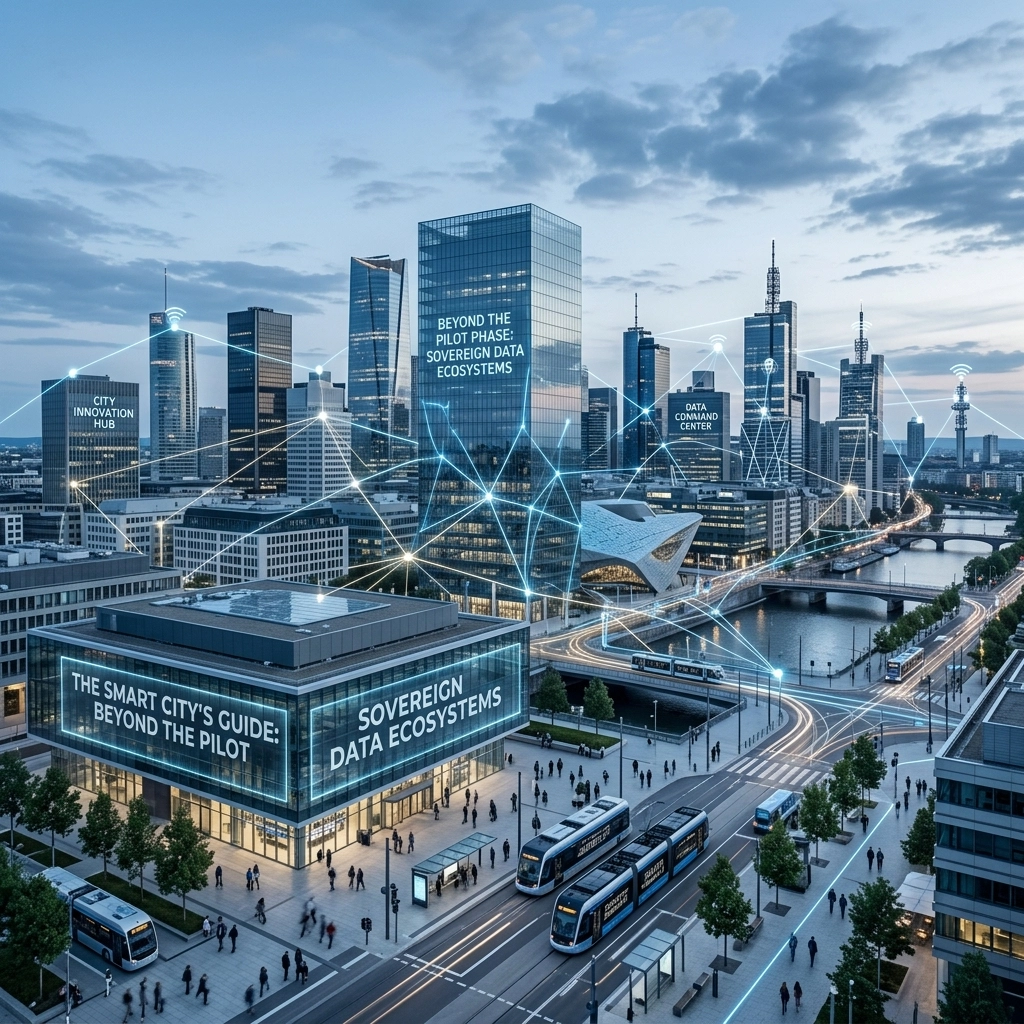
For nearly a decade, the "Smart City" has been the most promised yet most fragmented concept in urban development. We have seen thousands of pilot programs, smart streetlights in one district, a transit app in another, and perhaps a sensor-driven waste management trial in a third. However, these initiatives often suffer from "pilot purgatory," a state where innovation is trapped in a small-scale loop, unable to scale because the underlying data is siloed, proprietary, or disconnected from the city's broader goals.
As we move through 2026, the conversation has shifted. The focus is no longer just on "smart" technology, but on Sovereign Data Ecosystems.
To truly evolve, cities must move beyond isolated tests and toward a unified infrastructure where they, and their citizens, retain ownership and control over their digital assets. This is the era of the sovereign city, powered by Digital Twin Technology.
The Definition of Digital Sovereignty
At its core, data sovereignty is the concept that data is subject to the laws and governance structures of the nation or municipality where it is collected. In the context of a smart city, this means that the "urban brain", the vast amounts of data generated by sensors, traffic cameras, energy grids, and citizens, should not belong to a third-party tech giant. It belongs to the city.
The shift from proprietary to sovereign.
Historically, cities have relied on "black box" solutions from vendors where the data was stored on external servers, often in different jurisdictions. A sovereign data ecosystem reverses this. It utilizes federated data architectures, allowing different departments to share information seamlessly while maintaining strict control over who accesses it and how it is used.
By prioritizing sovereignty, cities ensure long-term resilience. They avoid vendor lock-in and create a foundation where AI and predictive analytics can thrive without compromising public trust or privacy.

Why Pilots Fail to Scale
If pilots are the "laboratory" of the smart city, why do so few make it to the "factory floor" of citywide implementation? The answer usually lies in three specific barriers:
- Interoperability Gaps: Most pilots use bespoke software that doesn't "talk" to the city’s existing legacy systems. When the trial ends, the data remains trapped in a format that the rest of the city cannot use.
- The "Data Silo" Mentality: Departments (Police, Fire, Transit, Utilities) often operate their own independent data sets. Without a unified ecosystem, these departments cannot collaborate on complex urban challenges like emergency response or carbon neutrality.
- Lack of Sovereign Infrastructure: Without a local, secure compute layer, scaling a pilot means sending massive amounts of sensitive urban data to the public cloud, raising significant security and regulatory concerns.
Moving beyond the pilot phase requires a transition to a Sovereign AI and Data Architecture. This provides the "connective tissue" that allows a small success in one neighborhood to be replicated across an entire metropolis.
The 3-Layer Architecture of a Sovereign Smart City
To build a city that is truly intelligent and sovereign, leadership must look at a layered approach to infrastructure. This isn't just about buying new hardware; it's about designing a digital ecosystem that can grow.
1. The Sovereign Compute Layer
This is the physical and virtual foundation. Instead of relying solely on centralized global clouds, sovereign cities are investing in localized edge computing and secure data centers. This ensures that critical infrastructure, like autonomous transit or power grid management, continues to function even if international connectivity is disrupted. It also keeps data within the legal jurisdiction of the city.
2. The Sovereign AI & Model Layer
In 2026, AI is the engine of the smart city. However, a "one-size-fits-all" AI model trained on generic data doesn't understand the unique nuances of a city like Dubai or Toronto. Sovereign AI involves training models on local data, optimized for local languages, cultural contexts, and specific urban regulations. These models are versioned and governed by the city, ensuring that the insights they provide are biased toward the public good, not a corporation's bottom line.
3. The Digital Twin Integration Layer
This is where the magic happens. A Digital Twin acts as the visual and functional interface for the sovereign data ecosystem. It aggregates real-time data from the compute layer and insights from the AI layer into a 4D virtual replica of the city. This allows decision-makers to simulate scenarios, such as a flash flood or a major transit strike, before they happen in the real world.

From Data Spaces to Actionable Insights
The global gold standard for this transition is the development of "Data Spaces." Initiatives like the European Data Space for Sustainable Smart Cities and Communities (DS4SSCC) have shown that when cities share a common architectural framework, they can innovate faster.
The Power of Federated Data:
- Decarbonization: By linking building energy data with transit patterns and weather forecasts, cities can create "Positive Energy Districts" that produce more power than they consume.
- Operational Efficiency: Instead of reactive maintenance, a sovereign ecosystem enables "Predictive Command Centers." This turns the city from a collection of reactive departments into a single, proactive operational nerve center.
- Citizen Trust: When data is managed through a sovereign framework, cities can implement "Privacy by Design." Citizens can be given transparency into what data is being collected and, more importantly, how it is benefiting their daily lives.
For a deeper dive into the technical requirements of these ecosystems, our Whitepaper provides a comprehensive roadmap for urban planners.
Practical Steps to Move Beyond the Pilot
If you are a city leader or a technology stakeholder, how do you stop "piloting" and start "operating"?
Step 1: Audit Your Data Sovereignty.
Identify where your city’s data currently lives. Is it sitting in a vendor’s cloud? Do you have the legal right to export and integrate that data with other systems? If the answer is no, your first priority is renegotiating those data rights.
Step 2: Invest in Open Standards.
The era of proprietary, closed-loop systems is over. To scale, you must demand interoperability. Ensure that any new technology procurement adheres to open-source protocols and federated data standards.
Step 3: Build the Virtual Foundation.
You cannot manage what you cannot see. Implementing a citywide Digital Twin provides the centralized platform needed to visualize these complex data flows. It moves the data from spreadsheets and databases into a spatial context that everyone: from engineers to citizens: can understand.
Step 4: Focus on High-Impact Use Cases.
Don't try to "fix the city" all at once. Choose a high-priority challenge: such as reducing traffic congestion or optimizing waste routes: and apply the sovereign data model to that specific problem first. Once the framework is proven, scaling to other departments becomes a matter of integration rather than invention.

The Future is Sovereign
The shift toward sovereign data ecosystems is not just a technical upgrade; it is a fundamental reimagining of urban governance. It is about moving away from being a "consumer" of technology and becoming a "governor" of a digital reality.
By breaking down data silos and investing in sovereign infrastructure, cities can finally realize the promise of the "Smart City" at scale. They can move from fragmented trials to a cohesive, living ecosystem that is resilient, sustainable, and, most importantly, under their own control.
The era of virtual cities is no longer a futuristic concept: it is the operational standard for 2026 and beyond.
Ready to transition your city from a series of pilots to a sovereign digital powerhouse?
At MetaWorldX, we specialize in building the Digital Twin infrastructure that makes sovereign data ecosystems possible. From Smart City integration to high-fidelity urban modeling, we help you take control of your digital future.
- Explore our capabilities: MetaWorldX Capabilities
- See it in action: Watch TwinTalk
- Start the conversation: Contact our team today
The path to a smarter, sovereign city starts with a single, unified vision. Let's build it together.